
A family in Scarborough called me on a Tuesday, frantic. Their father had passed six months earlier, the estate was settled, but a financial adviser had just mentioned that old bank accounts sometimes get transferred to the government after years of sitting untouched. They had no idea that money might be waiting for them somewhere in a federal registry, which is something I’ve seen trip up even well-organized families during probate. The phone call opened up a whole topic I think more Ontario residents need to understand.
What Are Unclaimed Bank Balances in Ontario Canada
Not long ago, I worked with a family in Oakville whose elderly mother had moved into a memory care facility. While going through her paperwork, her adult children discovered she had been maintaining a second chequing account at a different branch, one none of them knew about. The account had sat dormant for years while the family quietly covered two mortgages (a situation I’ve seen strain even the most organized households), and the bank had no current address to send notices to.
Dormant bank accounts, forgotten deposits, and old financial instruments are eventually moved to the Bank of Canada Unclaimed Balances Registry. This is a federal program, not a provincial one, and that distinction matters if you live in Ontario. As of December 31, 2025, the Bank of Canada held $1.6 billion in unclaimed bank balances. Having moved, changed names, or inherited property from a parent who kept their finances private, you have a real chance something is sitting there with your name on it. Teams at Bloom Homes sometimes flag this topic to sellers during consultations, because unclaimed balances tied to a property or estate often surface right when families are making big financial decisions (estates are the most common trigger).
What Types of Abandoned Property Can Be Claimed in Ontario
People tend to picture physical real estate when they hear the words “abandoned property.” Squat in a vacant house long enough, claim adverse possession, get the title. That’s a common picture, and it’s mostly wrong for our purposes here.
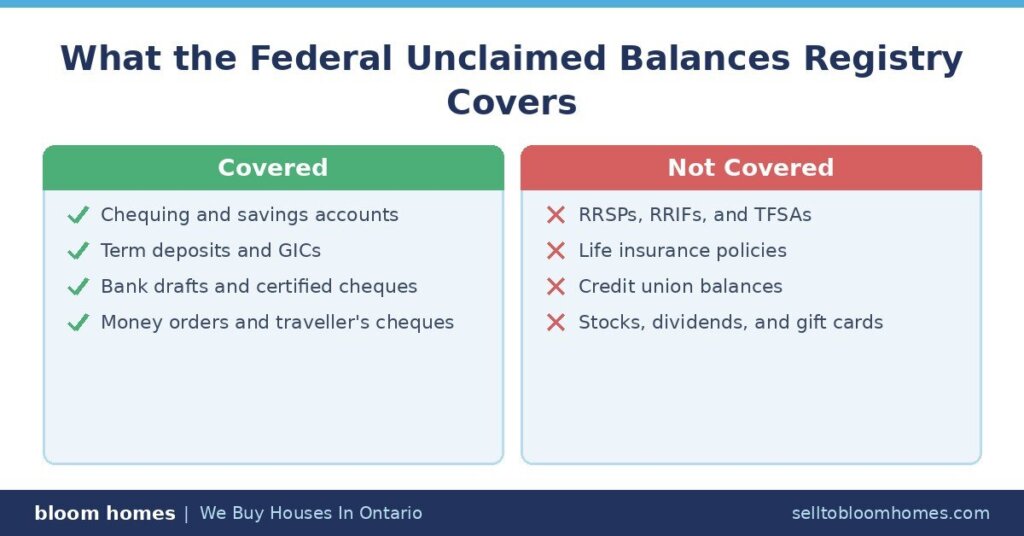
Unclaimed balances covered by the federal program include chequing and savings accounts, term deposits, guaranteed investment certificates (GICs), bank drafts, certified cheques, money orders, and traveller’s cheques. The Bank of Canada’s database covers properties held by federally regulated institutions, but it doesn’t include RRSPs, RRIFs, TFSAs, life insurance policies, credit union balances, stocks, dividends, or gift cards.
Bank deposit accounts and certified cheques represent the most common unclaimed balances. For life insurance and pension plans, you’d need to contact the specific institution directly, since Ontario has no provincial registry to catch those assets (a gap that surprises most executors).
How Long Before a Bank Balance Is Considered Unclaimed in Ontario
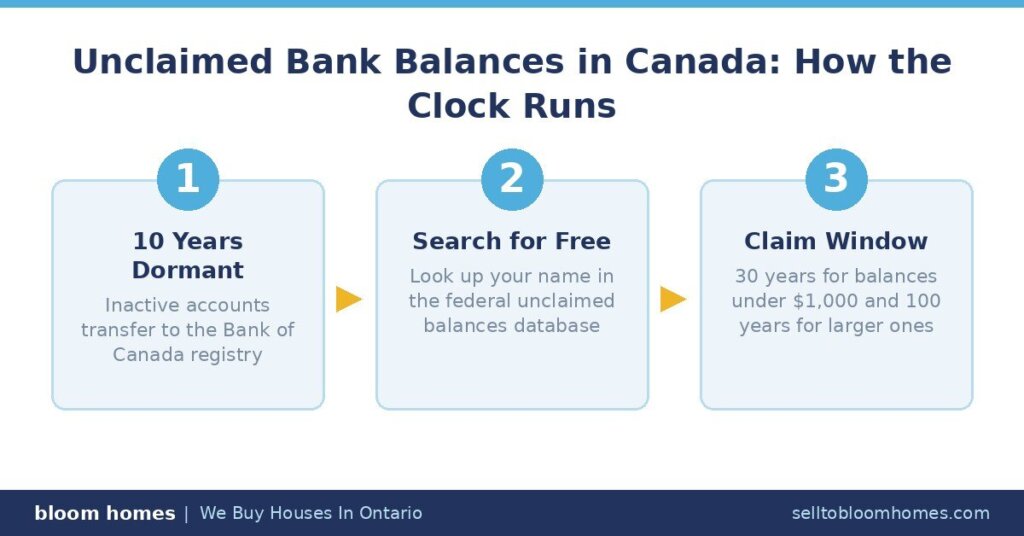
Balances transfer to the Bank of Canada after 10 years of owner inactivity, and are then held for 30 years (if under $1,000) or 100 years (if $1,000 or more) before escheating to the Receiver General for Canada. Miss the 30-year mark on a small account and that money is gone permanently.
Federally regulated financial institutions are required under the Bank Act to try to reach the account holder, sending written notices after two, five, and nine years of inactivity to warn that the account is dormant and explain how to keep it active or claim the funds. Banks actually send those letters, though in my experience they often go to an old address nobody updates.
Moving even once in the past decade without updating your bank records may have sent those notices to an address you no longer live at. That’s the single most common reason accounts go dormant.
Who Is Eligible to Claim Abandoned Property in Ontario Canada
Once a balance has been transferred to the federal registry, the circle of eligible claimants is broader than it appears.
The Bank of Canada holds these funds on behalf of the rightful owner or their legal representative. The original account holder can claim directly, but so can an estate executor, a power of attorney, or an heir with documented entitlement. You’ll need to provide proof of your relationship, such as a will or a death certificate (getting certified copies takes time). An estate that was never formally administered may require legal help to establish your standing before filing a claim.
Ontario remains the largest region in North America without unclaimed property legislation of general application. For assets held outside federally regulated banks, your only real path is to contact the institution holding the funds directly, which means you’ll need to track down paperwork you probably haven’t thought about in years.
Where to Search for Unclaimed Money Owed to You in Ontario
Readers sometimes push back here: “If the money was mine, wouldn’t I already know about it?” Not always. People remarry, relocate across provinces, or simply stop monitoring old accounts after a job change.
Searching is free, by last name or business name, at the Bank of Canada’s unclaimed balances tool, and there’s no fee to search or to file a claim. You can find that tool at unclaimedproperties.bankofcanada.ca. Since Ontario has no provincial registry, this federal database is your primary resource. After checking the Bank of Canada, also search your province’s own registry if you live in British Columbia, Alberta, Quebec, or New Brunswick, and check CRA My Account for uncashed government cheques.
Old employer pension administrators and former life insurers won’t appear in the Bank of Canada search, so you have to contact those institutions directly. If you’re also selling a property while sorting out an estate, the team at Bloom Homes has worked alongside families in exactly that situation.
How to File a Claim for Unclaimed Bank Balances in Ontario
Where do you even start? Go to the Bank of Canada’s Unclaimed Balances Registry at unclaimedproperties.bankofcanada.ca and search by your last name or former last name, using the city where the account was originally opened. Each listing shows the name, last known address, and amount category. Finding a match means clicking on it and following the instructions to submit a claim, providing identification and supporting documents to prove ownership (the bar for proof is pretty straightforward). Claims can be submitted online or by mail.
A claimant may face incidental costs proving entitlement, such as notarizing identity documents, but filing itself costs nothing. Some claims take weeks or months to process depending on complexity. For accounts in a deceased parent’s name, build in extra time to gather estate documents (probate paperwork especially) before you start.
What Happens to Unclaimed Balances If They Are Never Recovered
I’ve sat with a couple in Barrie whose father had just moved into assisted living, the garage still full of paperwork from a hardware business he’d sold years earlier. Sorting through filing boxes, they found statements from a trust company absorbed by a major bank two decades prior. The account had been dormant since before they’d finished high school, and those funds were almost certainly sitting in the federal registry unclaimed (trust company mergers bury accounts fast).
Unclaimed balances are held by the Bank of Canada for a shorter period if small and indefinitely if large. At the end of the prescription period, the balance transfers to the Receiver General of Canada and the right to claim it disappears forever. Families who never look will never find anything. If you’re working through an estate and also trying to sell a property, Bloom Homes can move quickly on the real estate side so you have breathing room to pursue these financial loose ends at the same time.
Frequently Asked Questions
What Are the Legal Requirements for Claiming Abandoned Property in Ontario?
Ontario does not have its own provincial unclaimed property legislation, so the primary legal framework is federal. For bank balances held by federally regulated institutions, you must prove ownership or legal entitlement through government-issued identification and, if claiming on behalf of a deceased person, through estate documents such as a will or probate grant. The Bank of Canada’s Unclaimed Balances Registry governs the process, and filing a claim carries no fee.
How Long Before You Can Claim Abandoned Property in Canada?
Bank accounts and financial instruments become unclaimed after 10 years of inactivity, at which point the balance transfers to the Bank of Canada. You can file a claim as soon as the balance appears in the registry. The window stays open for 30 years on balances under $1,000 and for 100 years on balances of $1,000 or more, so acting sooner is always better.
Can You Claim Anyone’s Unclaimed Property?
No. The federal unclaimed balances program is restricted to rightful owners, their legal representatives, and verified heirs. You cannot claim a balance simply because no one else has. If you’re an heir, you’ll need to document your relationship to the original account holder, typically through a will, a death certificate, or probate paperwork, before the Bank of Canada will process your claim.
What Is the Most Common Type of Unclaimed Property in Canada?
Bank deposit accounts and certified cheques are the most frequently unclaimed assets held by the Bank of Canada. Beyond those, forgotten GICs, term deposits, and money orders also appear regularly in the registry. Life insurance policies and pension plan balances are not held by the federal registry and must be pursued separately by contacting the individual institutions that issued them.
Dealing with an estate, a property sale, and a registry search all at once is a lot. If you want to talk through your options, we’re here. No pressure, no obligation.