
Sellers of hoarder homes spend months worrying about the wrong things. Sellers fixate on the cleanup bill, or on what the neighbours think, or on whether any buyer will ever set foot inside. Understanding your actual options before you spend a single dollar or sign a single contract is the real challenge, because those two things tend to happen in the wrong order.
What Most People Get Wrong Before They Even List
Those who sell hoarder properties routinely underestimate one thing: the home inspection. A buyer’s home inspector in Ontario isn’t just walking through looking at scuffed walls. In a hoarder house, the inspector can’t access half the rooms (sometimes literally can’t open the door). Blocked plumbing stacks, hidden water damage behind floor-to-ceiling stacks of newspapers, fire hazards near the furnace room, compromised electrical panels buried under years of accumulated materials. These all get flagged, and a standard financing condition can collapse the deal on inspection day even if the buyer loved the place.
According to the Ontario Real Estate Association, provincial home sales rose 5.5% year over year to 18,051 units in June 2026. But the MLS Home Price Index composite benchmark fell 4.6% to $753,300 in that same period, with inventory shifting toward buyers in most regions. Buyers have more choices than they’ve had in years. A hoarder house priced wrong or presented poorly sits while cleaner properties move.
Not long ago, I helped a young couple in Stoney Creek who were three months behind on their mortgage and had an auction date already scheduled. The husband’s father had passed the year before, and the house had decades of accumulated belongings stacked through every room, including a garage packed wall-to-wall with old auto parts. We got them to the closing table in time. They walked away with cash in their pocket, no auction, no credit hit. Getting the timeline right mattered more than chasing the highest number.
What Is the Difference Between Hoarding and Collecting?
Misreading this distinction can cost you real money when listing. A collector’s home, even a crowded one, presents very differently on the real estate market than a true hoarder house. Collectors organize, display, and maintain their collections in a way that buyers can actually see and appreciate. Hoarding disorder is a recognized mental health condition involving compulsive acquisition and genuine inability to part with possessions, regardless of their condition or usefulness.
A meta-analysis drawing from 11 carefully selected studies found the estimated prevalence of hoarding disorder to be approximately 2.5 percent of the population, translating to a very large number of Ontario households. Hoarding behaviour tends to begin earlier in life and worsen with each passing decade, eventually causing serious problems in relationships and daily functioning (the home itself shows every stage of that).
Sellers care about the distinction because hoarding disorder leaves measurable property damage: saturated subfloors, mold colonies behind clutter walls, pest infestations, odour soaked into drywall. A collector’s house needs cleaning. A hoarder house often needs remediation. Ontario law doesn’t require sellers to make repairs before selling, but it does require honest disclosure of known material latent defects, hidden problems that a reasonable inspection would not catch on its own. If there’s mold or structural damage you know about, that disclosure obligation doesn’t disappear just because the property is being sold as-is.
How Does Hoarding Disorder Affect a Property in Ontario Canada?
Picture a semi-detached home in Hamilton’s Crown Point neighbourhood: two years ago, every room navigable. By the time the family called us, the main floor bathroom hadn’t been accessible in eight months and the kitchen stove was completely buried. Hoarding disorder does exactly that to a property over time, and buyers can smell it, literally, before they’ve crossed the threshold.
The documented consequences of serious hoarding include fire hazards, tripping hazards, and health code violations. Structurally, the weight of accumulated possessions can stress floor joists and subfloor assemblies in older Ontario builds. Routine cleaning becomes impossible, leading to pest infestations, mold colonies, and buildup of allergens throughout the property (I’ve pulled up carpet that told the whole story).
A notable real-world example: a 2010 fire at 200 Wellesley Street East in Toronto, which originated in a hoarding unit, resulted in 17 injuries and displaced over 1,200 residents. An extreme case, certainly, but it underlines why home inspectors, lenders, and insurers treat hoarder houses differently. A property with active fire hazards won’t qualify for standard mortgage financing at all, which shrinks your buyer pool to cash purchasers by default.
What Are the Real Costs to Clean Up a Hoarder Home?
Sit across from me at your kitchen table and I’ll tell you this straight: the cleanup estimate you get from the first company you call is rarely the real number. Costs escalate when crews find hazmat conditions, animal waste, or water damage that wasn’t visible in the initial walkthrough.
For most homes, professional hoarder cleanout runs between $1,000 and $4,000, but severe cases involving biohazard conditions or structural damage can reach $10,000 to $25,000 and beyond. In the Greater Toronto Area, urban service rates tend to run higher than smaller towns across Ontario, which means the geography of your property matters as much as its condition. A mid-size home in Mississauga or Brampton will generally cost more to remediate than a comparable property in Belleville or Sarnia.
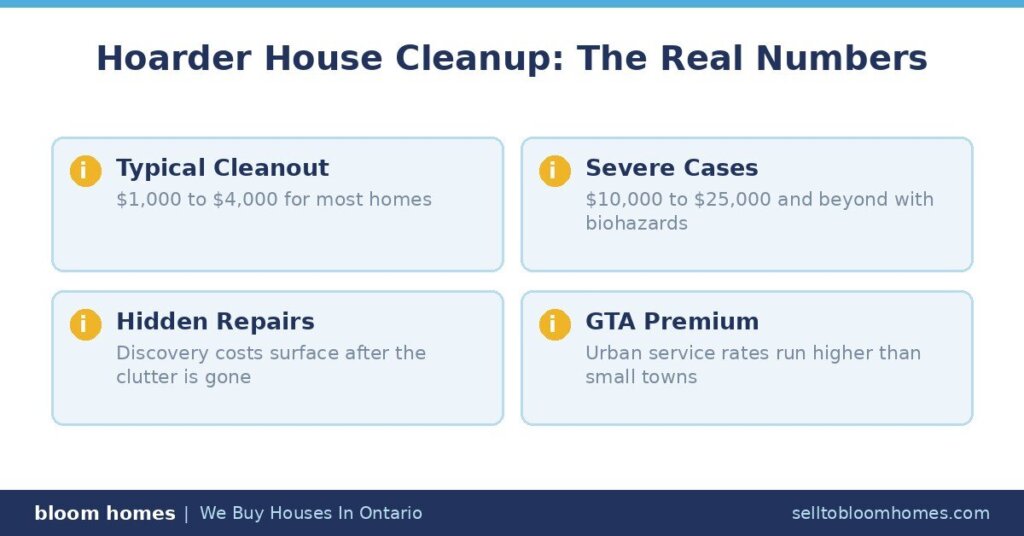
The cleanup cost is only the first bill. After the clutter is gone, the property inspection often surfaces repairs that were hidden for years: damaged plumbing, compromised electrical wiring, paint saturated with odour, rotted window framing. I’ve seen sellers budget for cleanup and then discover that remediation uncovered a foundation crack that cost more than the cleanup itself. Budget for discovery costs, not just removal costs. Selling as-is through a cash buyer frequently pencils out better than cleanup plus repairs plus carrying costs while the property sits on the MLS. Run the numbers on both paths before committing (I do this every time).
Can You Sell a Hoarder House As-is in Ontario Canada?
Skipping the cleanup entirely is a legitimate option, and for many sellers it’s the smarter one. Cash buyers and real estate investors purchase hoarder properties in their current state all the time. They price in the remediation and repairs, so the offer reflects the condition, but you avoid the upfront cash outlay, the contractor scheduling, and the months of holding costs while work gets done.
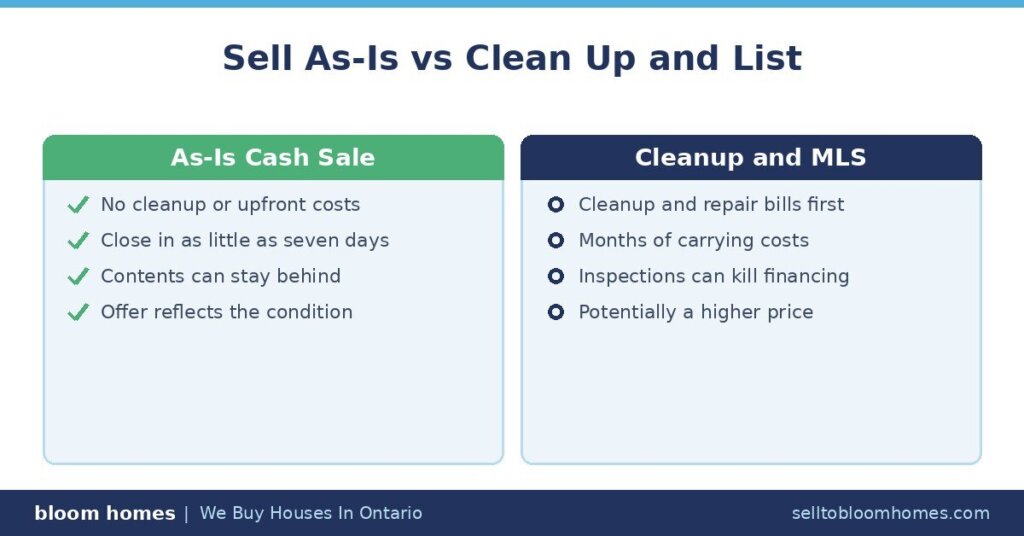
Median days on market for a Toronto-area home currently sits at 33 days, and that’s for conventionally presented properties. A hoarder house listed on the MLS can sit far longer, especially if the home inspection produces a deficiency list that scares off financed buyers. Cash sales close on your timeline. In Ontario, cash transactions close through lawyers to register title, with funds in the seller’s hands in as little as seven days after signing the purchase and sale agreement.
One important disclosure note: selling as-is doesn’t mean selling without honesty. Known latent defects, hidden mold, active water ingress, known structural issues, must be disclosed regardless of how the sale is structured. A good cash buyer who knows hoarder properties will factor those issues into their offer rather than using them to renegotiate after the fact. That’s one reason working with an experienced local buyer like Bloom Homes makes a genuine difference. They’ve bought these properties before and they don’t manufacture surprises at the last minute.
How Do Real Estate Agents Handle Hoarder Property Listings?
A seller in Barrie called me after her listing sat for 11 weeks with zero accepted offers. Her agent had tried twice to schedule professional photography, but the property condition made it impossible to produce usable images. The price kept dropping and the stigma kept building, which meant every week on market was making the next offer harder to get.
Traditional real estate agents, even skilled ones, aren’t trained for hoarder house listings. The MLS approach works beautifully for move-in-ready properties in Oakville or North York. For a hoarder house, the standard playbook fails: photography doesn’t work, open houses alienate buyers, and financed offers collapse on the home inspection. Agents earn their commission on volume, and a difficult property that lingers eats their time for marginal return.
Some realtors specialize in distressed and as-is properties and genuinely know how to reach investor buyers. If you go the MLS route, find one who has actually sold hoarder or estate properties in your region. The commission structure in Ontario typically runs 4 to 5 percent of the sale price split between buyer and seller agents, plus HST and closing costs. On a $750,000 property, that’s roughly $35,000 to $40,000 leaving the table before you see a dollar. For a property that already needs remediation, that math is worth examining carefully, especially when cleanup costs are already eating into your proceeds.
Who Buys Hoarder Homes in Ontario Canada?
The conventional buyer pool for a hoarder house is essentially zero. Retail buyers want move-in-ready or at worst cosmetically challenged; they don’t want a biohazard remediation project.
Real estate investors and professional cash buyers are your realistic market. These buyers have the contractor relationships, the capital reserves, and the risk tolerance to purchase a hoarder property in its current state, price in the work, and still close quickly. Some are local flippers. Others are landlords who plan to renovate and rent, making the property’s income potential just as important to them as the purchase price. A few are companies like Bloom Homes that specialize in exactly this kind of purchase across Ontario, offering straightforward cash offers without the drama of a traditional sale.
Estate buyers and property auction houses are another category. Ontario property auctions can move a hoarder house quickly, but they attract deeply discounted bids and there’s no price floor protecting you. Cash buyers typically offer more predictable outcomes. Heirs and estate administrators dealing with a hoarder house in Ottawa, London, or Hamilton’s lower east side generally find a direct cash offer produces a cleaner result than an MLS listing that drags through winter showings.
A seller who had recently moved her mother into assisted living in Kitchener reached out about the family home in Waterloo. It was a Saturday conversation, sitting in a living room still packed floor to ceiling with her mother’s belongings, including a dining set that hadn’t been used in twenty years. She wasn’t ready to sort everything, and the property was also tenant-occupied, making a traditional sale even more complicated. She didn’t have to clear everything out before moving forward. We purchased the property with the contents still inside, worked around the existing tenancy, and gave her time to take what mattered to her at her own pace before closing. For owners wondering how to sell a tenant-occupied property without dealing with extensive cleanouts, showings, or unnecessary disruption, this option exists more often than sellers realize.
What Is the First Step to Sell a Hoarder Home in Ontario Canada?
Where do you even start when the property feels too overwhelming to show, too expensive to clean, and too complicated to price?
Start with a realistic property assessment, not a cleanup plan. Before a dollar of remediation money is spent, get at least two opinions on what the property is worth in its current as-is condition. One opinion should come from a local cash buyer experienced with distressed properties; the other can come from a traditional realtor if you want to understand both paths. That comparison tells you whether the cleanup math works in your favour before you commit to it.
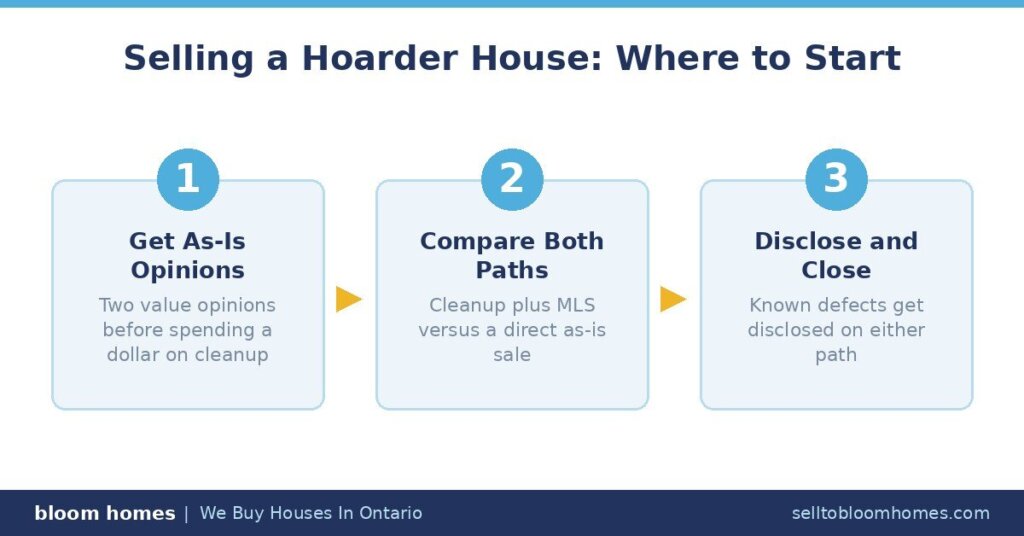
Knowing the range between an as-is cash price and a post-remediation MLS price lets you make the decision based on arithmetic rather than anxiety. Most sellers who run this comparison discover the gap is smaller than they feared, especially once they subtract agent commissions, remediation costs, carrying costs during repairs, and HST on services.
Reach out to Bloom Homes early in the process. A no-obligation conversation about your specific property costs nothing, gives you real numbers to work with, and lets you make decisions based on facts instead of guesswork. You don’t have to clean a thing before that call.
Frequently Asked Questions
What Is the Best Way to Sell a Hoarder House?
The best path depends on your timeline and your cash position. Selling directly to a cash buyer or real estate investor means no cleanup required, no agent commissions, and a closing timeline you control, often as few as seven days. If you have the capital and time for remediation, listing on the MLS after cleanup can push the sale price higher, but you’ll absorb remediation costs, agent fees, and months of carrying costs first. Run both numbers side by side before committing to either route.
Is Hoarding Illegal in Canada?
Hoarding itself is a recognized mental health condition, not a criminal act. That said, extreme property conditions can trigger municipal bylaw violations, property standards orders, or fire code enforcement from your local municipality. Ontario cities including Toronto, Hamilton, and Kingston each have property standards bylaws that allow inspectors to order remediation when a property poses health or safety risks to occupants or neighbours. The hoarding behaviour is a medical issue; the resulting property condition is where legal obligations can arise.
Can I Sell My House in Ontario Without an Agent?
Absolutely. Ontario law does not require a licensed real estate agent to complete a home sale. You can sell privately, directly to a cash buyer, or through a for-sale-by-owner platform. The disclosure obligations remain the same regardless of how the sale is structured: known latent defects must be disclosed honestly. Selling without an agent saves the commission, typically 4 to 5 percent of the purchase price plus HST, which on a mid-range Ontario home is a meaningful amount of money.
When Should I Worry About a House Not Selling in Canada?
If a property has been listed for more than 60 days without a serious offer, something is wrong with either the price, the presentation, or both. For a hoarder house specifically, the MLS listing model often works against sellers because financed buyers struggle with inspection conditions and lenders won’t fund properties in severe disrepair. If your listing is stalling, the answer isn’t always another price reduction. Sometimes switching to a direct cash sale is the faster and financially smarter move.
If you want to talk through your options for a hoarder house anywhere in Ontario, whether you’re in Scarborough, Windsor, Sudbury, or anywhere in between, we’re here. No pressure, no obligation, no requirement to clean a single room before you call. Reach out to Bloom Homes and get a straight answer about what your property is worth today.