
Most people assume they’ll see a power of sale coming from miles away. I’ve watched the process catch homeowners off guard even after they received the first letter, because nobody explained what each piece of paper actually meant or how fast the clock was running.
Property owners in Ontario who are behind on their mortgage, or even worried they might get there, should read this before doing anything else.
What Is a Power of Sale in Ontario?
A power of sale is the legal process that lets a mortgage lender sell a property after the borrower defaults, without going to court to take ownership. A lender doesn’t need a judge’s permission. They have the right baked directly into your mortgage agreement, and into provincial statute.
In a power of sale, the lender uses its rights under the mortgage to sell the property after the homeowner defaults. Until the sale is completed, the homeowner remains the property owner but may have an opportunity to correct the default before certain deadlines pass. Lenders then apply the sale proceeds toward the mortgage debt, legal costs, and other valid claims, with any remaining funds paid to the person entitled to them (rarely a large amount, in my experience).
You will find that last piece matters. When your home sells for more than you owe, that surplus belongs to you. Your lender is not entitled to profit from your equity.
Not long ago, I connected with a widow in Brampton whose husband had handled all the finances. She’d missed three payments after he passed, and when a Saturday morning letter arrived with “Notice of Sale” across the top, she had no idea her auction date was already being discussed. Two phone calls and a week later, she had enough information to make a real decision. Property equity gave her enough leverage that selling on her own terms made far more sense than letting the lender run the process (equity is the one thing that buys you options).
Which Ontario Laws and Court Decisions Govern Power of Sale?
Most articles skip right to the steps. Two separate legal tracks can trigger a power of sale, the piece they leave out, and which one applies changes your timeline.
A contractual power of sale typically follows about 15 days of continued default. A statutory power of sale under section 24 of the Ontario Mortgages Act typically requires the default to continue about three months. Your mortgage documents determine which applies. Most residential mortgages in Ontario contain a contractual clause, which is why the process can move faster than borrowers expect (and faster than most lawyers will tell you upfront).
Section 31 of the Mortgages Act and the prescribed Form 1 under O. Reg. 814/21 require the Notice of Sale to set out the mortgage and property in default, with amounts owing itemized separately, including principal, interest, arrears, taxes, insurance premiums, and enforcement costs.
A Notice of Sale must strictly comply with the requirements of the Mortgages Act. Errors in the notice can potentially invalidate the enforcement process, and courts have emphasized that strict compliance is required. A real estate lawyer who spots a procedural defect in your lender’s notice can buy you meaningful time, which in my experience is often enough to negotiate a repayment arrangement.
When Can a Lender Legally Start a Power of Sale in Ontario?
What does “in default” actually mean under your mortgage?
Once a borrower is in default, whether due to missed payments, unpaid property taxes, lapsed home insurance, or other covenant breaches, the process begins. Missed mortgage payments are the most common trigger, but homeowners who let their property insurance lapse or fall behind on property taxes are also vulnerable (I’ve seen this surprise people mid-process), even if they’ve never missed a payment.
The Notice of Sale cannot be delivered until the default has continued for the required period. After sending it, the lender must wait 35 days, or 40 if a married couple occupies the property, before proceeding. The longer 40-day period reflects the matrimonial home protections under sections 21 and 22 of the Family Law Act, which I’ve seen trip up lenders who assume the standard timeline applies to every file.
From first missed payment to a completed sale, the whole process runs four to six months, though your specific mortgage terms will shape the exact timeline.
How Does Power of Sale Work in Ontario?
A homeowner in Mississauga misses two payments in the fall. By spring, the property is listed under the lender’s control at a price the homeowner had no say in. This is not a worst-case scenario. The standard sequence plays out when nobody acts early.
Continued arrears will prompt the lender to send a default notice. This is the official communication that you are behind and that the mortgage is not in good standing. It doesn’t yet mean your home is being sold, but it sets the stage for the next step.
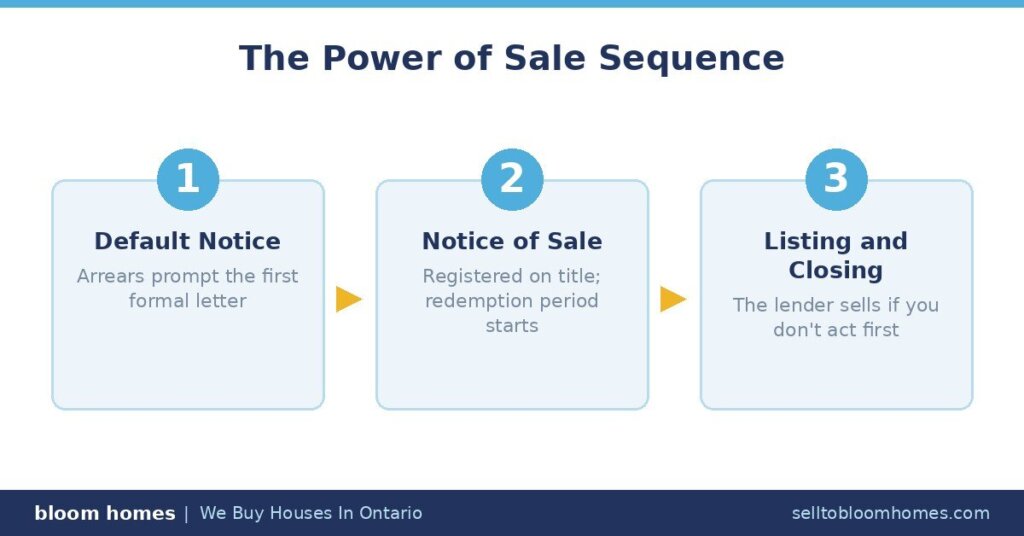
The Notice of Sale is the real turning point. It is registered on title and served to you. From this moment, you enter the redemption period. If the borrower pays the full amount due, including arrears, legal costs, and administrative fees, within this window, the process is halted. Miss that window and the lender moves to list the property, retaining a real estate broker and conducting at least two independent appraisals.
One thing I keep seeing: homeowners wait until the redemption period expires before calling anyone for help, when their options were widest in the two weeks after the Notice of Sale arrived.
Power of Sale Vs. Foreclosure in Ontario: What Is the Difference?
Power of sale is better for homeowners. Foreclosure is not.
In a power of sale, the lender sells the property and returns any surplus to you. In a foreclosure, the lender goes to court to take ownership of the property itself, keeps it, and keeps any later gain in value. If your home appreciates after a foreclosure closes, the bank keeps that appreciation.
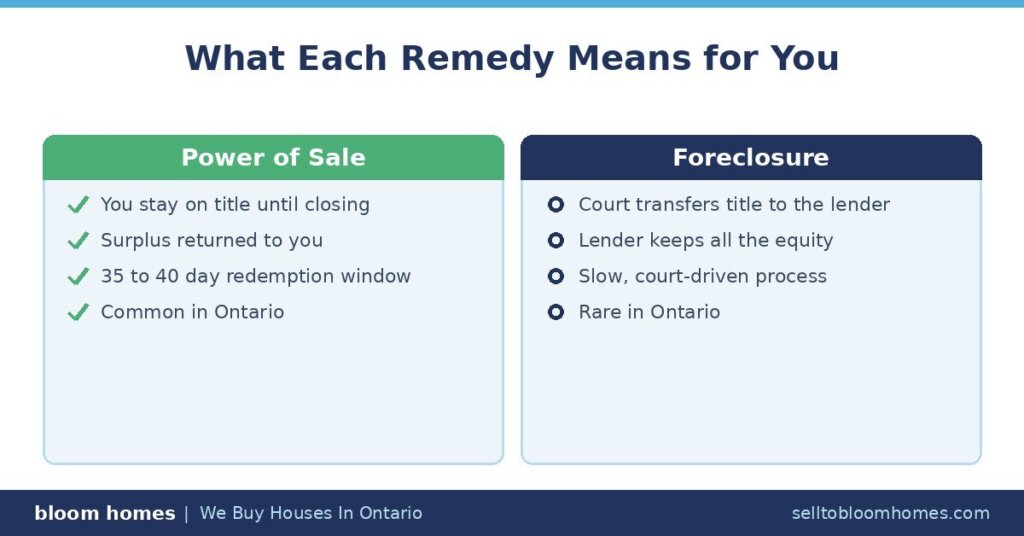
Power of sale is the most common mortgage remedy used in Ontario. Foreclosure exists here but lenders rarely pursue it, because the court process is slower and more expensive for them.
Title remains in the homeowner’s name until the sale closes, and homeowners retain the right to challenge a sale that didn’t achieve fair market value. That equity protection is real, but only if you have equity to protect. If your remaining mortgage balance is close to your property’s current market value, the surplus after fees and legal costs can be thin.
Can a Homeowner Stop a Power of Sale in Ontario?
Sitting across the kitchen table from someone in this situation, the first thing I tell them is: you probably have more runway than you think, but every day you wait makes the next step harder.
Borrowers may stop a power of sale by redeeming the mortgage, refinancing, negotiating with the lender, or challenging the enforcement process. Refinancing is worth exploring early. A private lender or second mortgage can sometimes bridge a gap and bring the first mortgage back into good standing before the redemption window closes.

Until there’s a binding agreement of purchase and sale, producing the full payout amount stops the process. It costs more at that stage because arrears and legal fees have continued to accumulate.
Selling the home yourself is often the smartest path if you have equity. You control the price, the buyer, and the closing date. The lender gets paid from the proceeds, you walk away with what’s left, and your credit takes far less damage than a completed power of sale would cause (I’ve seen the difference firsthand). A team like Bloom Homes can move quickly in exactly this kind of situation, giving you a real offer before the lender takes the wheel.
What Do Buyers Need to Know Before Purchasing a Power of Sale Property in Ontario?
An heir in Hamilton inherited a semi-detached near the Escarpment when his father passed. The estate had a mortgage in arrears, two siblings who wanted a quick close, and a garage full of thirty years of weekend projects. They wanted someone who could step in fast, skip the showings, and close on a Tuesday without conditions.
Buyers who purchase power of sale properties give up something most don’t expect: standard seller disclosures. The selling lender has no knowledge of the property’s physical condition and won’t warrant it. That means no representations about the roof, the foundation, or what’s behind the drywall. Budget for an independent home inspection (a good inspector runs thermal imaging too), because the lender will not offer one.
If the sale proceeds are insufficient to cover the outstanding debt, the lender may pursue a deficiency judgment against the borrower. Buyers aren’t on the hook for that shortfall, but title needs to be clean before closing. A real estate lawyer familiar with power of sale transactions isn’t optional.
For sellers in this position, Bloom Homes specializes in these kinds of purchases, taking the property as-is and closing on a timeline that keeps the homeowner in control of the outcome.
What Are the Current Trends Shaping Power of Sale Cases in Ontario?
In downtown Toronto alone, power of sale listings increased more than four times from 2023 to 2025, rising from approximately 11 listings in all of 2023 to 49 listings by mid-2025. According to CMHC data, Canada’s mortgage delinquency rate increased to 0.22% by Q2 2025, reflecting pressure from higher mortgage renewal rates. Homeowners who locked in at historic lows in 2020 and 2021 are now renewing into a completely different payment reality, and I’ve watched that shock ripple through neighbourhoods I’ve been buying in for years.
Toronto accounts for 13% of all power of sale transfers, followed by Peel at 9% and Simcoe at 6%. Barrie, Orangeville, and parts of the Simcoe County belt are showing pressure too.
Ontario’s median sold price sat at $700,000 in March 2026, with homes averaging 38 days on market. A homeowner who sells proactively can still move a property in a reasonable window. Waiting for the lender to list it means losing control of the asking price, the buyer, and the closing date.
Frequently Asked Questions
How Long Does Power of Sale Take in Ontario?
From the first missed payment to a completed sale, four to six months is typical. The process begins with a default notice, moves into a Notice of Sale and a redemption period of at least 35 days, and then proceeds to listing and closing if the debt isn’t resolved. Acting before the Notice of Sale is served gives you the most options and the most time.
How Does Power of Sale Work in Ontario?
When a borrower fails to uphold the terms of the mortgage, a power of sale can be used to recover the lender’s principal, interest, and expenses. The lender serves formal notices, waits out the redemption period, and then lists the property for sale. Any proceeds beyond what’s owed, including legal costs, are returned to you. If the sale falls short of the debt, the lender can pursue you for the difference.
Can You Stop a Power of Sale in Ontario?
Yes, and your options stay open longer than most people expect. Under the Mortgages Act, a borrower may redeem the mortgage by paying the amount owing before the lender completes the sale. Ontario courts have confirmed that the borrower’s right to redeem generally continues until the lender signs a binding agreement of purchase and sale. Refinancing, negotiating with the lender, or selling the property on your own terms are all viable paths, depending on how much equity you have and how early you move.
What Are the Legal Requirements for a Power of Sale in Ontario?
The Ontario Mortgages Act (R.S.O. 1990, c. M.40) sets out the procedures and timelines for exercising a power of sale. A Notice of Default may be issued approximately 15 days after a missed payment, followed by a formal Notice of Sale. The Notice of Sale must be properly served to all interested parties, including secondary mortgage holders, lienholders, and others with a vested interest. The lender must allow the full redemption period to expire before proceeding, and the property must be sold at fair market value. A real estate lawyer can review whether your lender has followed every required step.
If you’re behind on your mortgage and the letters are starting to arrive, or you just want to understand where you stand before things go any further, we’re here to talk it through. Bloom Homes works with Ontario homeowners in exactly these situations, no pressure, no obligation, just a straightforward conversation about your options while you still have them.