Most sellers in Ontario spend months thinking about what their home will sell for and almost no time thinking about what it’ll cost them to sell it. That gap between sale price and what actually lands in your bank account surprises people every single time. The numbers can sting if you’re not ready.
What Are Seller Closing Costs in Ontario?
Sit down with me for a second. Imagine you’ve accepted an offer on your house in Barrie or Kitchener or Oshawa, and you’re picturing a clean deposit hitting your account. Your real estate lawyer prepares a statement of adjustments, and before you see a dollar, a line of deductions runs down the page: commission, HST on that commission, legal fees, mortgage discharge costs, property tax adjustments, and possibly a condo-related fee on top.
Seller closing costs are the expenses pulled from your sale proceeds at the moment ownership transfers to the buyer. They don’t arrive as a separate bill in the mail. The lawyer handles them at closing, and you receive whatever’s left after they’re settled (sometimes less than you expected).
One thing sellers consistently get wrong: confusing your sale price with your net proceeds. These are two completely different figures. A homeowner in Mississauga who sells for $900,000 doesn’t pocket $900,000. After all seller-side costs, they might walk away with something closer to $840,000 to $855,000, depending on their mortgage situation and what commission rate they negotiated. This gap matters enormously for anyone counting on a specific number to fund a move, pay off debt, or buy a place across the province (and that last one trips up a lot of upsizers).
These costs are largely predictable, which means you can plan around them without scrambling at the last minute. Get the numbers early, run them past your lawyer, and you will know exactly what to expect on closing day. If you’d rather sidestep the traditional listing process entirely, Bloom Homes works with Ontario homeowners directly and can lay out your net figure upfront with no guesswork.
How Much Do Sellers Pay in Closing Costs in Ontario?
Some sellers push back when they first hear these numbers. “Six percent? Something can’t be right for a seller.” But it is, and often it’s more once you factor in HST.
As a general guideline, sellers can expect to pay between 1.5% and 6% of their home’s final sale price in closing costs. The range, though, doesn’t always capture the full picture because commission alone can already be substantial, and then 13% HST gets added on top of that commission. Once you add legal fees and mortgage-related costs, a seller on a mid-priced Ontario home is realistically giving up somewhere between that figure and 8% of their sale price before seeing a penny. That’s part of the cost of selling a house that sellers need to account for when calculating their actual proceeds.
According to the Ontario Real Estate Association for June 2026, provincial home sales rose year over year to 18,051 units, with the MLS Home Price Index composite sitting at $753,300. On a home at that price point with a standard commission plus HST, plus legal fees and discharge costs, a seller’s closing costs could easily clear $50,000 before touching mortgage payoff (and that’s before any repairs).
The honest approach is to build your budget from the bottom up: start with what you owe on your mortgage, add every verified closing cost line by line, and subtract the total from your expected sale price. That’s your real net. A closing cost calculator is a helpful starting point, but your lawyer’s written estimate is the number to bank on.
I’ve bought houses from sellers who were shocked at closing because they budgeted for commission and forgot everything else. Getting a full written estimate from your real estate lawyer at least 30 days before closing protects you from that surprise, keeping you from scrambling to cover costs the week before keys change hands.
What Is Real Estate Commission in Ontario?
A couple of years ago, I worked with a family in Scarborough who were selling their semi-detached to free up equity. They’d mentally spent the money twice before we even talked about commission. When their listing agent quoted 5% plus HST, the math finally hit them hard.
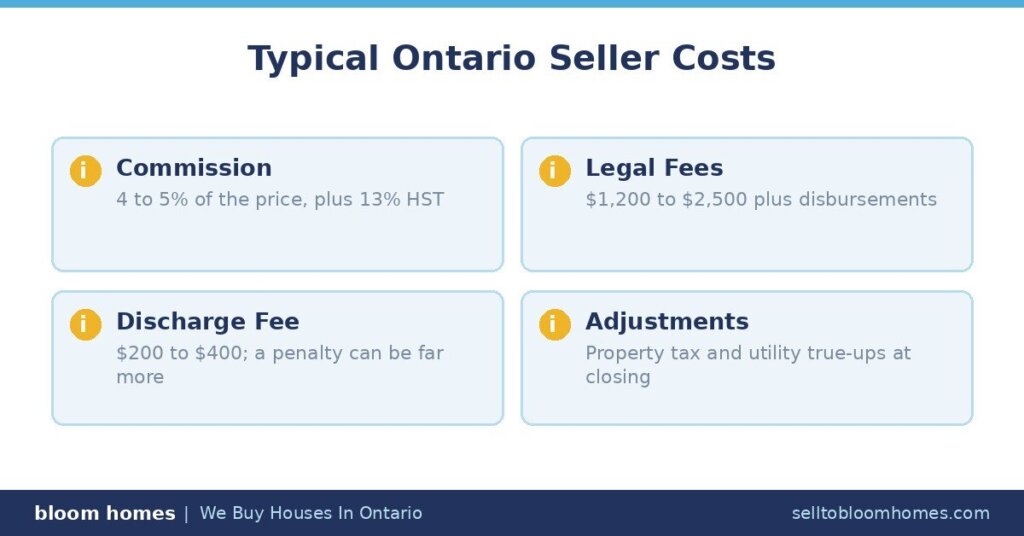
Ontario has no fixed or regulated real estate commission; most realtors charge 4 to 5% of the sale price, with 5% being the most common rate in 2026. The seller pays it from sale proceeds, and 13% HST applies on top. On a $500,000 home, a 5% commission is $25,000 plus $3,250 in HST, totalling $28,250, usually split between the seller’s and buyer’s brokerages.
On higher-priced GTA properties, this one line item alone can run past $60,000 once you include tax. Commission is almost always the largest single deduction from a seller’s proceeds. No other cost comes close.
In Ontario, there isn’t a fixed or regulated commission rate; it’s generally a percentage of the final sale price and is negotiable. Many sellers assume agents won’t budge, but many will, especially in markets where inventory is higher. Average GTA listing days on market are now 31 days, up from 24 days last year, which gives sellers a bit of leverage to negotiate terms with their agents before signing a listing agreement.
Read your listing agreement carefully before signing. The split between your listing agent and the buyer’s agent is set in that document, and it’s very hard to change after the fact.
Do Sellers Pay Tax on Real Estate Commission in Ontario?
“Wait, I have to pay tax on top of the commission?”
Yes. Every time. This surprises sellers more than any other cost on this list. Real estate commissions are a taxable service in Ontario, meaning a 13% HST surcharge applies to the total commission amount. While HST is a flow-through tax for the brokerage, it’s still a direct out-of-pocket cost for the seller at the time of closing.
So on a $750,000 home with a 5% commission rate, your base commission is $37,500. Add 13% HST and your total commission cost rises to $42,375. The extra $4,875 goes to the government, not the agent, but it still comes out of your proceeds. Many sellers quote each other commission rates without mentioning the HST, which creates a gap between the quoted figure and the final amount they actually pay.
No HST is paid by sellers on the home itself when it’s a resale residential property. New builds carry a buyer-side issue on that front. But any professional service you hire, including your real estate agent and your lawyer, carries HST on top of their fees. Budget for it. The lawyer’s invoice, the agent’s commission, and any staging fees you pay will all carry that 13%.
How Do Legal Fees Factor Into Seller Closing Costs in Ontario?
A seller in Kingston once handed her lawyer a folder of documents she’d assembled herself, thinking it would cut the bill. It didn’t. The legal fee was the same because the work the lawyer does is largely fixed by the transaction, not the seller’s prep.
Your real estate lawyer protects your interests by reviewing all documents, performing a title search, preparing the statement of adjustments, and facilitating the secure transfer of funds. In Ontario, legal fees for a standard home sale typically range from $1,200 to $2,500, plus disbursements for third-party costs like couriers or registration fees.
Disbursements are third-party expenses the lawyer pays or incurs to close the transaction, and they can include courier charges, document registration searches, bank wire fees, tax certificates, and mortgage payout administration. These add up, and sellers who focus only on the quoted legal fee miss the total. Always ask for an all-in estimate that includes disbursements (sometimes double the base fee), not just the base professional fee.
In Ontario, it is mandatory to have a lawyer to complete a real estate transaction. This isn’t optional. Your lawyer also coordinates with your lender to pay out the mortgage and get the discharge registered on title, which is part of why their role runs right until the moment funds are transferred on closing day.
What Other Fees Do Sellers Pay at Closing in Ontario?
Commission and legal fees are the big two, but they’re not the whole story.
Your mortgage payoff is the most important number to get right before you list. The mortgage generally needs to be paid out as part of the sale and the lender’s charge removed from the property; the Financial Consumer Agency of Canada confirms that a mortgage discharge is required when selling a mortgaged property. On top of the actual mortgage balance, your lender charges a discharge fee, typically between $200 and $400, to formally remove their claim from your title.
The bigger risk is breaking a mortgage term early. If you’re selling before your mortgage term is up, your lender will likely charge a prepayment penalty, usually calculated as either three months’ interest or the Interest Rate Differential (IRD), whichever is greater. The IRD method can produce a penalty running into the thousands on a large fixed-rate mortgage, so get a written payout statement from your lender before you list, not after you’ve accepted an offer.
Property tax adjustments are another line item that catches people. On closing day, property taxes are adjusted between buyer and seller; if the seller has pre-paid property taxes beyond the closing date, the buyer reimburses the seller for the overpaid portion (often a few hundred dollars). The reverse is also true: if you owe taxes for the period you owned the home, you cover that amount at closing.
Selling a condo in a building like those along Yonge Street in Toronto, or in the newer communities around Vaughan and Mississauga’s Square One area? A condo status certificate costs $100 by law, though many property managers add online convenience fees, so planning for $130 to $150 with portals or rush fees is practical. The document tells buyers about fees, reserve funds, and any litigation tied to the unit.
Can You Negotiate or Reduce Seller Closing Costs in Ontario?
Sellers who don’t ask about commission before signing a listing agreement almost always pay more than those who do.
Commission is negotiable. It always has been. Commission rates are not fixed, and the Real Estate Council of Ontario outlines the rules governing how these fees are structured and disclosed. Agents may not volunteer a discount, but many will move on the rate when a seller comes prepared and asks directly. Flat-fee listing options also exist for sellers who want more control over that cost, so pricing out at least two or three before you sign anything is worth doing.
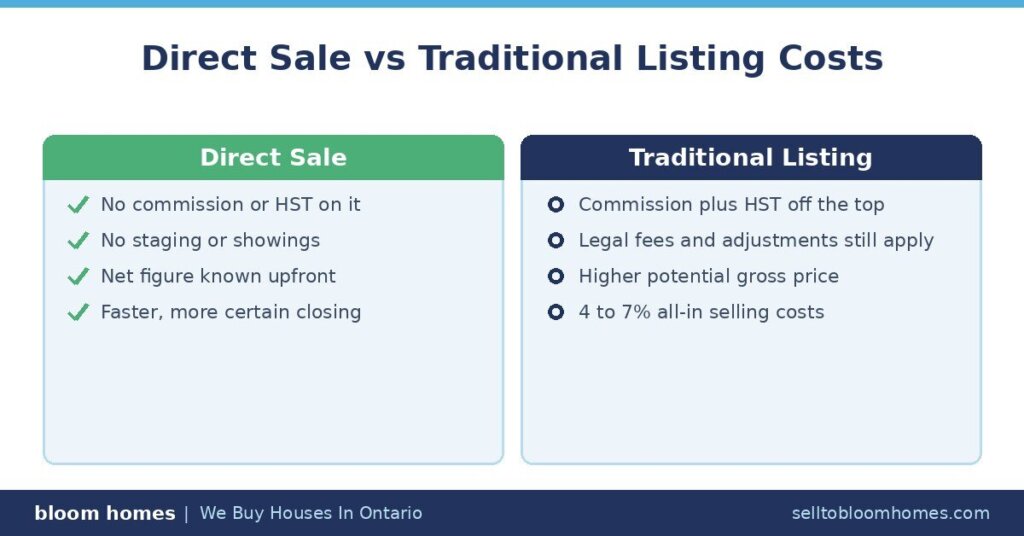
A different path altogether: selling directly to a local buyer like Bloom Homes means no agent commission at all, which is often the single largest reduction available to any Ontario seller. Whether the net result is better depends on your asking price expectations versus a direct offer, but it’s worth running the numbers both ways before you decide.
Legal fees are less negotiable but not impossible. More complex transactions, like estate sales, separation agreements, or properties with title issues, will cost more. A clean, straightforward freehold sale in Guelph or Hamilton is simpler for your lawyer and will land at the lower end of the range. Giving your lawyer organized documents and responding to requests quickly also keeps billable time down.
What about mortgage discharge costs? Your discharge fee is set by your lender and isn’t really negotiable. The penalty, though, can sometimes be reduced by timing your closing to align with your mortgage renewal date, when no penalty applies. Your mortgage broker can help you model that out.
How Do Ontario Seller Closing Costs Compare to Other Provinces?
Ontario sellers don’t pay land transfer tax. That often surprises people who know how large LTT is for buyers here.
Sellers do not pay land transfer tax or title insurance; those are buyer costs. In provinces like British Columbia, the situation is similar for sellers, though buyer-side transaction costs vary by province. What makes Ontario distinct is how heavily the commission and HST combination weighs on seller-side costs, particularly in high-value markets like the GTA, Waterloo Region, and Ottawa.
Total seller closing costs in Canada typically range from 4 to 7% of the sale price. Ontario sellers at the top of that range tend to be those breaking a fixed mortgage early, selling a condo in a hot urban market, or listing at a price point where commission dollars are large in absolute terms. Sellers in smaller Ontario markets like Windsor, Peterborough, or Sudbury may spend closer to the bottom of that range simply because lower sale prices keep commission amounts smaller even at the same percentage.
Unlike some U.S. markets, seller-paid buyer closing costs are not standard practice in Canada. This is worth knowing if you’ve sold a home across the border before. Seller concessions to help a buyer cover their closing costs happen occasionally here, but they’re not baked into the culture the way they are in some American markets.
What Is the Bottom Line for Sellers Closing a Home in Ontario?
$753,300: that was the average Ontario home price in June 2026, according to OREA data cited earlier. At that price with a 5% commission, 13% HST on commission, $2,000 in legal fees, and a $300 discharge fee, a seller pays roughly $47,000 to $50,000 in closing costs before touching the mortgage balance. Net proceeds depend on what’s owed.
Getting your paperwork in order early makes everything cleaner. Build your own version of a net proceeds estimate with real numbers from your lawyer and lender before you list. That means a written payout statement from your mortgage lender and an all-in quote from your real estate lawyer, including disbursements. Once you have those two numbers, the rest of your calculation is straightforward.
A seller in Oakville reached out on a Thursday afternoon with a job transfer starting in five weeks. She had a tenant in the garage suite, open building permits on a deck she’d added, and a fixed-rate mortgage she’d be breaking 18 months early. None of that made her situation impossible, but every one of those details affected her closing costs and her timeline. We worked through the numbers, addressed the open permits through her lawyer, and she was out with money in hand before the transfer date. The detail that helped most: knowing what the IRD penalty would be before she accepted any offer, so there were no surprises at the lawyer’s table.
For sellers who want to skip the full traditional process, Bloom Homes offers a direct, transparent purchase option. No agent commissions, no staging, no open houses. Just a clear offer and a timeline that works around your situation.
Frequently Asked Questions
What Are Normal Closing Costs for a Seller in Ontario?
For most Ontario home sellers, total closing costs run somewhere between 4% and 7% of the final sale price when you add up real estate commission, HST on that commission, legal fees, and mortgage discharge costs. On a $750,000 home, you’d realistically be looking at $40,000 to $55,000 in total deductions before your mortgage payoff. Getting a written estimate from your lawyer and your lender before you list gives you the most accurate picture.
What Are Common Hidden Closing Costs in Ontario?
The ones that catch sellers off guard most often are HST on real estate commission, prepayment penalties for breaking a fixed-rate mortgage early, and disbursements added to the base legal fee. Property tax and utility adjustments at closing are also frequently overlooked. If you’re selling a condo, the status certificate fee is a small but easy-to-miss expense as well.
How Can I Calculate the Closing Costs for Selling My Home in Ontario?
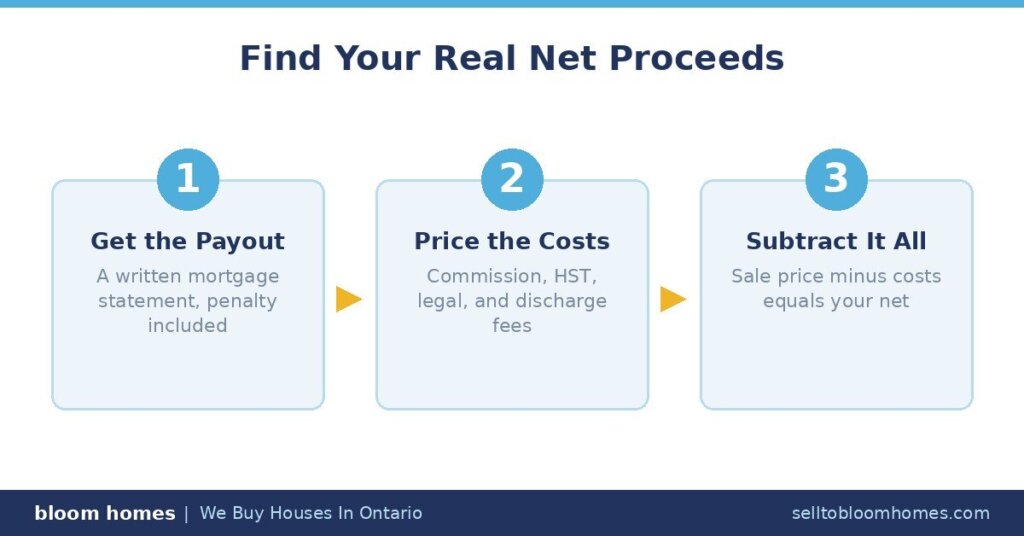
Start with your expected sale price, then subtract your commission (including 13% HST), your legal fees and disbursements, your mortgage discharge fee, any mortgage prepayment penalty, and any property tax adjustments. Your real estate lawyer can prepare a statement of adjustments estimate, and your lender can give you a written payout statement; together, those two documents give you an accurate net proceeds figure before you ever accept an offer.
What Fees Do Sellers Pay at Closing in Ontario?
Sellers in Ontario typically pay real estate commission plus HST, legal fees and disbursements, a mortgage discharge fee, and a prepayment penalty if breaking a mortgage term early. Property tax and utility adjustments are settled at closing as well, and condo sellers pay for a status certificate. Buyers cover land transfer tax and title insurance, so those don’t appear on your side of the ledger.
If you want to talk through what your specific numbers look like before you list, or if a direct sale without commissions makes more sense for your situation, reach out to Bloom Homes. No pressure, no obligation, just a straightforward conversation about your options.