Selling a house in Ontario and walking away with every dollar of profit sounds great. For most homeowners, that’s exactly what happens. But for sellers who own a rental, a vacation property, or a home they converted from one use to another, the Canada Revenue Agency is going to want a portion of the gain, and not knowing how that works before closing day is one of the more expensive surprises I’ve seen in this business.
What You Need to Know First
A while back, I worked with a landlord in Oshawa who had held a bungalow for nearly fifteen years. Two separate agent listings had expired with zero offers, one in fall and one the following spring, both on a property that sat empty through each attempt. Solid brick exterior and a garage full of tools gave the place appeal, but the pricing and the listing strategy weren’t clicking with traditional buyers. We ended up buying it directly, and only then did the landlord realize he hadn’t sat down with a CPA to model the tax hit before agreeing to a number. The proceeds were good, but the tax calculation came as a shock at filing time. Running those numbers before you sell, not after, is the entire point of this article.
A capital gain is the difference between what you paid for an asset and what you sell it for. Simple in concept, messier in practice when a house has had multiple uses over the years. Ontario sellers deal with a combination of federal and provincial tax rules, and the good news is that most of them are workable once you understand the structure.
If you’d rather talk through your specific situation with someone who buys houses in Ontario regularly, Bloom Homes is a resource worth keeping in your back pocket. They work with sellers across the province and can help you understand what a direct sale looks like alongside the tax implications.
Capital Gains Tax in Ontario Canada
The tax code actually shelters most homeowners entirely. A family buys a detached house in Barrie, lives there for twelve years, sells for far more than they paid, and walks away without owing the CRA a cent on that gain. Principal residence exemption covers the full gain when the property qualifies, that is the reason. Where things go sideways is when sellers assume their situation is that clean-cut and skip the verification step, which in my experience takes about twenty minutes but saves serious headaches later.
A capital gain is realized when you sell. Until the sale happens, the gain is just paper appreciation. This matters because sellers sometimes think the tax clock started years ago when the property went up in value. It didn’t. Selling itself is the tax event.
When a capital property sells at a profit, half of that profit is added to income in the year of sale, and the actual tax payable depends on the taxpayer’s marginal tax rate and the province where taxes are filed. Ontario has some of the higher combined marginal rates in the country, which is why running this math before you list the property matters so much.
Capital gains tax in Canada is not a separate line-item bill. It is not a separate tax that shows up in your payables; it is part of the profit added to your annual taxable income. Sellers sometimes brace for a dedicated “capital gains bill” and are confused when none arrives, only to get a larger-than-expected income tax assessment instead.
How the Capital Gains Inclusion Rate Works in Canada
Sellers sometimes push back on this rule and ask why they’re being taxed on a gain when they already paid for the house with after-tax dollars. Fair objection. Canada’s tax system partially offsets this by taxing only a fraction of the gain, not all of it, which is the answer.
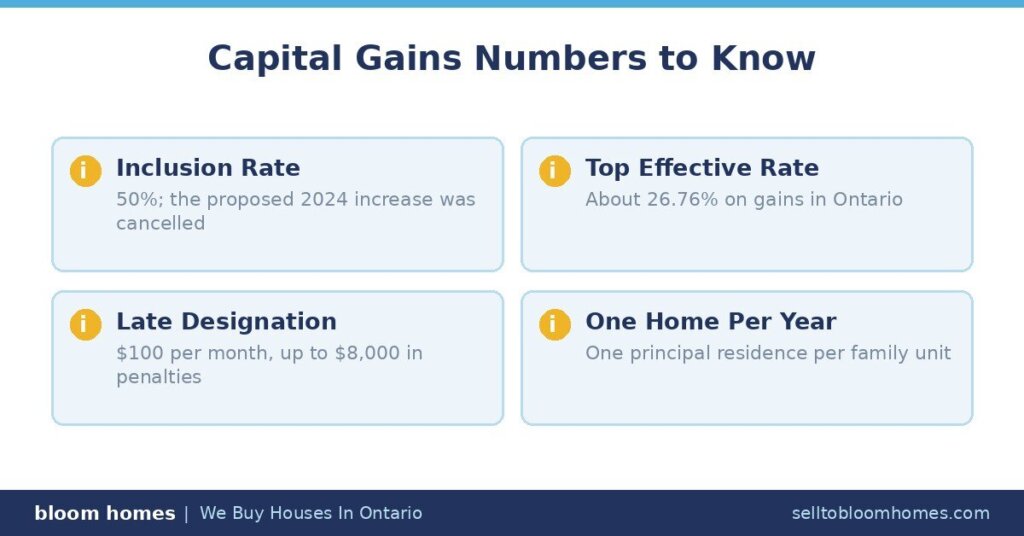
Under current federal tax rules in Canada, 50% of a realized capital gain must be included as taxable income. The remaining portion of the gain is not taxed at all. This is the inclusion rate, and it’s the same for every type of capital property from stocks to investment real estate to a rented condo in Kitchener.
In 2024, the federal government proposed raising the inclusion rate to 66.67% on the portion of an individual’s annual capital gains above $250,000, and on all gains for most corporations and trusts. That change was deferred and then cancelled in March 2025, so it never became law. All capital gains continue to be included in income at the same flat rate, which means your planning assumptions from a couple of years ago still hold.
Only the taxable portion of the gain is added to income, and that amount is taxed the same way as other income earned during the year. So if you sell a Sudbury rental property in June and realize a $200,000 gain, $100,000 of that gets layered on top of your employment income, your rental income from the rest of the year, and anything else you earned. Your marginal rate for that top slice is what determines the actual bill.
Capital Gains Tax Rates in Ontario Canada
A retiree in Mississauga sells a cottage they’ve owned since the 1990s. Their gain is large, they’re otherwise in a modest income bracket, and they’re stunned to learn their effective tax rate on the gain is far lower than they feared. That’s because the inclusion rate interacts with their actual bracket, not a flat “capital gains rate.”
Capital gains are taxed at your combined federal and provincial marginal rate, but only on the included portion. In Ontario, someone in the top income tax bracket might pay a combined marginal rate of about 53.53%. At the standard inclusion rate, the effective tax on the capital gain would be roughly 26.76%, which still adds up fast on a property that’s appreciated significantly.
With the current inclusion rate and current federal and provincial income tax rates, no one in Canada pays more than 27% tax on capital gains. That ceiling is relevant for Ontario sellers with large gains who might otherwise assume the bill is catastrophic.
Your marginal income tax rate determines everything here. Sellers with lower total income in the year of sale pay less. That’s not a loophole; it’s how the progressive income tax bracket system works for capital gains the same way it works for employment income. An accountant who knows Ontario’s combined federal-provincial rate tables can model several scenarios, including timing the sale to a lower-income year, and the difference can be real money on a $400,000 to $800,000 gain.
What Counts as a Proceed of Disposition in Ontario
For years I thought “proceeds” just meant the sale price. It doesn’t, and getting this wrong understates your gain in ways the CRA notices.
When a home is not fully exempt, your capital gain is the sale price minus your adjusted cost base (what you paid plus eligible costs) and your selling costs. Those selling costs reduce your gain dollar for dollar. Real estate commissions, legal fees, and closing adjustments you pay as the seller all belong in that deduction.
Your adjusted cost base (ACB) is the other side of the equation. Before calculating your capital gains, you need to find your adjusted cost base (ACB), which is your original purchase price adjusted to include any additional purchase fees. What often gets missed: capital improvements to the property. A new roof on a Guelph duplex, a finished basement in an Ajax rental, or a structural addition anywhere on the property all increase your ACB and reduce your final gain. Maintenance and repairs, though, do not; those are operating expenses, not capital costs.
Many landlords forget to include renovations, additions, and major repairs in their adjusted cost base, and that oversight means they report a larger gain than they actually realized. Keep every receipt from every capital project for as long as you own the property and a few years beyond.
What Is Capital Cost Allowance and How It Affects Your Capital Gain
Claiming capital cost allowance aggressively on a rental property without modeling the exit tax is one of the faster ways to wipe out the benefit you thought you were banking.
Capital Cost Allowance (CCA) is the CRA’s optional annual depreciation deduction for rental buildings and equipment in Canada. Landlords claim it to reduce taxable rental income (typically at 4% on Class 1 buildings); you cannot use CCA to create a rental loss, and claimed CCA is recaptured as income when you sell.
Upon sale of a rental property, any profit earned over and above the initial cost is treated as a capital gain. Capital gains are taxed at a reduced rate on the gain, whereas recapture is 100% taxable. That distinction is huge. Your recapture piece gets added to your income at your full marginal rate, not the preferential capital gains rate.
CCA claims reduce a property’s undepreciated capital cost, not the adjusted cost base. The ACB stays fixed at the original purchase price. When you sell, any CCA previously claimed is “recaptured” and taxed as ordinary income, on top of any capital gain. Many investors see years of small CCA deductions followed by one large recapture bill at sale and wonder why they bothered. The math doesn’t always favor claiming it, especially if you plan to sell within a decade.
How to Calculate Capital Gains Tax in Ontario
This formula is simpler than most sellers realize.
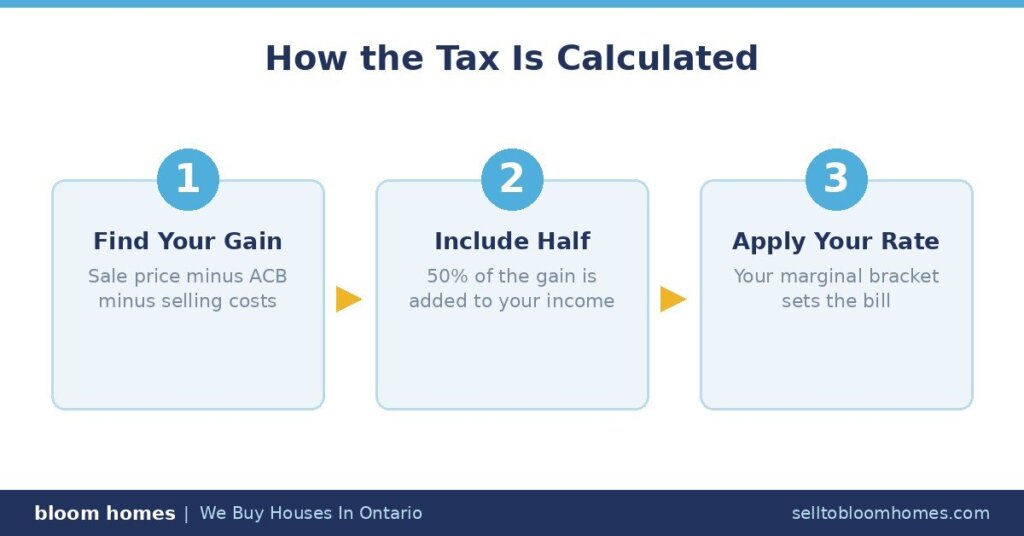
Your realized capital gain is your sale proceeds minus your ACB minus your eligible outlays and costs of disposition. Half of that number gets added to your income for the year. That added amount then gets taxed at whatever your marginal rate is for that slice of income (and that rate can shift if the gain is large). Your capital gains tax owing for the year is the result.
A plain example: you paid $350,000 for a Hamilton investment property and sell it for $600,000. Selling costs total $25,000. Your ACB is $350,000 and you’ve never claimed CCA. Your gain is $225,000. Half of that, $112,500, gets added to your income. At a combined marginal rate of 43%, your tax on the gain is roughly $48,000. Not trivial, but also not the full $225,000 that sellers sometimes fear when they first hear “capital gains tax” (Hamilton numbers, but the math travels).
If a property was your principal residence for only some years, a partial exemption applies using the formula: divided by years owned. That formula is your exemption fraction. Multiply your total gain by that fraction and the result is sheltered. The rest is taxable.
What’s the right move if the numbers look uncomfortable? Talk to a CPA before you finalize a sale price. The tax liability affects your net proceeds and should factor into whether a direct sale, a listed sale, or a timed sale makes the most sense for your situation.
How the Principal Residence Exemption Reduces Your Tax Bill in Ontario
Sit across the kitchen table from most Ontario homeowners and ask them what they’ll pay in capital gains tax when they sell their house, and the answer almost always comes back: “Nothing, right? We live there.”
Most of the time, that’s correct. Capital gains on the sale of your home can be sheltered from tax through the principal residence exemption. If the property was your principal residence for every year you owned it, the entire gain is exempt.
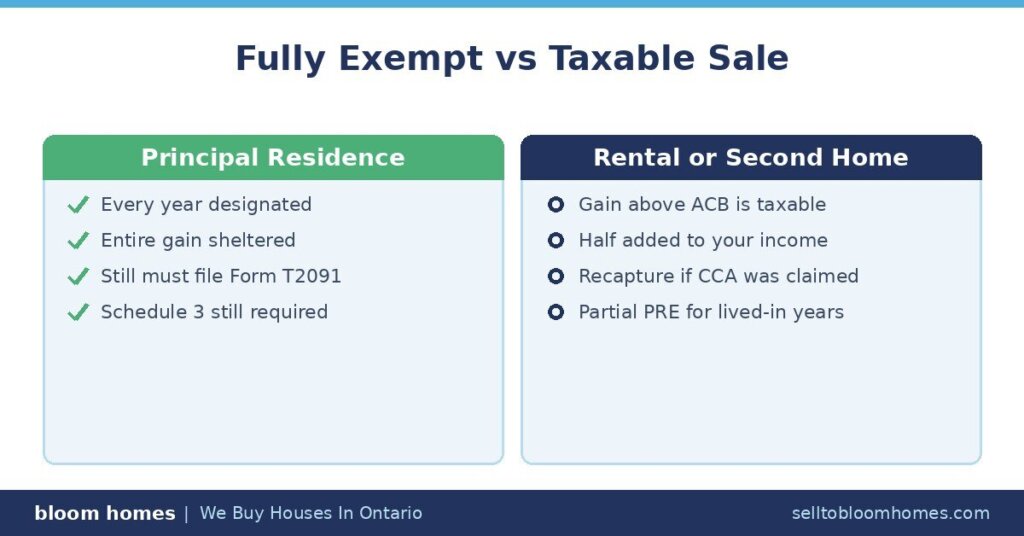
One catch is the reporting requirement. If you sold your property in 2026 and it was your principal residence, you have to report the sale and designate the property on Schedule 3, Capital Gains or Losses. You also have to complete Form T2091, Designation of a Property as a Principal Residence by an Individual.
Effective 2016 and later tax years, the CRA will only allow the principal residence exemption if you report the disposition and designation of your principal residence on your income tax and benefit return. Skipping that filing because you assume the full gain is exempt is a mistake. If you forget to designate, the CRA can accept late designations, but a penalty applies equal to the lesser of $8,000 or $100 per complete month from the original due date to the date the CRA receives a satisfactory request (that clock starts immediately).
If you own more than one home at the same time, only one of them can be designated for the principal residence capital gains exemption for a particular tax year when you sell. Families with a primary home in Ottawa and a cottage near Parry Sound, for example, have to choose which property gets the designation for each year of dual ownership. That choice has real tax consequences and deserves careful planning, so working through the numbers with an accountant before you list either property is worth every hour you spend on it.
Capital Gains on Rental and Investment Properties in Ontario
What happens when you sell a property you’ve been renting out in Scarborough for the last eight years?
If you’re selling a rental property, vacation home, or investment property, the capital gain is taxable at the standard inclusion rate. No exemption applies unless the property was also your principal residence for some of those years, in which case a partial exemption calculation using the formula above can reduce the taxable portion.
The Ontario market data from March 2026 shows a median sold price across the province of $700,000, leaving many landlords who bought properties even five years ago sitting on gains large enough to create real tax events at sale. This is not hypothetical for most Ontario investors.
You must time the sale here in ways you don’t for principal residences. Selling a rental property in a year when you’ve retired or taken an extended leave, and your total income is lower, can push the taxable portion of the gain into a lower marginal rate bracket. That’s not tax evasion; it’s legitimate planning that a good accountant can help you model before you commit to a sale date. Bloom Homes works with landlords across Ontario who are weighing exactly this kind of decision, and they can help you think through timing alongside offer terms.
Who Qualifies for Capital Gain Exemptions in Canada
A seller inherits a property that was their elderly parent’s home in Oakville. Owned outright, no rental history, no mortgage. They sell it within a year of inheriting it and assume they owe nothing. They might be right, but the answer depends on how the estate handled the deemed disposition at death and whether the property was designated properly.
The most widely available protection is the principal residence exemption described above. Beyond that, the exemptions get narrower.
The capital properties eligible for the Lifetime Capital Gains Exemption (LCGE) include qualified small business corporation shares and qualified farm or fishing property. A regular residential rental property in Kingston does not qualify. This exemption is for business and agricultural assets, not investment real estate.
Effective June 25, 2024, the federal government increased the LCGE to $1,250,000 for qualifying property, and this limit is indexed to inflation going forward. For 2026, the indexed limit is approximately $1,275,000.
A non-resident who owns property in Canada must pay tax on any taxable capital gain when selling it and generally cannot claim the principal residence exemption. Non-residents selling Ontario property face additional withholding requirements and must notify the CRA. If you’ve spent years living outside Canada while holding Ontario property, get professional advice before listing (ideally before the listing agreement is signed). The rules for non-residents are stricter on every dimension.
How to Lower Your Capital Gains Tax Liability in Ontario
Splitting the sale across two tax years is a strategy most articles skim past, but it can shift a meaningful portion of a taxable gain into the following calendar year when a seller’s income is lower.
One approach worth knowing: capital losses from other investments, such as stocks you sold at a loss, can offset capital gains from a property sale in the same tax year. You can reduce the amount of capital gains tax you owe by holding your investments in registered accounts, offsetting capital gains with capital losses, and claiming the principal residence exemption. Sellers who hold a mix of real estate and investment assets will find this offset strategy particularly useful when timing a property sale alongside a down year in their portfolio.
Boosting your ACB before you sell is another lever. Any capital improvement you’ve made but not yet documented properly should be tracked down and added to your cost base before filing. Renovation receipts, permits, contractor invoices, all of those belong in a folder that follows the property from purchase to sale (I’ve found gaps years after the work was done). Selling costs also reduce the gain, so every eligible professional fee should be captured.
If you rented a property for a period and also had the same property as your principal residence at different times, talk to your accountant about how to handle the designation. The rules around mixed-use properties are genuinely complex, and the planning opportunities are real. A property in Windsor that you lived in for five years and then rented for three is not the same tax story as a pure investment property, and the partial exemption calculation can preserve a meaningful piece of the gain.
What Forms and Publications You Need to Report Capital Gains in Canada
Which form do you file when you sell a property? Schedule 3 is the starting point for every capital gains disclosure in Canada.
All capital gains, exempt or not, must be reported on Schedule 3, Capital Gains of the T1 Income Tax and Benefit Return. Sellers sometimes think that if the gain is fully exempt under the principal residence exemption, they have no reporting obligation. That’s not how the CRA sees it.
For 2016 and later years, a return must include basic information on Schedule 3; for 2017 and later, individuals also complete Form T2091(IND). A sale of your principal residence must be reported on Schedule 3 to claim the exemption.
Rental property sellers have additional forms to deal with. In the year of sale, file Form T776 showing rental income and expenses up to the sale date, the capital gain calculation, and CCA recapture if applicable. Report the capital gain on Schedule 3 of your T1 return.
The CRA’s official publication for capital gains is T4037, Capital Gains, available directly at canada.ca. That guide covers inclusion rate history, proceeds of disposition, adjusted cost base calculations, and exemption rules in detail. For principal residence designation specifically, Income Tax Folio S1-F3-C2 at canada.ca is the authoritative CRA document. Keep the CRA’s principal residence reporting page bookmarked as well (especially around filing time).
Common Mistakes Ontario Residents Make When Reporting Capital Gains
Miss the T2091 and the entire exemption can be disallowed. That’s the severity of the paperwork requirement, and it catches sellers who assume their accountant will handle something the accountant assumed the seller would flag.
A pattern I keep seeing: sellers who convert their principal home to a rental for a few years before selling assume the exemption still covers the entire gain. If a property was your principal residence for only some years, a partial exemption applies using the formula: (years designated + 1) divided by years owned. The years it was rented are not covered unless you made a specific election under the CRA’s rules for a change of use. Missing that election costs real money and there’s no retroactive fix once the filing deadline passes.
Another one: not keeping renovation records. A Brampton landlord I worked with had done a full kitchen renovation, new windows throughout, and a rear addition on a property he held for twelve years. No receipts. His ACB was effectively understated by well over $60,000, and every dollar of that translated to more taxable gain. Keep your documents.
A third mistake is assuming that a property sold through a traditional listing handles the tax filing automatically. Your real estate lawyer handles the closing and the transfer of title, not your income tax filing (two very different closing tables). Capital gains are reported on your personal tax return, so speak with an accountant or tax professional about how a sale affects you.
Finally, sellers who list in a year when their income is unusually high, think bonuses, severance, or a business exit, can end up with the capital gain taxed at the highest marginal bracket when waiting one more year might have meant a lower rate. With homes in Ontario sitting at a median sold price of $700,000 as of March 2026 and an average of 38 days on market, there’s generally enough time to plan a strategic listing date rather than rushing into a sale without looking at the income tax picture first.
That last point ties directly to why sellers sometimes consider a direct sale to a buyer like Bloom Homes. A direct sale can close on your timeline, giving you control over which tax year the proceeds land in, which is a real advantage when income planning matters.
Frequently Asked Questions
How Do You Avoid Capital Gains Tax in Canada When Selling a House?
The most effective tool is the principal residence exemption, which shelters the entire gain on a home you’ve lived in and designated as your principal residence for every year you owned it. Beyond that, sellers can reduce taxable gains by boosting their adjusted cost base with documented capital improvements, offsetting gains with capital losses from other investments, and timing the sale to a year when their overall income is lower. None of these strategies require exotic planning; they require good recordkeeping and a conversation with a CPA before you list.
How Much Capital Gains Tax Do I Pay on $100,000 in Canada?
At the current 50% inclusion rate, a $100,000 capital gain adds $50,000 to your taxable income for the year. The actual tax you owe on that $50,000 depends on your marginal income tax rate. In Ontario, someone in the top combined bracket of roughly 53.53% would owe approximately $26,765 on that gain. A seller in a lower bracket would pay considerably less, which is why the year you choose to sell and your total income in that year both matter.
How Long Do You Need to Own a House Before Selling to Avoid Capital Gains in Canada?
There is no specific minimum ownership period that triggers or removes the capital gains exemption. What matters is whether the property qualified as your principal residence for the years you owned it, not how many years that was. A property you owned for two years and lived in the entire time can be fully exempt. A property you owned for twenty years but rented for half of them will only be partially exempt. Duration alone doesn’t determine your tax outcome; the nature of the use does.
How Much Capital Gains Tax Do I Pay on $300,000 in Canada?
With a 50% inclusion rate, a $300,000 capital gain means $150,000 gets added to your taxable income. In Ontario at the top combined marginal rate of approximately 53.53%, the tax owing would be around $80,295 on that included amount. Most sellers won’t be at the top bracket for the full $150,000, so the real number is often lower once the progressive bracket structure is applied. A CPA can run the actual calculation using your complete income picture for the year.
If you’re selling a property in Ontario and want to talk through the numbers, the timing, or whether a direct sale might work better for your situation, the team at Bloom Homes is happy to have that conversation. No pressure, no obligation, just a straightforward look at your options from people who’ve been through this process hundreds of times across the province.