Sellers typically focus entirely on what they’ll net from the sale. They calculate the agent commission, maybe budget a bit for legal fees, and start mentally redecorating the next place. What they miss is what the buyer is quietly factoring in on their end, and it changes the math on your deal more than you’d think.
Home buyers in Toronto must pay both the Ontario provincial land transfer tax and the Municipal Land Transfer Tax (MLTT), and that stacked cost shapes how much a buyer can realistically offer you. Understanding this tax as a seller isn’t optional. It’s how you price smartly, negotiate honestly, and avoid deals falling through at the finish line.
What Is the Land Transfer Tax in Toronto?
Ontario’s land transfer tax is one of the most quietly consequential costs in any real estate transaction in this province.
When you buy land or an interest in land in Ontario, you pay Ontario’s land transfer tax. Land includes, but is not limited to, any buildings, buildings to be constructed, and fixtures such as light fixtures, built-in appliances, and cabinetry (cabinetry counts even if it’s bolted in). Every conveyance of property triggers it. There are no carveouts for neighbourhood, property type, or market conditions. A condo in the Entertainment District gets taxed. A semi-detached in Leslieville gets taxed. A Victorian in Cabbagetown gets taxed.
Canada’s LTT is a marginal tax, meaning each portion of your house’s value is taxed at its own marginal tax rate, much like Canadian income tax brackets. You don’t pay the top rate on the whole purchase price; you pay progressively higher rates only on the portions of the price that fall into higher brackets.
Starting February 1, 2008, a Municipal Land Transfer Tax has been applied to purchases on all properties in the City of Toronto in addition to the provincial land transfer tax. The dual-tax structure is what makes buying in Toronto uniquely expensive compared to the rest of Ontario. A seller in Scarborough competing with a seller in Pickering is, indirectly, fighting that cost gap every time a buyer runs the numbers, because those extra thousands show up immediately in any honest affordability calculation.
The harmonized sales tax (HST) applies to newly constructed homes or substantially renovated homes, but does not apply to resale homes. Sellers of existing properties don’t collect HST on the sale price, but buyers and sellers both need to understand how the land transfer tax fits alongside every other closing cost in play.
Who Pays Land Transfer Tax in Toronto?
A lot of sellers walk into our conversations thinking this tax is their problem to solve. It sounds reasonable: the tax is on the “transfer,” and they’re the ones transferring the property. Turns out, that’s not how it works.
In Ontario, the land transfer tax is paid by the buyer, not the seller, when they acquire property or a beneficial interest in land, such as a house or condo. At closing, sellers don’t write a cheque for this, which means the full amount lands on the buyer’s side of the ledger.
Not long ago, I was working with a landlord in East York who had three months of missed mortgage payments and an auction date coming up faster than he’d expected. He owned a solid brick house with a finished basement and a detached garage full of tools he hadn’t touched in years. One thing that kept surfacing in his thinking was whether the tax burden would spook buyers. Once we walked through how the buyer carries the LTT cost (not the seller’s problem), he had a clearer picture of what his net proceeds would look like and could make a realistic decision about timing.
The practical impact on sellers is real, though, even if the tax isn’t yours to pay directly. Savings of $10,000 to $20,000 or more can result from the difference in land transfer tax compared to buying in Toronto, and this difference is one reason some buyers choose properties just outside Toronto’s borders. When buyers feel squeezed at the closing table, they push back harder on your list price, or they choose the comparable property in Etobicoke‘s boundary zone or Scarborough’s outer edges that sits just outside the MLTT zone. Your pricing strategy has to account for that pressure.
Toronto Municipal Land Transfer Tax Vs. Ontario Land Transfer Tax
So you’re selling a place in the Beach or up in Lawrence Park, and your buyer asks: “Why is my closing cost so much higher here than in Oakville?” That’s a fair question, and the MLTT is the answer.
Toronto is the only municipality in Ontario that levies its own additional land transfer tax. Every other city in the GTA, Mississauga, Brampton, Markham, Vaughan, Burlington, collects only the provincial levy, leaving buyers crossing the city boundary into Toronto facing a meaningfully different closing cost picture. The Toronto MLTT rates closely mirror the provincial rates but apply on top of them.
For buyers in the 905 regions, the math is much simpler. If you purchase in the 905 regions such as Mississauga, Brampton, Markham, Vaughan, Oakville, or any other municipality outside Toronto’s city limits, you only pay the Ontario provincial LTT, keeping your closing costs noticeably lower than a comparable purchase inside the city. There is no municipal land transfer tax in these areas.
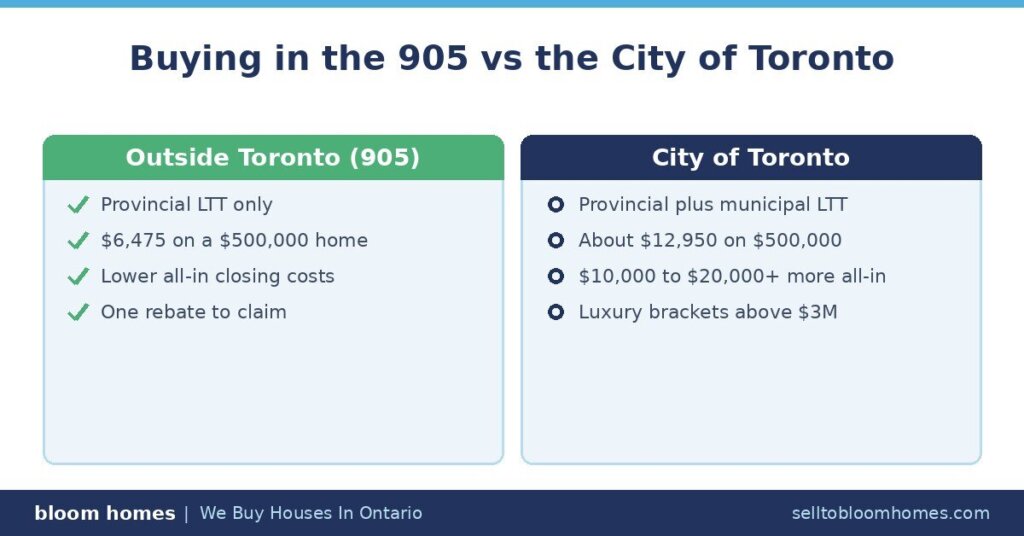
Sellers in the City of Toronto proper face a real affordability headwind. Buyers are already stretching for properties in a city where prices routinely exceed $900,000, and then the MLTT lands on top of everything else. That tax doesn’t change what your home is worth, but it absolutely changes what a buyer can comfortably pay after accounting for all-in costs (closing day math hits differently than the listing price suggests).
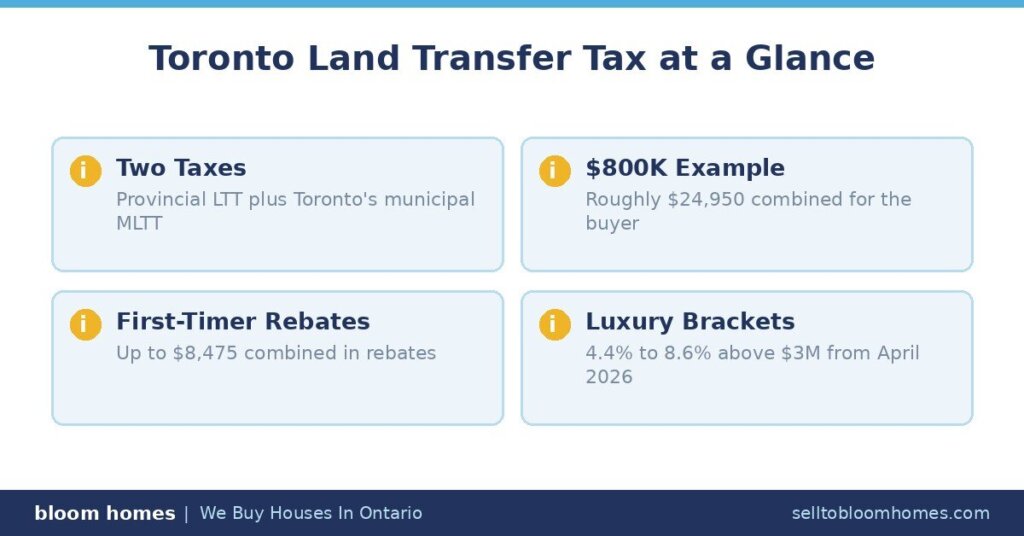
At the top end of the market, there’s a newer layer. On December 17, 2025, City Council passed an amendment to introduce graduated Municipal Land Transfer Tax rates for high-value residential properties containing one or two single-family residences, with the new MLTT rates taking effect on April 1, 2026. The new luxury tax brackets apply to homes containing one or two single-family residences and range from 4.4% to 8.6% on the portion of the purchase price within each applicable bracket. If your Rosedale or Forest Hill home is priced above $3 million, this is something your buyer’s lawyer will be calculating very carefully (closing cost estimates shift fast at this level).
Current and Historical Toronto Land Transfer Tax Rates
Those rates have existed in their base form since 2008, and the core bracket structure hasn’t changed as dramatically as you might expect given how much Toronto prices have climbed since then.
The provincial tax brackets work on a sliding scale. On a purchase price, the first $55,000 is taxed at a 0.50% marginal tax rate, the portion between $55,000 and $250,000 carries a 1.0% rate, and the portion between $250,000 and $400,000 carries a 1.5% rate. Higher price tiers carry higher rates, so the more expensive the property, the steeper the effective bite on that upper portion.
Toronto’s MLTT mirrors that structure, leaving you effectively paying double the provincial amount at most standard price points. A buyer purchasing an $800,000 home in Toronto pays approximately $12,475 in provincial LTT plus $12,475 in municipal LTT, for a combined total of roughly $24,950. That’s real money that has to be in hand on closing day (liquid, not tied up in investments), not folded into the mortgage.
For a $900,000 home in Toronto, the total combined LTT (provincial + municipal) is approximately $30,950. Keep that number in mind when you’re wondering why buyers in certain price bands seem more resistant to full list price offers. It’s not stubbornness. It’s arithmetic.
How Is Toronto Land Transfer Tax Calculated?
Here’s what I tell sellers sitting across from me at the kitchen table: the tax is not one flat percentage of your sale price. It’s calculated in layers, exactly like income tax, where each bracket only touches the portion of your price that falls within it.
Your LTT is not just a simple average tax of your home’s value. Instead, it’s a marginal tax, and each portion of your house’s value is taxed at its own marginal tax rate. So when you see a $500,000 property and someone quotes you “the land transfer tax,” they mean the sum of several different calculations stacked together.
On such a purchase, the Ontario LTT alone totals $6,475, calculated as $275 plus $1,950 plus $2,250 plus $2,000 across the applicable marginal tax brackets. Toronto buyers then pay a matching MLTT on top of that, for a combined bill of roughly $12,950 before any other closing costs come in (title insurance, legal fees, adjustments).
That calculation is one your lawyer handles at closing through the Teraview system, so buyers don’t have to run it manually. But sellers benefit from knowing these figures because they explain buyer behavior. A buyer who’s been quoted $25,000 to $30,000 in combined LTT on a mid-range Toronto property is going to negotiate differently than one who doesn’t have that number yet.
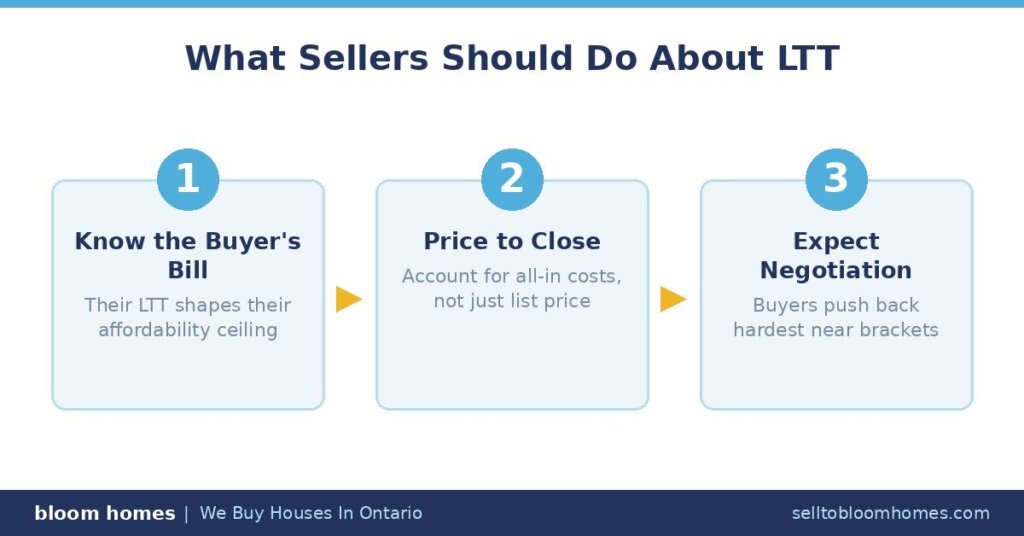
Do you know where your buyer’s affordability ceiling actually sits once you account for what they owe at the closing table? Most sellers don’t think about it in those terms. Sellers who do price their homes to close, not just to attract showings.
First-time Home Buyer Rebates for Toronto Land Transfer Tax
A first-timer buys a condo in Regent Park. Their lawyer runs the numbers, applies two rebates they barely knew existed, and suddenly the land transfer tax bill drops to zero. Meanwhile, their coworker buying a similar unit in Waterfront Toronto, not knowing to check eligibility (a five-minute conversation with a lawyer), ends up paying the full amount.
Both the provincial and Toronto governments offer land transfer tax rebates for first-time home buyers, and these rebates can reduce or eliminate your LTT obligation. The Ontario government offers a rebate of up to $4,000 for eligible first-time home buyers. Toronto offers an additional rebate of up to $4,475 for first-time buyers purchasing in the city, which covers the full Toronto MLTT on qualifying homes. Combined, first-time buyers in Toronto can receive up to $8,475 in rebates, which is real money worth understanding before you make an offer.
Real eligibility strings are attached to the refund. To qualify for the Ontario land transfer tax refund, you must be a Canadian citizen or a permanent resident of Canada, be 18 years or older, and occupy the home as your principal residence within 9 months of the purchase. You must also have never owned a home or any interest in a home anywhere in the world, and your spouse must not have owned a home while being your spouse.
This is one of the most misunderstood rules. Unlike some federal first-time home buyer programs, Ontario’s Land Transfer Tax Rebate is generally a one-time opportunity. If you have ever owned a home, even years ago, inherited one, or owned a partial interest in one (that last one surprises a lot of buyers), you may not qualify.
As a seller, first-time buyer eligibility in your buyer pool matters because it affects how confidently buyers can bid in your price range. A Kensington Market condo priced at $420,000 attracts a different buyer profile than a detached in North York priced at $1.2 million, and those buyer profiles have very different rebate access.
How Toronto Land Transfer Tax Affects Buyers and Sellers
Underestimating this tax’s effect on buyer psychology costs sellers real money.
Current Toronto MLS stats indicate an average house price of $987,025, with a median of 33 days on market for a home as of August 2026. In a market where homes are sitting for over a month on average, buyers have time to do math. They’re factoring in their LTT bill, their lawyer fees, their home inspection, and their moving costs (all of it adds up fast) before they finalize what they’re willing to offer. Sellers who price without accounting for that full buyer cost picture get fewer offers and longer days on market.
Tax policy also shapes how different property types trade. The average selling price of a condo in Toronto was $563,100 in September 2025, down 8.1% over the prior 12 months on a year-over-year basis. A $10,000-plus LTT bill hits harder for condo buyers, who tend to be more budget-constrained on an already tight purchase. Sellers of condos, especially in densely built neighbourhoods like Liberty Village or Yorkville, face a buyer pool that’s quietly doing that calculation on every showing.
For sellers using a direct buyer rather than listing on the open market, the LTT conversation still happens, just differently. When Bloom Homes purchases your property, they factor their own closing costs into the offer, so you don’t get blindsided by a deal that collapses because a buyer miscalculated what they owed at closing. That certainty has real value when you’re on a deadline.
Electronic Registration and Toronto Land Transfer Tax
The land transfer tax is collected through Teraview, Ontario’s electronic land registration system, at the same moment the title changes hands, not days later, not after the fact, right at registration.
The City of Toronto designated Teranet as the official MLTT collection agent for all electronically registered transfer documents. Beginning on February 1, 2008, the Teraview software calculates the MLTT, which is deducted from the registering lawyer’s electronic registration bank account. Your buyer’s lawyer has to have those funds available before they can complete the registration. No funds, no keys.
With electronic registration (known as “e-reg”), documents can be created, signed, exchanged between law offices, and then registered, all in electronic format. This means the entire conveyance, including the tax collection, happens within a tightly coordinated digital process. Lawyers on both sides work simultaneously in Teraview, and the tax payment flows to the city the instant the transfer is registered. There’s no paper cheque, no next-day settlement.
When lawyers register land transfers, four separate charges are electronically collected by Teraview: the registration fee, the provincial and municipal land transfer taxes, and an administration fee (plus HST) to collect the tax. Most sellers never see this on their side of the statement of adjustments, but your lawyer will walk you through how it appears on the buyer’s closing costs.
One pattern I’ve seen repeatedly: deals stall at the last moment not because the buyer couldn’t afford the property, but because they hadn’t properly funded their lawyer’s trust account to cover both the LTT and closing costs together. Your real estate lawyer is worth every dollar for exactly this reason. Coordination matters. If you’re working with a team like Bloom Homes, who handle multiple closings and know these logistics from the buyer side, you get a counterparty who isn’t going to be scrambling at the last minute.
Frequently Asked Questions
A homeowner in Etobicoke reached out recently, wanting to offload a rental property she’d inherited and never intended to manage. The place had been a source of headaches for years. Her main question before anything else: “Am I going to get hit with a tax on this sale?” Getting clear on who owes what, and what’s available in rebates, was the first thing we worked through together.
How to Avoid Land Transfer Tax in Toronto?
Avoiding the land transfer tax entirely isn’t an option for most transactions. The tax is paid by the buyer when they acquire property or a beneficial interest in land. Certain transactions are exempt, such as transfers between spouses, but standard arm’s-length property sales are always taxable. First-time buyers can reduce or eliminate the tax through the provincial and municipal rebate programs, but sellers have no mechanism to waive it on the buyer’s behalf. The most practical approach for buyers is to understand the rebates they qualify for and budget accurately from the start.
How Much Land Transfer Tax Would I Pay on a Property Worth $500,000 in Ontario?
On a $500,000 purchase, the Ontario LTT totals $6,475, calculated across the applicable marginal tax brackets. If you’re buying within the City of Toronto, you’d pay roughly the same amount again as the MLTT, bringing the combined total to approximately $12,950. Outside Toronto, you owe only the provincial levy of $6,475. The exact figure depends on your lawyer’s calculation at registration using the current marginal rate schedule.
Can I Get a Refund for Land Transfer Tax in Ontario?
First-time buyers may apply for a refund within 18 months of the property’s registration, with a maximum $4,000 tax rebate available on the Ontario land transfer tax. Toronto first-time buyers can layer the MLTT rebate on top, potentially recovering up to $8,475 combined. Rebate applications are typically handled by your real estate lawyer at closing, but confirm the process and your eligibility well before your closing date. If you miss the filing window, the rebate isn’t recoverable.
What Is the Land Transfer Tax in Toronto?
Toronto’s land transfer tax is actually two taxes: the Ontario provincial land transfer tax and the City of Toronto’s Municipal Land Transfer Tax, both applying to every property purchase within city limits. The cost of your land transfer tax is a percentage of your home’s value, estimated using the property’s purchase price. The rates run from 0.5% on the first $55,000 up to higher rates on portions above $400,000, with both the provincial and municipal levies calculated on the same marginal basis. For most mid-range Toronto homes, the combined bill lands somewhere between $20,000 and $35,000. The City of Toronto’s official MLTT page has a calculator that gives you an exact figure based on your purchase price, and the Ontario Ministry of Finance covers the provincial side in full detail.
If you’re trying to figure out how all of this affects your specific situation, your property, your timeline, your net proceeds, we’re glad to talk it through. No pressure, no obligation. The team at Bloom Homes works with Toronto homeowners across neighbourhoods from Scarborough to Etobicoke every week, and we know these numbers inside and out. Reach out whenever you’re ready.