Separation is hard enough before the house gets involved. Once it does, the stress multiplies, the disagreements multiply faster, and even a home you both love can start to feel like an anchor. I’ve sat at a lot of kitchen tables across this province, from Burlington to Kingston to Barrie, and the question I hear most often is some version of: “Can we just get this done without it destroying us financially or emotionally?” The answer, almost always, is yes. But you need to know what you’re actually dealing with first, and that clarity alone takes some of the weight off.
Do You Have to Sell the House in a Divorce in Ontario?
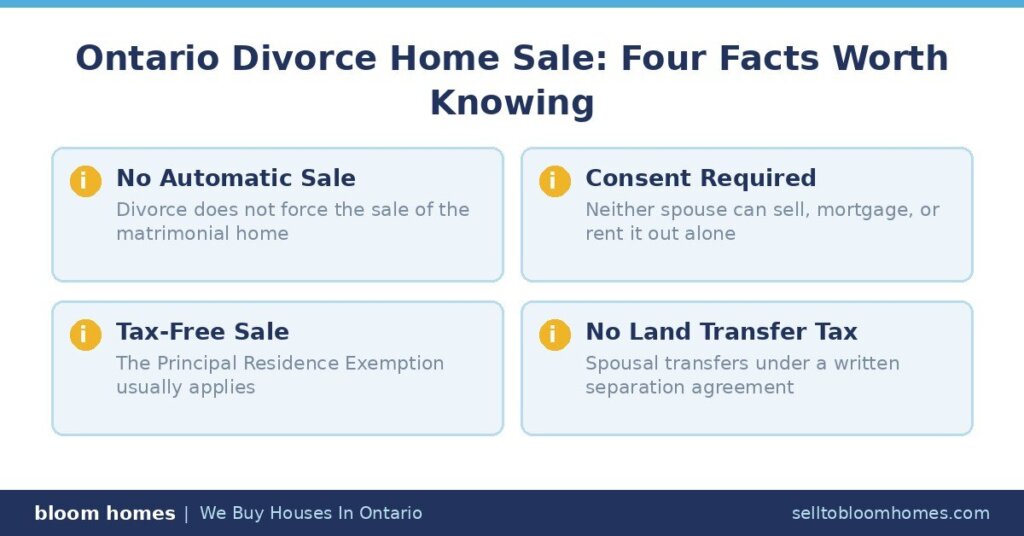
Nobody wants to hear “you have to sell,” especially when kids are in the picture or when one spouse has lived in the home for twenty years. Here’s what the law actually says: divorce does not automatically force the sale of the matrimonial home in Ontario. Pause and sit with that for a moment, because a lot of couples assume the house has to go on the market the second the separation is official.
One spouse who wants to keep it can frequently negotiate a purchase of the other’s share or offset it against other assets, such as investments or retirement accounts. A pension, savings, or an RRSP can all come into play as part of the equalization math (and the numbers rarely balance on the first pass).
Selling is often the cleanest exit. A judge can order the sale of the matrimonial home when neither party can afford to buy out the other’s share. With a joint mortgage, carrying costs split between two households, and neither spouse realistically able to qualify for the full balance alone, selling tends to be the path of least resistance. Working with a team that understands this situation, like the folks at Bloom Homes, can help you move quickly when you need to without sacrificing what you’re owed.
Legal Rules for Selling Matrimonial Property in Ontario
A lot of people walk into a separation expecting that whoever’s name is on title has the final say. That falls apart fast under Ontario’s Family Law Act.
One spouse cannot unilaterally sell, mortgage, or rent out the matrimonial home without the written consent of the other. It doesn’t matter who bought the property before the marriage, who makes the mortgage payments now, or whose name is listed first on title. As long as it’s the family’s primary residence at the date of separation, even if only one spouse is the legal owner (and I’ve seen this trip up sole-title holders), it may legally be considered the matrimonial home.
There’s a wrinkle that many people overlook, especially in second marriages. Ontario’s Family Law Act has a rule not found in most other provinces: if one spouse already owned a home at the date of marriage and it becomes the home they live in together, the value of that matrimonial home is not credited to the starting value of assets used for the equalization calculation. Owning the home outright before marriage (and paying it off solo) can be a real hit for someone in that situation. A family lawyer, not just a real estate agent, is who you want advising you on this piece.
What Are Your Options If You Don’t Want to Sell the House?
Common-law spouses in Ontario have different property rights than married spouses. Unlike married couples, the property-division provisions of the Family Law Act are triggered at the end of a marriage and property is divided essentially in equal portions, subject to certain rules and exceptions. Common-law couples don’t get the same automatic equalization rights, so their options and risks are genuinely different. If you’re in a common-law relationship, get legal advice specific to that situation before assuming any married-spouse rules apply to you.
For married couples who want to keep the home, the main paths are: negotiate a buyout of the other spouse’s share offset against other assets, or transfer one spouse’s interest to the other as part of the divorce settlement, making them the sole legal homeowner.
Mediation is worth mentioning here. A trained mediator can help both spouses reach a separation agreement on the home without the time and expense of litigation. Property disputes that go to court take much longer and cost much more than most families expect.
How to Split Home Equity Fairly During Divorce
Ontario follows an “equalization of net family property” approach rather than directly splitting physical assets. This means that while one spouse might retain the home, they may need to compensate the other for their share of its value. Getting an independent appraisal, not just an agent’s market opinion, is the right starting point. Two brokers from competing offices can come in $50,000 apart on the same house in Mississauga (I’ve watched this happen in a single afternoon), and a certified appraiser’s number gives both lawyers something to work from.
What often gets skipped is the cost of carrying the home after settlement. Property taxes, insurance, maintenance, and the mortgage don’t stop. If one spouse keeps the home but stretched financially to buy out the other, they’re often back in trouble within two years. I’ve seen this pattern more times than I can count: a spouse fights hard to keep the house, wins, and then lists it anyway eighteen months later because the carrying costs are unsustainable alone (especially on a single income).
Step-by-step Process to Sell Your Home During Divorce in Ontario
Two spouses agreed on everything except the listing price. Six weeks later, after two price reductions and a buyer who backed out, they were back at square one. Getting aligned before the property hits the market is the work that matters most, and I’ve watched that delay cost sellers far more than the original price gap ever would have.
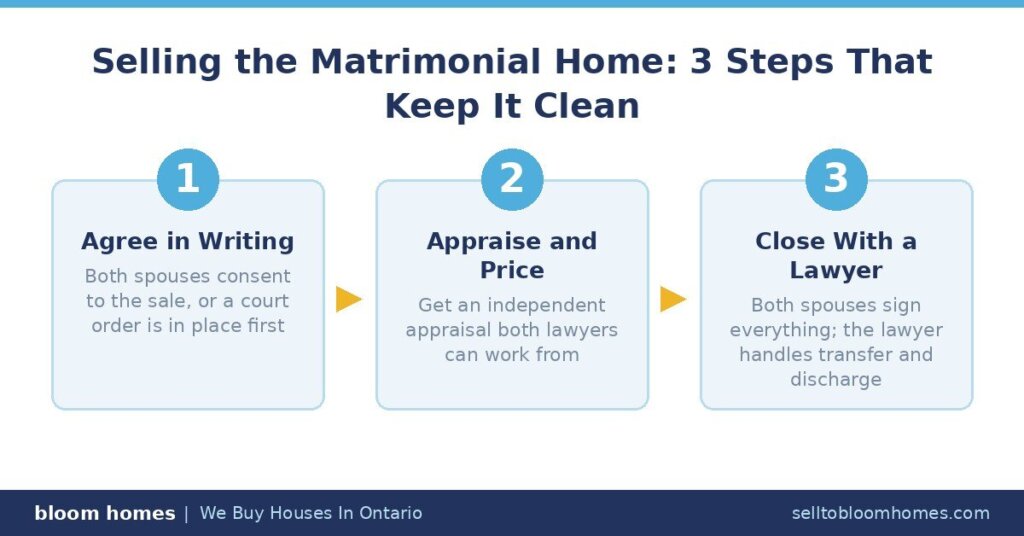
Generally, the process runs like this:
Both spouses must agree in writing before any sale can proceed, or a court order must be in place. Once you have that agreement, get the home professionally appraised and agree on a realistic asking price. Then hire a real estate agent both parties trust, or consider selling directly to a buyer to skip the listing process altogether. Make sure both spouses sign all documents, including the listing agreement, any offers, and the final transfer documents (missing one signature can restart the whole process). Your real estate lawyer will prepare the transfer deed and handle the discharge of the mortgage.
Bloom Homes can buy the property directly, skipping showings, open houses, and the uncertainty of whether a financed offer will close. For divorcing couples who need a clean, fast exit with a firm closing date they can both plan around, that matters.
Financial and Tax Implications of Selling a Home During Divorce in Ontario
Canada’s Principal Residence Exemption allows homeowners to avoid paying capital gains tax on the sale of their principal residence. For most divorcing couples selling the family home, that exemption applies and the sale is tax-free. But there’s a catch when one spouse has moved out and potentially designated a different property as their principal residence (this voids the exemption for that spouse). Sort this out with a tax professional before the sale closes, not after.
In Ontario, a transfer of the matrimonial home from one spouse to another can be made without attracting land transfer tax if it’s pursuant to a written separation agreement. That’s a meaningful saving on a property worth $700,000 or more.
Expect to give up somewhere between 4 and 6 percent of your sale price to agent commissions if you go the traditional listing route, plus legal fees and closing adjustments. On a home priced near Ontario’s average selling price of $753,300 in June 2026, that’s a real number to factor into your equity split before you sign anything.
What Is the Best Time to Sell a House During Divorce in Ontario?
Could waiting for spring make a real difference to your sale price? April through June has traditionally been the strongest selling season across Ontario. According to the Ontario Real Estate Association, provincial home sales rose 5.5% year over year in June 2026, suggesting buyer activity picked up through the spring. If you’re selling in a softer season, pricing correctly matters more than timing.
The honest answer is this: the best time to sell a divorce property is when both spouses are aligned and ready, not when the calendar says spring. A house that hits the market with a motivated, cooperative seller team sells better in January than a contested listing in May. Every extra month you carry the mortgage together while living separately is equity walking out the door, and I’ve watched that add up faster than either party expected.
How to Qualify as a First-time Home Buyer After Divorce in Ontario
A seller I worked with in a semi-detached in Guelph was convinced she’d never qualify as a first-time buyer again after the marriage ended. She’d owned the home with her spouse for seven years. She was wrong.
Several programs treat separated buyers as first-timers again, depending on how much time has passed and which program you’re accessing. The CRA defines a first-time homebuyer as someone who did not live in a home they owned at any time in the current calendar year or the previous four calendar years. So if you moved out of the matrimonial home and haven’t owned since, the four-year clock may already be ticking in your favor.
The FHSA and RRSP Home Buyers’ Plan can be used together, allowing eligible buyers to access up to $100,000 in tax-advantaged savings toward a down payment. The FHSA lets you contribute up to $8,000 per year to a lifetime maximum of $40,000, with contributions being tax-deductible. The Home Buyers’ Plan allows first-time buyers to withdraw up to $60,000 from their RRSP toward a down payment, but it requires repayment over a 15-year period (that repayment clock starts immediately).
Frequently Asked Questions
Can My Husband Force Me to Sell Our Marital Home in Ontario?
One spouse cannot unilaterally sell, mortgage, or rent out the matrimonial home without the written consent of the other. Both of you have equal rights to possess the home under the Family Law Act. A judge can order a sale in specific circumstances, such as when neither spouse can afford a buyout, but your spouse acting alone cannot put the house on the market without your written consent.
What Is the Biggest Mistake During a Divorce?
Letting the process stall. Every month you and your spouse remain in financial limbo costs money in carrying costs, legal fees, and opportunity. The second biggest mistake is fighting for the house out of emotion when the numbers don’t actually support keeping it. A home worth keeping on two incomes can become a burden on one, and many people learn that lesson the hard way, after signing the settlement.
How Do I Protect My Money in a Divorce?
Get a separation agreement in writing before any property changes hands. Document the value of all assets, including retirement savings and pensions, at the date of separation. In Ontario, a property transfer pursuant to a written separation agreement can avoid land transfer tax, so getting that agreement right protects you at the transaction level too. Work with both a family lawyer and a tax professional; one without the other leaves gaps.
What Can You Not Do During a Separation in Ontario?
No matter the actual title ownership of the house, neither spouse can force the other to leave the home, nor can they unilaterally sell, mortgage, rent, or change the locks. Beyond the home, avoid making large financial moves, including withdrawing from shared accounts or liquidating investments, without legal advice. Those decisions can affect your equalization calculation and create disputes that slow everything down.
If you’re trying to sort out the house while everything else in your life feels uncertain, we’re here to help you think through it. No pressure, no obligation. Reach out to Bloom Homes whenever you’re ready, even if you’re just at the “figuring it out” stage.