Landlords in Ontario often spend years building equity in a rental property, watching the numbers grow, and then get genuinely blindsided by the tax bill when they finally sell. Not because they weren’t smart people. Because nobody sat them down and walked through all of it before the deal closed.
That’s what this is.
Selling an Investment Property in Ontario: Tax and Timing Considerations
Picture three siblings who inherited their parents’ semi-detached in Stoney Creek a while back. They’d been carrying two mortgages for almost a year, waiting to agree on what to do, while property taxes and maintenance quietly ate at the equity they were trying to protect. When we finally got the call, the tenants had already moved out and the garage was packed with furniture nobody wanted. We moved fast, closed cleanly, and they split the proceeds without a family fight. But the CRA piece hit them unexpectedly at tax time, and I’ve seen that same confusion play out more times than I can count.
If you own a rental property anywhere in Ontario, from Oakville to Thunder Bay to Kingston, the moment you put it on the market, you’re not just making a real estate decision. You’re making a tax decision too. Those two things need to be worked out at the same time.
According to data from the Ontario Real Estate Association for June 2026, provincial home sales rose 5.5% year over year to 18,051 units, and the MLS Home Price Index composite came in at $753,300, down 4.6% year over year. Pricing softness matters for investment property sellers because a lower sale price doesn’t automatically mean a lower tax bill. Your gain is calculated against what you originally paid (your adjusted cost base), not what the market happens to be doing right now.
As of August 2026, the median days on market in Toronto sits at 33 days. In a market where properties move in about a month, you can plan your closing date with some precision, and that date has real tax consequences we’ll cover shortly.
The team at Bloom Homes works with Ontario landlords and investors every week, and the questions we hear most often aren’t really about price. They’re about what the seller actually walks away with after tax. Getting that number right starts before you list.
What Are the Change of Use Rules for Rental Properties in Ontario
Converting a property from your home to a rental, or from a rental back to your home, is one of the most consequential things you can do from a CRA standpoint, and most people treat it as an administrative detail.
When a property changes from being your principal residence to an investment property, or vice versa, the CRA treats the change as a deemed disposition at fair market value, meaning you are considered to have sold the property at market value and immediately reacquired it, which can trigger capital gains tax on any accrued gain. The situation happens even though no money actually changes hands, which means you can owe tax on a gain you never actually received in cash. Just a change in how you use the property, and the CRA wants its share of what the home was worth at that moment.
If you later convert the property back to its former use, another deemed disposition occurs, potentially triggering additional taxes. Someone who moved out of their Barrie bungalow, rented it for three years, then moved back in before eventually selling faces two separate deemed disposition events before the actual sale. Each one needs to be documented and reported.
Keep records of the fair market value at the time of any change of use. An appraisal from a licensed appraiser dated at the time of conversion is the right way to do this. Your accountant can’t reconstruct that number from memory years later, and the CRA will not simply accept your estimate.
Partial rental use also requires proportional allocation of gains. Renting out the basement of your Hamilton home while living upstairs doesn’t put the whole property into rental territory, but it does mean a portion of any eventual gain is taxable. The allocation should reflect the actual rental portion of the building, and your CPA should document it annually.
Principal Residence Exemption vs Rental Property: What Ontario Sellers Need to Know
A family in Mississauga bought a condo on Hurontario Street in 2014, lived in it for two years, then moved to a larger home and kept the condo as a rental. They assumed the principal residence exemption would cover the whole gain when they sold in 2025. It covered two years. The rest was taxable.
The principal residence exemption is a federal tax rule that shelters the capital gain on your home from tax for every year it was your principal residence, defined as a home that you, your spouse or common-law partner, or your child ordinarily lived in during the year. Your exemption doesn’t disappear the moment you start renting. It stops applying for every year the property isn’t your designated principal residence.
Using a formula, the exemption reduces the taxable gain: one plus the number of years you designate the home, divided by the total number of years you owned it. So if you owned a property in Nepean for ten years and lived in it for four, roughly half the gain might be sheltered, depending on how you structure the designation. The fraction gets applied to the total capital gain, and only the uncovered portion is taxable (which is where the real planning happens).
You cannot use the PRE if you claimed CCA on the property; claiming CCA causes you to forfeit the exemption for those years. This is where a lot of Ontario landlords quietly cost themselves money. They claimed CCA to reduce rental income tax over the years, then tried to apply the principal residence exemption at sale, and the CRA disallows exactly that combination. A good CPA will model which approach saves more tax over the full ownership period before you ever claim a dollar of CCA.
Failing to report the sale on your return can lead to a late-filing penalty of $100 per month, up to $8,000, and the CRA can deny the exemption entirely. Report the sale. Every time.
How Capital Gains Tax Works When You Sell a Rental Property in Ontario
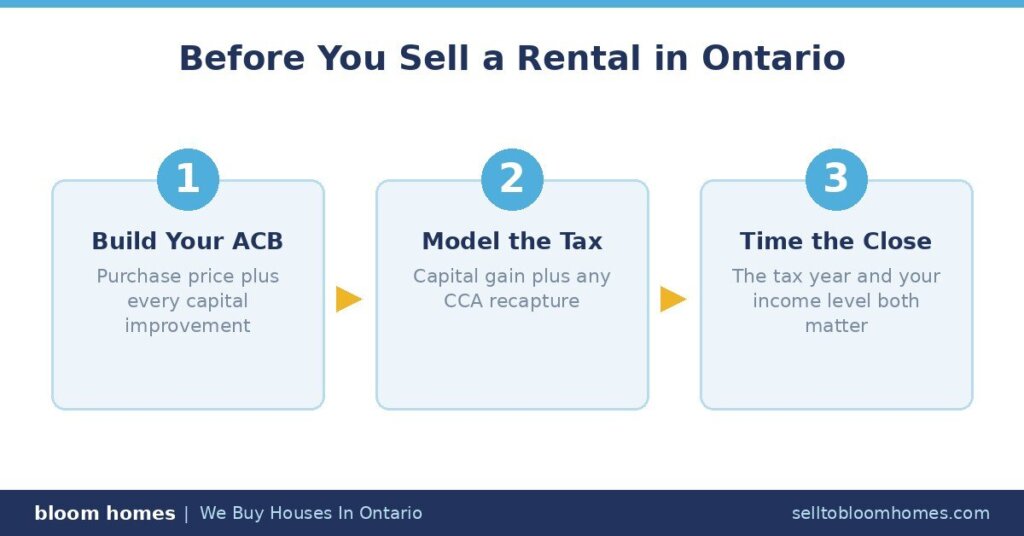
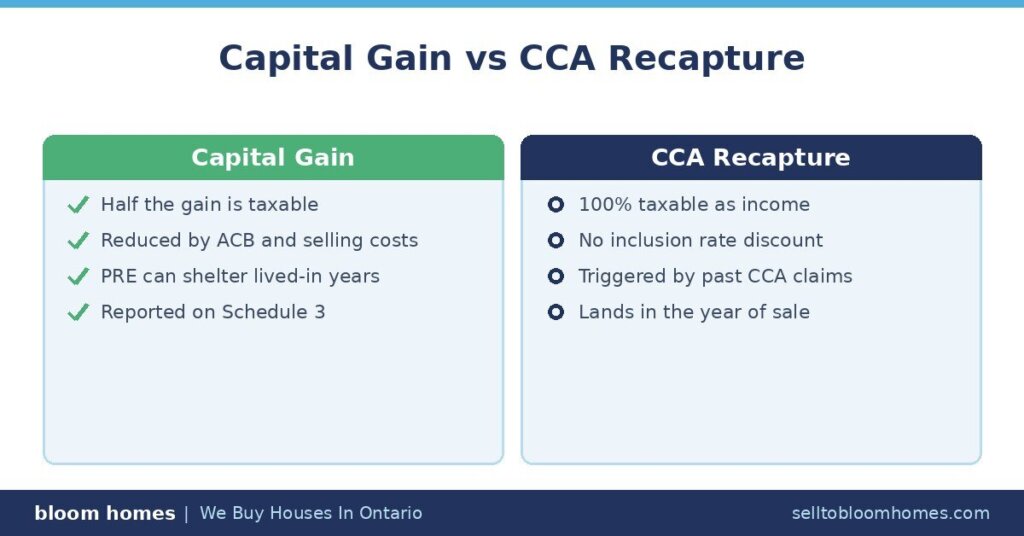
CCA recapture gets taxed at your full marginal rate, not at the capital gains rate. This distinction is what trips people up, and most articles on this topic skip straight to the inclusion rate without explaining the two-layer structure.
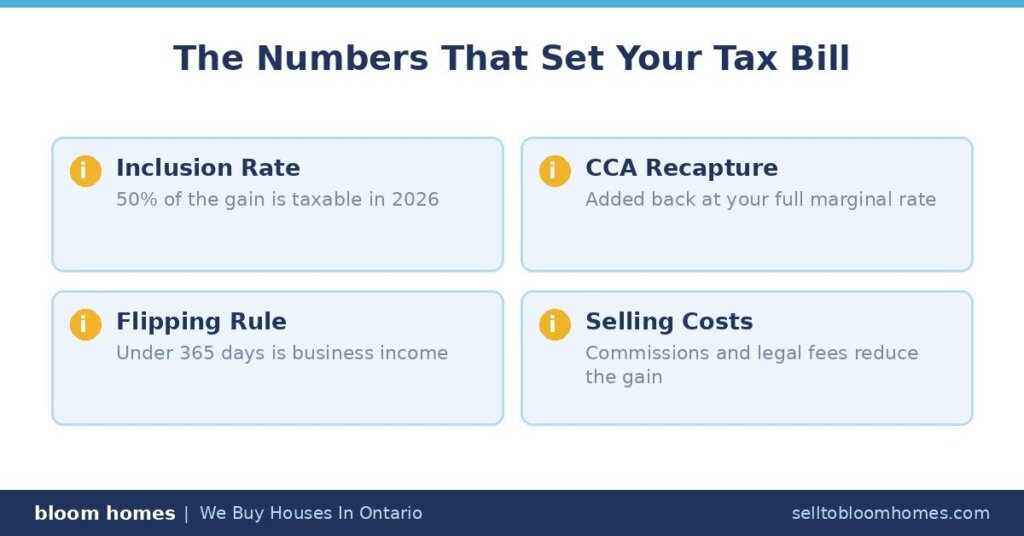
In Canada, the capital gains inclusion rate is currently 50%, meaning only half of the gain is subject to tax. The proposed increase to two-thirds introduced in 2024 was cancelled in March 2025, and for 2026 the inclusion rate for individuals remains unchanged.
The taxable portion of your gain gets added to your other income for the year and taxed at your marginal rate. In Ontario, combined federal and provincial marginal rates at the upper income brackets run exceptionally high. So only half the capital gain is included, but that included half gets taxed hard if your employment income already puts you near the top of the bracket.
If you claimed Capital Cost Allowance on the property during the rental years, the CRA requires you to add back a portion of those deductions as income in the year of sale. This recaptured CCA is taxed as regular income, fully included rather than at the reduced rate.
Since 2023, profit from the sale of residential property held for less than 365 days is treated as business income rather than a capital gain, and any loss from such a sale is deemed nil. This is Canada’s property flipping rule. Sell an Ontario investment property within a year of buying it, and you’re paying full income tax on the gain, not the reduced inclusion rate.
Deductions and Adjustments That Can Lower Your Capital Gains Tax in Ontario
Sellers who paid $650,000 for a rental property in 2017 and put $60,000 into a new roof, updated HVAC, and a finished basement before selling in 2026 have a much better tax position than they might think, provided they kept every receipt.
To calculate your adjusted cost base, you start with the purchase price and add eligible expenses such as closing costs, lawyer fees, and capital improvements. This reduces the taxable capital gain and is your most powerful tool and the most neglected one. Every receipt for every capital improvement should be in a file (I keep mine organized by tax year). Repairs and maintenance don’t count, but structural upgrades, additions, and permanent fixtures generally do.
Selling costs such as real estate commissions and legal fees also reduce the gain. Commissions on a $750,000 sale in Hamilton or Kitchener typically run five to six percent of the sale price, a meaningful deduction sitting right in your closing statement.
Placing profit into an RRSP is another way to offset the tax hit, provided you have available room. Contributing in the same tax year as the sale creates a deduction that can partially offset the increased income.
On the CCA side, many tax professionals advise against claiming it on rental properties precisely because of what happens at sale. In an appreciating market like the GTA, the long-term cost of recapture often outweighs the short-term tax savings, leaving you owing more at sale than you ever saved year to year. Have this conversation with a CPA before the property sells, not after.
How Timing Your Sale Affects the Tax You Owe in Ontario
Does closing in December versus January make any real difference to your tax bill?
Yes, by roughly sixteen months. Delaying a sale from December 31 to January 2 of the following year defers the tax payment by approximately sixteen months, since you wouldn’t owe until April of the year after the sale. On a large capital gain, that’s a meaningful amount of time for your money to keep working before it goes to the CRA.
You also need to consider the year of sale if your income fluctuates. A taxpayer who retires mid-year has lower employment income in that year than in the year before. Selling after retirement, or after a year when business income was low, can put you in a lower marginal tax bracket and translate into thousands of dollars in savings (sometimes more than a price negotiation wins you) without any change to the property’s sale price.
Selling during a slower market can also affect your net proceeds. If your ACB is relatively high compared to recent market values, you might owe less than you’d expect. Run the numbers first.
The team at Bloom Homes can give you a fair cash offer quickly, which makes it easier to plan your tax year deliberately rather than being at the mercy of how long a listing sits.
Gst/hst and Land Transfer Tax on Investment Property Sales in Ontario
Two costs that sellers consistently underestimate at closing are HST and land transfer tax, and they work very differently depending on your property type.
HST applies to new construction homes in Ontario but is not required on resale properties. Most Ontario landlords selling a standard resale rental home don’t need to collect or remit HST on the sale itself. Where it gets complicated is if the property was used for short-term rentals. Short-term rentals of less than 30 days may be subject to HST if gross rental income exceeds $30,000 annually. Landlords who ran an Airbnb operation out of a North York or Ottawa property may have HST obligations they haven’t fully accounted for (and that number adds up fast).
Land transfer tax is the buyer’s cost, not the seller’s. Across Ontario, LTT typically runs between one and three percent of the purchase price, and inside Toronto it effectively doubles because buyers pay both the provincial and the municipal land transfer tax. As a seller, you don’t pay this directly, but it affects your buyer’s carrying costs and therefore your negotiating position.
As of April 1, 2026, Toronto increased its municipal land transfer tax rates for high-value residential properties, with new luxury brackets on the portion above $3 million ranging from 4.4% to 8.6%. For investment properties in prime Toronto neighbourhoods like Rosedale, Forest Hill, or The Annex, this is worth discussing with your agent when setting your ask.
How to Get a Pre-sale Tax Projection Before You List in Ontario
Some sellers push back on this: they don’t want to pay an accountant before they’ve even listed. That’s understandable. But a pre-sale projection costs far less than the surprise tax bill it prevents.
A qualified CPA who works with Ontario real estate investors can model your specific situation before you list. They’ll calculate your ACB including all eligible capital improvements, assess whether any CCA you claimed creates a recapture exposure, run your gain through both the capital gains inclusion rate and the recapture calculation, and show you what you’d owe under two or three different sale price scenarios. For someone selling a rental condo in Scarborough or a duplex in Hamilton, that projection might shift your target price, your timing, or your decision about whether to sell at all.
You report the capital gain on Schedule 3 of your personal tax return, or on the T2 if the property was held in a corporation. A property held inside a corporation faces different inclusion rules and may have additional dividend tax considerations when proceeds flow out.
For landlords and investors in Mississauga, Toronto, and across the GTA, understanding these rules can mean the difference between paying 26% or 53% on your gains. That range reflects real planning decisions that get made, or missed, before closing day.
Working with Bloom Homes doesn’t replace that conversation with a CPA, but it simplifies everything around it. No open house prep, no repair lists, no weeks of uncertainty. You get an offer, you know your timeline (sometimes within days), and you can bring that clarity to your accountant.
Mistakes Ontario Landlords Make When Selling a Rental Property
The most common mistake is treating every dollar spent on a rental property as a repair deduction in the year it was spent, when a significant portion should have been added to the ACB as a capital improvement. New windows in a Whitby rental, a rebuilt deck near Port Credit, a rewired electrical panel in an older London home, those are capital items, not expenses. Deducting them as current repairs shrinks the ACB and grows the taxable gain at sale, which I’ve watched cost landlords far more than the short-term deduction was ever worth.
Missing the fair market value documentation at the time of a change of use is the second major error. Most sellers don’t get an appraisal at the moment they stop living in a property and start renting it (I’ve had to dig up old listings to piece together a number). Without that baseline, the gain calculation becomes a negotiation with the CRA rather than a clean computation.
Misclassifying a capital improvement as a current repair is a red flag for the CRA. An audit on a rental property sale often starts with exactly that line of questioning, and if you’ve been reporting major improvements as repairs for years, the reassessment can cover multiple past tax years.
The mortgage often gets reviewed last, if at all. A mortgage prepayment penalty on a five-year fixed-rate product can run into the tens of thousands of dollars on a property in the $700,000 to $900,000 range. That comes off the top of your proceeds just like any other selling cost, so confirm your payout amount with the lender before you commit to a closing date.
Post-sale Tax Filing Requirements for Investment Property Sellers in Ontario
Miss the filing deadline for a property sale and the CRA can reject your principal residence exemption, adding a tax bill to what should have been a clean exit.
CRA rules state that if you sell any property, you must report the sale on your income tax return. This applies even if you owe no tax, and even if the principal residence exemption covers the entire gain. Omitting it is not a gray area.
Your capital gain gets reported on Schedule 3 of your T1 personal return for the year of sale. If the property generated CCA recapture, that income also flows through on your T1 for the same year. Both items land in the same tax year and both get added to your income before the marginal rate is applied, so there’s no splitting them across filings to soften the hit.
A late-filing penalty for failing to report a sale can accumulate monthly, up to a significant maximum, and in cases of non-disclosure the CRA can deny the principal residence exemption outright. Budget for your tax payment before the return is due. A large capital gain from a property in Vaughan or Burlington can generate a substantial amount owing, and interest accrues on unpaid tax from the filing deadline forward.
One Thursday afternoon some time ago, a man called us. He lived in Sudbury and had been managing his mother’s Brampton townhouse remotely since she moved into a memory care facility. Two bedrooms, a finished basement, lawn equipment still in the garage. He needed to sell quickly and didn’t need to be researching tax forms at the same time. We made it simple: clear offer, flexible closing, and a straightforward path to the door. But before he accepted anything, we made sure he had a CPA’s number in hand, because in inherited property situations I’ve seen the tax piece create more stress than the sale itself. The filing piece matters as much as the deal itself.
Frequently Asked Questions
What Are the Tax Implications of Selling a Rental Property in Ontario?
Selling a rental property in Ontario triggers at least two separate tax events: a capital gain on the appreciation above your adjusted cost base, and potentially a CCA recapture if you claimed depreciation during the rental years. The capital gain is taxed at 50% inclusion, meaning half of the gain is added to your income for the year and taxed at your marginal rate. CCA recapture is fully taxable as regular income, with no inclusion rate discount. Both amounts land in the same tax year as the closing date, so timing the sale matters.
How Are Capital Gains From Selling a Rental Property Taxed in Canada?
The gain is calculated by subtracting your adjusted cost base (your original purchase price plus eligible capital improvements and buying costs) and your selling costs from your sale price. Half of that net gain is included in your taxable income for the year and taxed at your personal marginal rate. In Ontario, combined federal and provincial marginal rates at higher income levels can be well above 50%, so the effective tax on a large gain can be meaningful even at the 50% inclusion rate. Your CPA can run a projection before you list.
How to Avoid Capital Gains Tax on Property in Ontario?
You can’t eliminate it entirely on an investment property, but you can reduce it. Maximizing your adjusted cost base by including all eligible capital improvements lowers the gain. Applying the principal residence exemption for the years you actually lived in the property shelters that portion. Timing the sale to a tax year when your other income is lower reduces the marginal rate applied to the gain. Contributing to an RRSP in the year of sale can also offset some of the increased income. A qualified CPA who handles Ontario real estate is the right person to model all of these together.
How Do Taxes Work When Selling an Investment Property Held in a Corporation?
If your rental property sits inside a corporation, the capital gain is reported on the corporation’s T2 tax return rather than your personal T1. The corporation pays tax on the taxable portion of the gain at the corporate rate, but when the after-tax proceeds flow out to you as a shareholder, they may be subject to additional dividend tax. The combined tax outcome can be comparable to personal ownership, but the mechanics differ and the planning options are different too. Get advice from a CPA before closing if your property is held in a corporation.
If you want to talk through your options, we’re here. No pressure, no obligation. The team at Bloom Homes works with Ontario property owners at every stage, from landlords who’ve held a rental for twenty years to families managing an inherited home they never planned to keep. Reach out when you’re ready, and we’ll take it from there.