Losing someone is hard enough. Then the house becomes your problem.
Maybe you’re the executor. Maybe you’re one of three siblings who can’t agree on anything. Maybe the mortgage is still running, the property taxes are due, and nobody has touched the furniture since the funeral. Whatever your situation, selling a family home after a death in Ontario involves more moving parts than most families are warned about, and those gaps in knowledge can cost you time, money, or both.
Ontario’s overall MLS benchmark price sat at $749,800 in July 2026, down 3.9% from July 2025. That’s still a lot of equity for most families. Getting to it means working through probate, tax filings, potential heir disagreements, and a real estate market where estate sales routinely take longer than conventional ones because of legal prerequisites. Knowing what’s coming is half the battle.
Selling a Family Home After a Death: What You Need to Know
A couple of years ago, I worked with a family out of Oakville who had listed their late mother’s home twice with two different agents. Both listings expired without a firm offer. Dated and difficult to coordinate from out of town, the property kept generating agent recommendations for staging and repairs, and every showing felt like an intrusion on their grief. By the time they called me, they’d been carrying the utility bills, property taxes, and insurance on an empty house for nearly eight months, which in my experience adds up faster than any family expects when they’re also dealing with an estate.
That’s a pattern I keep seeing: families are often sold on the traditional listing route when their actual situation – vacant property, heirs spread across different cities, estate administration still grinding through the courts – calls for something faster and simpler. The market isn’t broken. This approach is just wrong for the circumstances.
Provincial home sales rose 5.5% year over year to 18,051 units in June 2026, so buyers are out there. Your estate sale may or may not be set up to attract them. If Bloom Homes can close before probate wraps up and take the property as-is, that’s worth knowing about from day one, not after two failed listings that eat up months you didn’t budget for.
What Happens to a House When Someone Dies in Ontario, Canada
When a person dies in Ontario, their estate, including any real property, is handled according to their will, or under the rules of intestacy if there is no will. Named in the will, an executor, or a court-appointed administrator, is responsible for managing the estate, which includes selling or transferring property as directed (a role that carries real legal weight).
Until the estate is properly administered, the home doesn’t legally transfer to anyone. It sits in limbo, still titled in the deceased’s name, still accumulating costs. Real property held solely in the deceased’s name generally cannot close without a probate certificate; no deed can transfer until the court weighs in.
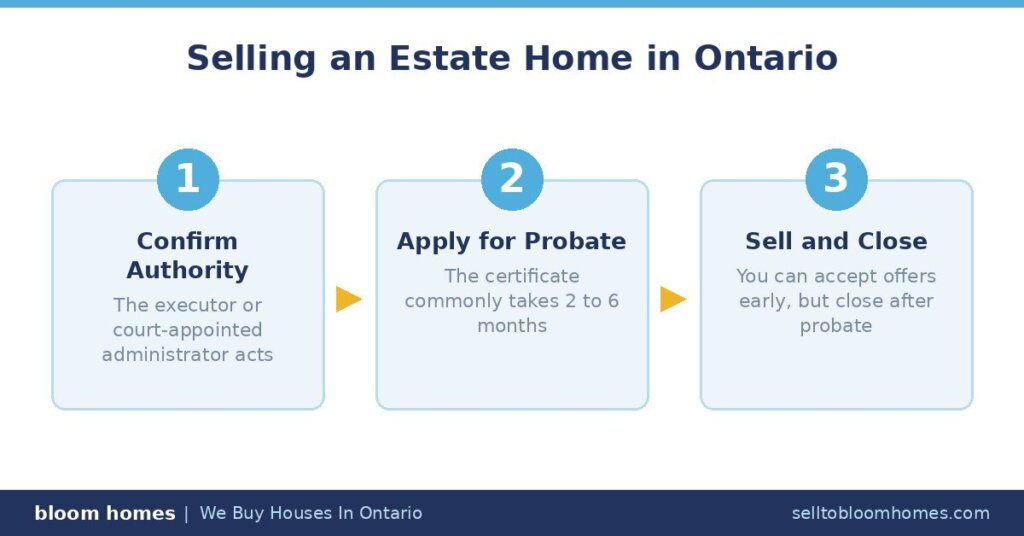
Selling can begin while applying for probate, but probate must be granted to finalize the sale. You can list, market, and even accept an offer; you just can’t close until the certificate is in hand. Most buyers will wait if you’re transparent about the timeline. Cash buyers, in particular, are used to it.
What Are the First Legal and Probate Steps Before You Can Sell
Before selling an inherited property in Ontario, the executor typically needs to obtain a Certificate of Appointment of Estate Trustee, Ontario’s equivalent of probate. This certificate formally authorizes the executor to act on behalf of the estate and is required by most buyers, lenders, and real estate lawyers for a sale to proceed (and title insurers, in my experience).
Probate is handled through the Ontario Superior Court of Justice. Real-world wait time from filing to certificate commonly runs 2 to 6 months, and full estate settlement often takes 8 to 12 months, months of carrying costs on an empty home. Obtaining a CRA Clearance Certificate, which confirms all taxes are paid and protects the executor from personal liability, can take several additional months. Your Ontario estates lawyer can confirm exactly what sequence applies to your situation. Don’t assume a will by itself gives you the authority to act (it doesn’t always).
What If the Inherited Property Still Has a Mortgage in Ontario
A mortgage doesn’t die with the borrower.
The mortgage remains a legally registered charge against the property and must be dealt with through the estate administration process. During probate, the estate is responsible for keeping payments current, which means someone needs to be actively monitoring the account every single month. Miss payments and you risk the lender moving toward Power of Sale proceedings, adding legal complexity and cost to an already full plate.
Estate trustees must notify the lender as soon as possible, usually by providing a death certificate. Some Canadian lenders allow beneficiaries to assume an existing mortgage, subject to income and credit qualification. When assumption isn’t possible, beneficiaries may refinance in their own name or sell the property, so it’s worth getting the lender’s written position early before decisions get made for you.
Lenders make reverse mortgages fully due upon death, and estates are typically given 6 months or so to repay the balance, including accumulated interest. If the family home carries a reverse mortgage, selling is almost always the cleanest path forward because that repayment clock starts the moment the borrower dies. A team like Bloom Homes can move quickly enough that you’re not watching interest accrue while the estate grinds through court.
What Are Your Options If Multiple Heirs Inherit the Same Property
One sibling wanted to sell immediately and split the money. One of them wanted to move in. The third had gone completely silent. By the time they sorted it out, they’d lost a serious buyer and spent six weeks in family tension that could have been avoided with one conversation upfront.
Inherited homes often have several beneficiaries with different priorities. Those conversations are easier when the estate trustee establishes who makes the final decisions and how updates will be shared. If trustees are acting jointly, they should agree in writing on the listing price range, offer process, and signing authority, because a handshake understanding tends to fall apart the moment a real offer lands on the table.
An executor has a legal duty to act in the best interest of all beneficiaries, not just the loudest one. Courts can compel a sale when parties are deadlocked, but that process is slow and costly. Selling to a direct buyer can sidestep a lot of that friction, since you’re negotiating one offer rather than herding disagreements through an MLS transaction.
How Do Capital Gains Tax and Inheritance Tax Work in Ontario, Canada
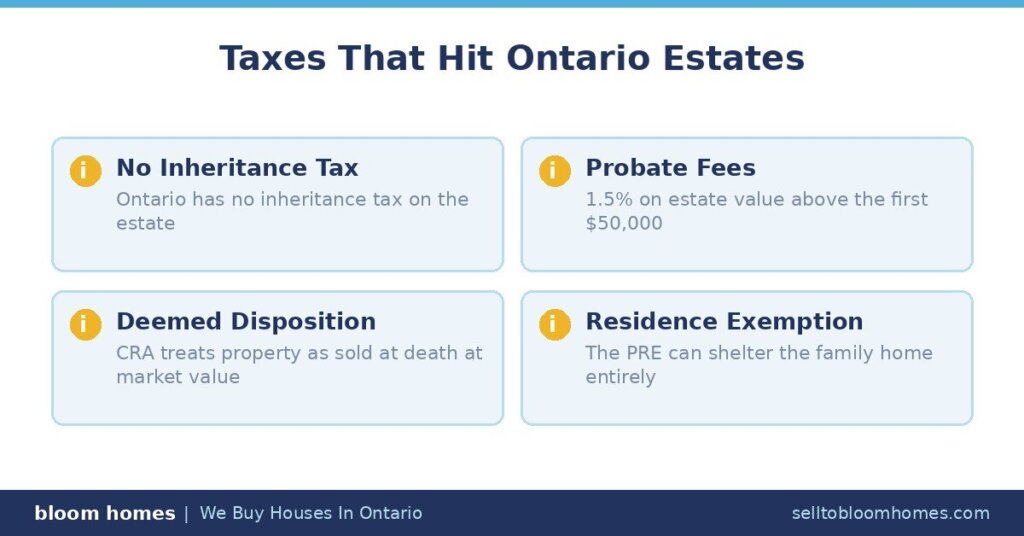
What taxes will my estate actually owe when I die? Ontario does not have an inheritance tax, but three other taxes hit estates at death: probate fees, capital gains tax via deemed disposition, and full income inclusion on RRSP/RRIF balances.
The deemed disposition rule is the one families most often fail to anticipate. When someone passes away in Canada, the CRA treats all capital property as if it were sold immediately before death at fair market value. If the home was the primary residence for the full period of ownership (not just the final years), the principal residence exemption shelters those gains entirely in most cases, eliminating potentially hundreds of thousands in taxes on a family home. This is an important consideration when selling a house in probate.
For properties that don’t qualify, Canada’s capital gains inclusion rate is a flat 50% for all individuals and corporations in 2026, after the proposed increase to 66.67% above $250,000 was cancelled by the federal government in March 2025.
On probate costs: in Ontario, estates valued over $50,000 pay 1.5% on the amount exceeding $50,000. For a $1 million estate, this equals $14,250 in probate fees alone, leaving that number to come off the top before you feel good about your net. Factor that into your net proceeds before settling on a list price or a cash offer.
Should You Sell the Inherited Home As-is or Make Repairs First
Does fixing up the property actually put more money in your pocket? The math on repairs rarely works for estate sales. Contractors take weeks to schedule. Families are coordinating everything remotely. The property sits vacant longer, meaning more carrying costs, more insurance risk, and more months of emotional energy tied up in a building. Spending $20,000 to chase a $25,000 price bump sounds logical until you factor in the time, the stress of managing tradespeople, and the reality that buyers in markets like Hamilton, Barrie, and Mississauga are comfortable making renovation decisions themselves.
Many estate homes sell as-is, yet preparation still matters. A professional appraisal, clean photos, and transparent disclosure about the home’s condition can go a long way without a single contractor.
Selling as-is to a direct buyer removes all the guessing. Bloom Homes buys properties in any condition (I’ve seen some rough ones qualify), which means the family doesn’t need to agree on repairs, find a contractor, or wait out a reno timeline while the estate clock runs.
Is a Cash Sale or Traditional Sale Better After a Death in the Family
A family in Brampton inherited their father’s bungalow and listed it on a Friday. By Tuesday, they had a conditional offer that fell apart three weeks later when the buyer’s financing was declined. They’d already told the other beneficiaries to expect the money. Starting over was demoralizing.
Financing conditions are the most common reason estate sales collapse after an accepted offer. For families who’ve already been carrying the property for months, that uncertainty is its own kind of burden.
A cash sale comes with no financing conditions. Cash buyers close in two to four weeks rather than the 60 to 90 days a conventional mortgage transaction can take. The tradeoff is that cash offers are usually below full market value. Whether that gap is worth it depends on how long the estate has been carrying the property and how aligned the heirs are.

I’ve watched families chase an extra $30,000 on the open market and spend $18,000 in carrying costs, legal fees, and failed-deal frustration before settling for less than the first cash offer. The traditional route isn’t wrong. It’s just not always right.
Frequently Asked Questions
What Are the Taxes on Selling My Parents’ House After Their Death in Ontario, Canada?
Canada doesn’t have a formal inheritance tax, but that doesn’t mean the estate owes nothing. The CRA treats all capital property as if it were sold at fair market value the moment before death under the deemed disposition rule. If the home was your parents’ principal residence for every year they owned it, the principal residence exemption will likely eliminate capital gains tax. For secondary properties like a cottage or rental, the estate pays capital gains tax on 50% of the appreciation, taxed at the deceased’s marginal rate. Ontario’s Estate Administration Tax also applies at 1.5% on estate value above $50,000 when probate is required. Talk to an estate accountant before filing the terminal return.
How Do I Sell My Deceased Mother’s House in Ontario?
The executor named in the will, or a court-appointed administrator if there is no will, has the authority to handle the sale. Your first step is applying for a Certificate of Appointment of Estate Trustee through the Ontario Superior Court of Justice. Once issued, you can finalize a sale. You can list and accept offers while probate is pending, but the deal can’t close until the certificate is in hand. After the sale, proceeds settle any outstanding mortgage, taxes, and estate debts before being distributed to beneficiaries. If speed matters, a direct cash buyer like Bloom Homes can often work around the probate timeline and close as soon as it clears.
Is It Better to Sell My Parents’ House Before or After Their Death?
Selling before death, when a parent is still the legal owner and can sign documents, avoids probate entirely and can simplify the transaction considerably. That said, a sale before death can trigger capital gains tax on any property that isn’t the principal residence, payable immediately rather than deferred through the estate. There’s no universal right answer; it depends on the parent’s health, the family’s financial situation, and whether the home qualifies for the principal residence exemption. An estate lawyer and a tax accountant should both be in the room for that conversation.
Can a House Stay in a Deceased Person’s Name in Ontario?
There’s no fixed deadline forcing an estate to sell or transfer property, but keeping a home in a deceased person’s name indefinitely creates real practical problems. The property cannot be sold, refinanced, or transferred without going through the estate process and obtaining the Certificate of Appointment of Estate Trustee. Ongoing costs like property taxes, insurance, and mortgage payments remain the estate’s responsibility the whole time. Most title insurers and real estate lawyers won’t touch a transaction without a properly probated will, so an extended delay effectively locks the property. Your county land registry office can answer title-specific questions for your situation.
Selling a family home after a loss is one of the hardest things a family can be asked to do under a deadline. If you want to talk through your options, we’re here. No pressure, no obligation. Reach out to Bloom Homes whenever you’re ready, whether that’s today or three months from now.