Most people figure they’ll pocket an extra $40,000 or $50,000 by skipping the agent. The math looks clean on a napkin. Subtract the commission, keep the difference. What actually hits you on the other side, though, is a stack of disclosures, a purchase agreement with 30-plus clauses, a buyer who wants to renegotiate after the inspection, and the creeping realization that none of this is passive. Selling your home privately in Ontario is completely legal, and for the right homeowner in the right situation, it genuinely works. But it’s not simple, and anyone who tells you otherwise has never had a deal fall apart the week before closing.
How to Sell Your House Without a Realtor in Ontario Canada
Ontario’s housing market is moving right now: June 2026 data shows sales rose to 18,051 transactions, up 4.7% month-over-month, while the average home price in the province came in at $831,595, down 2.4% compared to June 2025. Price softening matters a lot if you’re planning a private sale, because your margin for pricing error is thinner than it was two years ago.
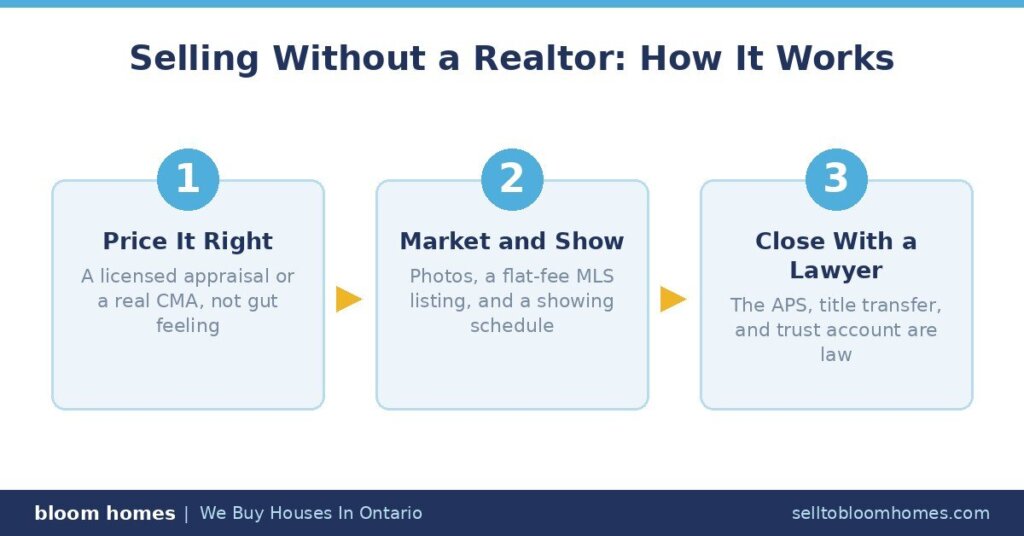
Selling without a realtor is entirely legal in Ontario. You don’t need a license to sell your own home. What you do need is a clear head, realistic expectations, and a real estate lawyer. Selling on your own looks like this: set your price, market the property, host showings, collect and negotiate offers, accept one, and then close the deal through a licensed real estate lawyer who handles the legal paperwork, title transfer, and trust account funds (that last part isn’t optional).
A while back, I worked with a couple in Stoney Creek who were splitting assets after a divorce. They didn’t want an agent, didn’t want showings stretched across two months, and definitely didn’t want to sit across from each other at an open house on a Sunday afternoon. Attached to the bungalow was a detached garage packed with tools neither of them planned to keep (clearing it out took one long Saturday). We closed the deal on a Wednesday, they each walked away clean, and nobody needed to negotiate over a lockbox schedule. The situation was a good fit for a private sale precisely because they had a willing buyer before they ever listed.
Ontario is the only province that CREA currently expects to see sales rise in 2026, which tells you buyer activity is still real. Reaching those buyers without MLS may not be possible.
What Is Your Home Worth in Ontario’s Current Market?
Pricing is where most FSBO sellers quietly blow the deal. Set too high, and your listing goes stale. Buyers and their agents notice a property that’s sat for six weeks, and they use it against you at the offer table. Set too low, and you’ve donated money to someone who would have paid more.
Toronto MLS data as of August 2026 shows the median days on market for a home sitting at 33 days, so the window between listing and offer is tighter than many sellers assume. You won’t have months to slowly inch your price down, which means your opening list price needs to be close to right from day one.
Without MLS access, getting an accurate value means going one of a few routes. A licensed appraiser will give you a defensible, written number, usually for a few hundred dollars. A comparative market analysis, or CMA, is something many agents will provide for free, though they’re hoping to earn your listing in return. Online automated valuation tools like Zolo or Realtor.ca can give you a ballpark, but they lag market shifts and don’t account for your specific block in Kitchener or the ravine lot backing your property in Barrie (backing lots price very differently).
FSBO sellers without MLS data often price based on emotion or outdated comparables. An overpriced property sits, and a stale listing is harder to sell than a correctly priced one.
My honest take: if you’re not willing to do a real CMA or pay for an appraisal, you’re probably not ready to sell privately. Pricing by gut feeling costs far more than a $300 appraisal.
What Does It Cost to Sell Fsbo Vs. with an Agent in Ontario?
A seller in Oakville decided to go FSBO to skip the listing agent’s commission. Six weeks in, she had one low offer from a buyer with no agent and a financing condition she didn’t fully understand. She countered, he walked. She eventually hired an agent anyway.
Sellers see that story play out more often than they realize, and it points to the real cost picture. Plan for your total selling costs to be between 1.5% and 6% of your home’s final sale price, with real estate commissions being the largest variable. Going FSBO eliminates the listing agent’s portion, but several costs remain regardless.
Real estate lawyers charge legal fees that often range anywhere between $500 and $2,000 or more, depending on the complexity of the sale. The fee is not optional; all closing funds in Ontario flow through a lawyer’s trust account by law. Beyond legal fees, you’ll likely pay for professional photos (budget a few hundred dollars), a home inspection if buyers request one, and possibly a flat-fee MLS listing package.
Flat-fee listing platforms give you MLS exposure for as little as $250 to $350 plus HST for a six-month listing, with upgraded packages available at higher price points.
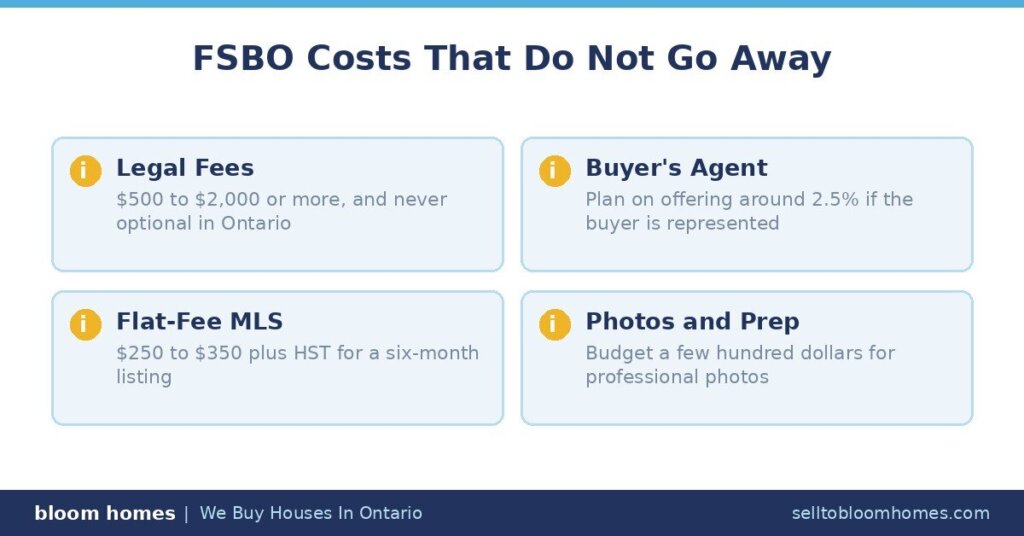
Here’s what rarely gets mentioned: even without a listing agent, you’ll likely still need to offer around 2.5% commission to the buyer’s agent. So you’re really comparing a full 5% commission against a fraction of that plus your out-of-pocket costs for photography, a flat-fee MLS listing, and legal work. The savings are real, just not as dramatic as the napkin math suggests.
Ontario Fsbo Disclosure Rules and Legal Requirements
What exactly do you have to tell buyers, and what happens if you miss something?
Ontario law requires sellers to disclose known material defects. Failing to do so creates legal liability that extends past the closing date. That’s not a technicality. A buyer who discovers a foundation problem you knew about can come after you long after you’ve moved on.
Under TRESA, sellers and their agents must now disclose everything they know about a property. As a self-represented party (the formal term under Ontario’s Trust in Real Estate Services Act), you aren’t a registered agent, so TRESA’s rules aimed at brokerages don’t apply to you directly. But Ontario’s common law and property statutes still bind you fully. You cannot hide known defects, misrepresent material facts, or stay conveniently silent about something you know would affect a buyer’s decision.
You need a proper written Agreement of Purchase and Sale, you must meet your disclosure obligations, your title must be clear, and funds must flow through a lawyer’s trust account on closing. The standard purchase agreement in Ontario is OREA Form 100. It’s an eight-page document covering financing conditions, property tax adjustments, which fixtures stay, inspection rights, and liability allocation. Read it carefully before you sign anything.
The Real Estate Council of Ontario (RECO) offers helpful guidance on what private sellers must legally disclose and how to protect themselves from liability. Their website at reco.on.ca is worth an hour of your time before you list.
A real estate lawyer is non-negotiable here, not a nice-to-have.
The Real Challenges of Selling Your Home on Your Own in Ontario
Sit down with me at the kitchen table for a minute, because this is the part nobody lays out plainly.
The two hardest parts of a private sale are not the paperwork and not the marketing. They’re the negotiation and the time. Buyers know you don’t have an agent in your corner, and the smarter ones will use that. They’ll come in low, attach conditions you don’t fully understand, and wait to see if you blink. If you’ve never negotiated a real property transaction before, that moment can get uncomfortable fast.
Without access to the MLS, restricted to registered real estate professionals and their clients, your marketing reach is limited to FSBO-specific platforms, social media, Kijiji, and word-of-mouth, leaving you with a fraction of the exposure a listed property gets. Fewer eyeballs means fewer competing offers and less upward pressure on price.
Sellers consistently underestimate the time commitment. Responding to inquiries, scheduling and hosting showings, fielding lowball offers, following up with lenders when a buyer’s financing wobbles, coordinating with your lawyer on closing conditions: it adds up fast. Weeks, not afternoons.
I’ve noticed over many transactions that sellers who go in with a real marketing campaign, professional photos, a flat-fee MLS listing, and a clear showing schedule tend to do better than those who throw up a yard sign and wait. The difference between a thoughtful private sale and a hasty one shows up directly in the final price, which in my experience can mean tens of thousands of dollars on a mid-range property.
Many FSBO sellers use flat-fee MLS services, professional photography, and real estate lawyers while maintaining control of the transaction. The hybrid approach is often the sweet spot.
Is It Safe to Sell Your House Privately in Ontario? a Risk Checklist
An heir I worked with in Mississauga had just moved her parent into assisted living and was left managing a 1970s split-level with a carport full of old garden equipment from three decades of weekends. She needed to move the property without the added stress of constant agent calls, and she wasn’t in a rush, but she also didn’t want to navigate disclosure documents alone.
You carry real risks in private sales that deserve honest inventory. Use this checklist before you decide:
Disclosure liability. If you fail to disclose a latent defect, such as a foundation crack, you face litigation risks, and there’s no errors and omissions insurance protecting you the way it would a licensed agent.
Financing conditions. Buyers write in financing conditions. If you don’t understand what “condition on financing for five banking days” means operationally, and the deal collapses on day four, you need to know exactly what your recourse is. Your lawyer explains this, so get that conversation out of the way before any offer lands on the table.
Old liens, undischarged mortgages, easements, or survey discrepancies can surface at closing. A title search, which your lawyer will order, is what catches these. Budget for title insurance too, since most lenders require it.
Buyer verification. Any private seller should ask a buyer for proof of pre-approval from a lender early in the conversation. Walking an unqualified buyer through your home three times before finding out their financing was never real is a waste everyone can avoid, so I always ask for that document before the first showing.
If you’re unsure about any item on that list, Bloom Homes is a trusted local buyer that can offer you a direct cash purchase and handle the complexity for you, no listing, no showings, no crossed fingers waiting on a buyer’s bank.
Cash Offer Alternative to Fsbo in Ontario: What You Need to Know
Getting the legal side wrong on a private sale can cost you more than the commission you tried to save.
For some homeowners, the FSBO route just doesn’t fit. The property needs work. The timeline is tight. Facing a separation, a health issue, or an estate situation where one more moving part feels like too much, the seller finds the idea of managing showings and negotiations on top of that genuinely overwhelming. In those cases, selling directly to a cash buyer is worth a serious look.
Ontario home prices are expected to stabilize rather than fall sharply in 2026, and several Ontario regions are shifting toward buyer-friendly conditions as listings rise and demand stays constrained by income qualification limits. That environment creates real pressure on sellers who need to move quickly, because buyers have more negotiating room than they’ve had in a few years.
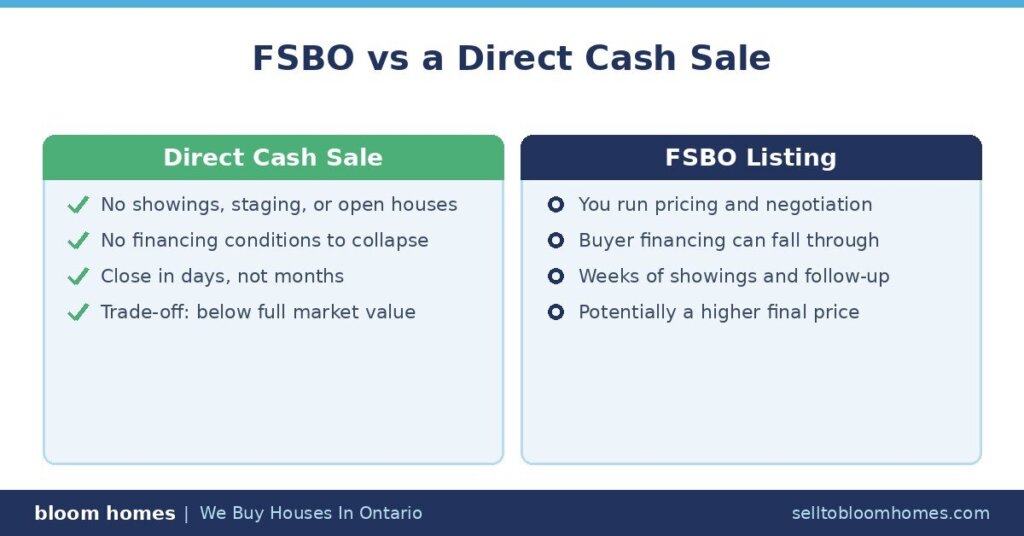
A cash offer from a local buyer removes all financing condition risk. No deal falling apart at day four because a lender changed their mind. No cleaning, staging, or parade of Sunday open houses. Cash offers typically come in below full market value as the trade-off, since the buyer is absorbing risk, speed, and convenience costs. That trade-off is worth it for some situations and not for others, and in my experience the sellers who benefit most are the ones under genuine time pressure.
The Canadian Real Estate Association’s July 2026 forecast points to 463,336 sales nationally for 2026, showing there are still active buyers across Ontario. But reaching them privately takes real work, and if your situation calls for simplicity over maximum price, a direct sale is a legitimate path.
Bloom Homes works with Ontario homeowners across Mississauga, Hamilton, Barrie, Kingston, and surrounding areas, buying properties directly, in any condition, without requiring you to list or wait. If you want to know what a cash offer looks like for your specific property before deciding whether to go the FSBO route, that comparison is free to make (and takes maybe a phone call).
Frequently Asked Questions
Can I Sell My House in Ontario Without an Agent?
Selling your home privately, without a real estate agent, is entirely legal in Ontario, and many homeowners do it successfully each year. You handle pricing, marketing, showings, and negotiations yourself, and you work with a real estate lawyer to complete the closing documents and transfer funds. The process takes more effort than most sellers anticipate, so go in with realistic expectations.
What Are the Risks of Selling Your Home Without a Realtor?
The biggest risks are pricing inaccurately, missing disclosure obligations, and misunderstanding offer conditions. One of the primary risks of a for-sale-by-owner transaction in Ontario is the lack of professional liability insurance that a registered brokerage provides. You’re also responsible for your own negotiation, which puts you at a disadvantage if a buyer’s agent is on the other side of the table. A real estate lawyer won’t eliminate every risk, but they’ll catch most of the legal ones before they become problems.
How Do I Sell My House Privately in Ontario?
Many Ontario sellers combine the FSBO approach with a flat-fee MLS listing service that places their property on MLS and REALTOR.ca for broader buyer exposure. Beyond that, you’ll need professional photos, a clear asking price backed by real comparables, a written Agreement of Purchase and Sale, and a licensed real estate lawyer to handle the closing. The RECO Information Guide is a good starting point for understanding your legal obligations as a self-represented seller.
What Are the Typical Fees Involved in Selling a House in Ontario?
Even without a listing agent, you’re looking at legal fees ranging from $500 to $2,000 or more, plus the cost of a flat-fee MLS listing if you want that exposure, professional photography, and potentially a buyer’s agent commission of around 2.5% if the buyer is represented. Total selling costs generally land between 1.5% and 6% of your sale price, depending on the services you use. A good real estate lawyer can walk you through what applies specifically to your transaction before you commit to anything.
Selling privately in Ontario isn’t the right move for every homeowner, but it’s absolutely the right move for some. If you’ve got the time, the patience, the pricing knowledge, and a good lawyer lined up, you can do this. If your situation is more complicated, or if you’d rather skip the process entirely and just get a fair offer and a clean close, reach out to Bloom Homes. No pressure, no obligation, just a straight conversation about what your options actually look like.