
Your mom got the diagnosis on a Tuesday. By Thursday, the social worker was already talking about placement timelines, waitlists for memory care beds in Mississauga, and monthly costs that made your stomach drop. Somewhere in that blur, someone mentioned the house, and now you’re trying to figure out what to actually do with it (while still processing everything else).
This is a situation I’ve sat across the table from dozens of times. Families in Barrie, Burlington, Scarborough, Whitby, and all across Ontario are selling a parent’s home to bridge the gap between a pension cheque and a long-term care bill. Nobody walks you through how it all fits together. So let’s get into the details.
How to Know When It’s Time to Sell a Parent’s Home
Is the house actually paying for anything right now, or just sitting there costing you money?
This is the question worth asking first. A vacant property in Ontario doesn’t just wait politely. Property taxes keep coming. Insurance premiums don’t stop. A remaining mortgage keeps demanding payments regardless of whether anyone’s sleeping there. Utilities, maintenance, lawn care in summer, snow removal in winter. A home that feels like an asset on paper can quietly bleed cash for months before a family realizes it’s working against them.
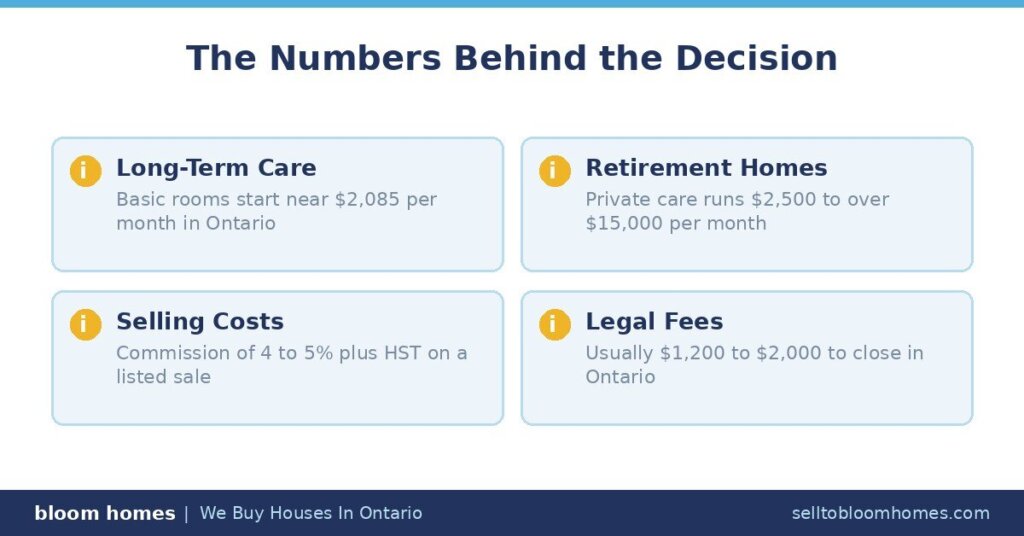
Each family’s sale decision is triggered by a different moment. Sometimes it’s the care plan itself, when the doctor says your parent needs 24-hour supervision and returning home isn’t medically realistic. Sometimes it’s math, when you add up private retirement home costs ranging from roughly $2,500 to over $15,000 per month and realize the pension won’t cover it without selling an asset.
Long-term care homes have accommodation charges starting at approximately $2,085.37 per month for a basic room as of July 1, 2025, with the provincial government covering clinical care. That base rate is manageable for many families, even though it can creep higher fast once you factor in preferred room upgrades. But preferred rooms cost more, and if your parent’s care needs shift, so does the bill.
Waiting longer means the empty house costs more. Selling isn’t giving up. It’s redirecting equity toward the person who built it.
What Is a Parent’s Home Worth in Ontario Right Now?
Ontario’s housing market has been softening, and sellers who go in assuming peak-year prices are setting themselves up for disappointment.
According to the Ontario Real Estate Association, provincial home sales rose 5.5% year over year in June 2026, but the MLS Home Price Index composite benchmark fell 4.6% to $753,300, with apartments posting the steepest decline at 8.0%. Single-family detached homes in established neighbourhoods have held up better than condos, but the market is still softer than it was two or three years ago (a gap I’ve watched widen since 2024).
In Toronto specifically, the current average house price sits around $987,025, with the median days on market at 33 days as of mid-August 2026. That’s a useful benchmark, but it doesn’t tell the whole story for sellers outside the 416. A detached bungalow in Kitchener, a semi in Kingston, or a two-storey in Oshawa will each price differently based on their local micro-market (sometimes by a surprising margin).
Three siblings brought me a property in Oakville early last year. Their father’s house had been sitting empty for about four months after he moved into a memory care facility. They’d tried two different real estate agents, two listings that expired with zero firm offers, while carrying a mortgage and full insurance premiums on a vacant home. We came in, assessed the property as-is including all the furniture and a garage full of tools (that garage alone took an hour to walk through), and closed the deal in a few weeks. The outcome wasn’t the peak-market number they’d hoped for two years earlier, but it stopped the bleeding immediately.
Fair market value is what a ready, willing, and able buyer will pay today, not what Zillow estimates or what your neighbour got in 2022.
Which Home Features Add the Most Resale Value in Ontario
A 1960s bungalow in Hamilton’s Westdale neighbourhood went through our process recently: dated kitchen, original windows, functional but tired. An updated version of the same house down the street had sold for noticeably more a month earlier, and the family wanted to know if renovating was worth it (a fair question given the gap in price).
Buyers in Ontario’s current market are practical. Updated kitchens and bathrooms still move the needle most on resale. An eat-in kitchen with modern countertops, decent lighting, and updated appliances tells a buyer they won’t have to touch it for years. Bathrooms with a walk-in shower carry genuine appeal, especially for aging-in-place buyers who represent a real segment of your buyer pool.
The other features worth knowing about: a furnace that’s less than ten years old, updated electrical panels, and windows that don’t draft. Buyers in Waterloo or London order home inspections and they read them. A flagged furnace becomes a price reduction. An original 1970s electrical panel becomes an issue for mortgage lenders. These mechanical details affect the pool of buyers you can attract.
Most sellers underestimate how much stairs matter. A home with three floors and no main-floor bedroom sells to a narrower pool than a bungalow where everything is on one level. A parent’s home with limited accessibility will often attract buyers who are investors or families willing to renovate.
None of this means you must renovate before selling. It means you need to price accurately for what the property is today.
How to Stage and Prep a Parent’s Home Before Listing It
The sale of a family home typically can’t begin until someone deals with the contents, and most articles on this topic treat that part like a footnote.
Clearing out a parent’s home is logistical work, but it’s also a grief process, and the two happen at the same time. Dishes, photo albums, antiques, furniture from marriages that outlasted careers. This takes longer than families expect, and listings don’t wait while you work through it emotionally.
Once the home is clear, staging doesn’t need to be expensive, but it does need to be intentional. Buyers in Markham, Brampton, and Ottawa all respond to a home that reads as clean, bright, and move-in ready. Fresh paint in neutral tones costs very little relative to the price impression it makes. Decluttering the garage, power-washing the driveway, and replacing burned-out light bulbs are low-cost, high-return moves that I’ve seen shift offers from hesitant to competitive.
Donation centres, estate sale companies, and junk removal crews are your actual first calls before the real estate agent. An estate sale can turn years of accumulated belongings into cash, which means the house is already partway cleared before you’ve spent a dollar on hauling. What can’t be sold or donated goes to a hauler, and a full cleanout of a three-bedroom home typically runs a few thousand dollars depending on region and volume.
All of that coordination alongside managing your parent’s care transition can feel like too much, making selling the home as-is to a direct buyer a real option that skips the entire staging process.
What Steps Do You Take to Sell a Parent’s Home in Ontario?
The first step before anything else is confirming who has the legal authority to sell. A mentally capable parent signs the listing agreement and transfer documents themselves. If they’re not capable, whoever holds a valid Power of Attorney for Property acts on their behalf. Without a valid POA, a family may need to pursue guardianship through the courts, which takes time and money you might not have, and care bills keep running throughout that process.
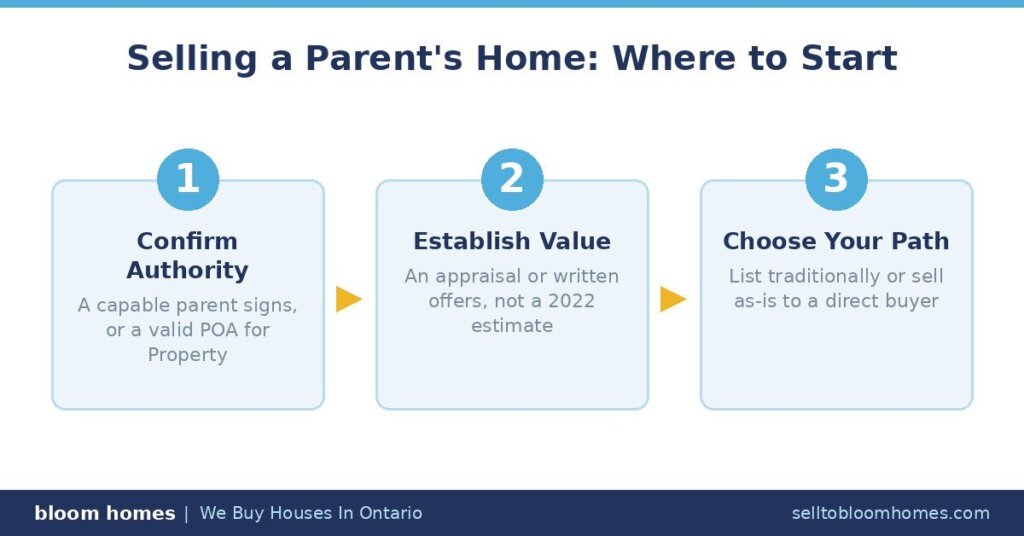
Once authority is confirmed, the process looks like this: get a clear picture of what the home is worth today, decide on your sale method (traditional listing with a real estate agent or direct sale to a buyer like Bloom Homes), deal with the contents, and close. A real estate attorney handles the title transfer. If there’s a mortgage remaining, the lender discharge and any prepayment penalties get settled from proceeds at closing.
Real estate commission runs 4% to 5% of the sale price plus 13% HST, and legal fees for selling in Ontario usually range from $1,200 to $2,000. Those numbers add up fast on a province with home prices in the high six figures.
A direct sale to a local buyer skips the commission, the open houses, and the conditional period waiting game, which matters when care bills are counting down.
Checklist for Selling a House to Pay for Senior Care in Ontario
Some families worry that selling the home will automatically disqualify their parent from government assistance programs. The proceeds from the home sale become assets, and assets affect means-tested programs, including Ontario’s Long-Term Care Rate Reduction Program. A resident with no dependants may qualify for some level of assistance if their annual income is approximately $26,812 or less, based on 2025 accommodation rates. Talk to your parent’s care home administrator and a financial advisor before assuming the sale resolves your financial situation.
Here’s what to work through before listing:
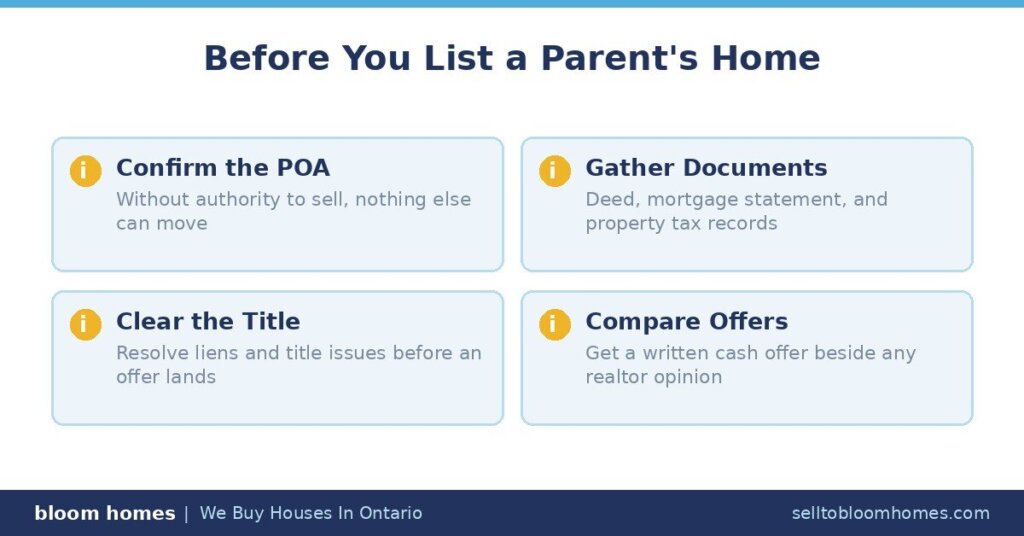
Confirm POA or legal authority to sell. Gather the mortgage statement, tax records, and the deed if you can find it. Don’t worry if it’s missing, since you don’t need a paper property deed to sell your house in Ontario. Order an updated property assessment or ask two or three buyers for offers to establish current market value. Resolve any outstanding liens or title issues with your real estate attorney (title surprises slow everything down). Decide whether to clear and prep the home for a traditional listing or sell as-is.
Get a written, no-obligation offer from a direct buyer like Bloom Homes alongside any realtor opinion. Comparing both options costs you nothing, gives you real data to work with, and lets you make a decision based on actual numbers rather than assumptions. Know whether a mortgage discharge penalty applies and factor it into your net proceeds calculation. Confirm with the long-term care home how and when the sale proceeds need to be reported.
Privacy matters here too. A traditional listing puts the home on public MLS. A direct sale keeps the transaction private, which some families prefer given the personal nature of the circumstances.
Selling a Parent’s Home in Ontario to Pay for Senior Care
Miss the principal residence exemption filing and you hand the Canada Revenue Agency a tax bill that could have been avoided entirely.
If the property was your parent’s principal residence for every year they owned it, the PRE exempts the entire capital gain. But the exemption isn’t automatic. You must file both Schedule 3 (Capital Gains or Losses) and Form T2091IND (Designation of a Property as a Principal Residence) to claim it; failing to file these forms means you cannot apply the exemption and will owe tax on the capital gain.
This is where a Canadian tax professional earns their fee. If the property was ever rented out, or if your parent owned a cottage at the same time, the exemption math gets complicated fast. Only one property can be designated as a principal residence per family unit per year.
Any gain that is not exempt is taxed at the 50% inclusion rate in 2026, meaning only half the capital gain gets added to income and taxed at your parent’s marginal rate. The CRA requires the sale to be reported even when no tax is owed, so filing is not optional just because the numbers work out in your favour. Skipping that step because you think no tax is owing is the mistake that turns into a penalty later.
What Families in Ontario Are Saying About This Process
A landlord in Guelph reached out after getting a contractor estimate to renovate the kitchen of his late mother’s bungalow before listing it. The estimate came in Thursday morning, and it was more than the kitchen was worth relative to what it would add to the sale price. The garage was packed with decades of belongings, the bathroom had pink tile from 1974 (original fixtures still intact), and the property had been a rental for two years before she moved to a care home.
He’d already spent three months trying to co-ordinate contractors and cleaners, managing everything from two hours away. We talked through the numbers together: what the home would net after commissions, repairs, legal fees, and the time value of another four months carrying it empty versus what we could offer for it today, as-is, furniture and all. He chose to sell directly. The money was in his account and redirected to his mother’s care within weeks.
That story repeats. Families across Ontario are navigating this same math, and a lot of them waste months trying to squeeze a renovation profit out of a situation where time is the real cost.
If your family is at that point, Bloom Homes works with families throughout Ontario who need to sell without the delays and costs of a traditional listing. No repairs, no staging, no commission. Just a straightforward offer so you can make a decision with real numbers in hand.
Frequently Asked Questions
Do I Have to Sell My Mom’s House to Pay for Her Care?
No, selling is not legally required. Ontario’s government-subsidized long-term care homes charge standardized accommodation fees regardless of whether your parent owns property. However, if the home sits empty while carrying costs like taxes, insurance, and maintenance, selling often makes practical financial sense. A financial advisor familiar with Ontario senior care planning can help you weigh keeping versus selling based on your parent’s full income picture.
Can My Parents Sell Me Their House for $1 in Canada?
Technically a parent can transfer a property to a family member for a nominal amount, but the Canada Revenue Agency treats the transaction as if it occurred at fair market value for tax purposes. That means any capital gain is calculated based on what the home was actually worth, not the $1 transfer price. There can also be gift tax implications and complications for means-tested care programs. Talk to a tax lawyer or accountant before going this route, because the apparent savings often disappear once the full tax picture is clear.
What Are the Taxes on Selling My Parents’ House After Their Death in Ontario?
When a homeowner passes away, the CRA treats the property as if it were sold at fair market value on the date of death, called a deemed disposition. If the home was your parent’s principal residence for every year they owned it, the principal residence exemption can still shelter the capital gain, but the estate must claim it properly on the terminal tax return. Any gain not sheltered is included in the estate’s income for that year at the 50% inclusion rate. An estate lawyer and a tax professional working together on the probate process will make sure the exemption is claimed correctly so the estate doesn’t overpay.
Is It Better to Sell a Parent’s House Before or After Their Death in Ontario?
Selling while your parent is alive and the home is still their principal residence generally offers a cleaner tax result, provided the exemption applies and the paperwork is filed. After death, the home goes through the estate and may be subject to probate fees in Ontario, calculated on the estate’s value including real property. Selling before death can also allow your parent to direct the proceeds toward their own care, which many families find more straightforward than managing an inheritance. Every family’s situation differs, so discussing the timing with an estate attorney before making that decision is worth the cost of a consultation.
If you want to talk through your options, we’re here. No pressure, no obligation. Whether the home needs work or is already empty, whether you’re weeks into this process or just starting to figure out the numbers, a quick conversation with Bloom Homes costs you nothing and might save you months of carrying costs and second-guessing.