
Most homeowners receiving a Notice of Sale assume the process has already run away from them. This belief costs people real money. The clock hasn’t expired. You still have ownership of your property, and depending on where you are in the process, you may have more room to maneuver than your lender would like you to think (and lenders count on that assumption).
What Most Articles Leave Out About Selling a Foreclosed Home in Ontario
Canada’s mortgage delinquency rate climbed to 0.22% by Q2 2025, reflecting the squeeze from higher mortgage renewal rates. The number sounds small until you’re one of the homeowners behind it. What rarely gets mentioned alongside this stat is that a lender-controlled sale almost never fetches the best price for your home. A bank’s obligation is to recover what it’s owed, not to maximize your proceeds. Selling your property for $80,000 over your mortgage balance means you get that surplus. But if the lender’s agent prices it low to move quickly, that gap can shrink to $30,000, and you had no say in it (I’ve watched this happen more than once).
As of March 2026, the median sold price across Ontario sat at $700,000, with homes averaging 38 days on market. Thirty-eight days is enough to accept an offer from a local home buyer and start the payoff conversation with your lender, if you move the moment the Notice of Sale arrives. Waiting two weeks before picking up the phone is where most homeowners lose their best option, and in my experience it’s usually because they’re still hoping the situation will resolve itself.
What Is Foreclosure and How Does It Work in Ontario?
A homeowner in North York missed four months of mortgage payments after a job loss. A formal notice was sent by the bank. Three months later, the bank owned the home and kept every dollar above the debt. True foreclosure, that outcome, is what people picture when they hear the word “foreclosure” in Ontario, but it almost never actually happens here.
Ontario lenders almost never use true foreclosure. Power of sale is the standard route, a faster process that lets the lender sell the property to recover the debt. True judicial foreclosure is court-driven and slow, often taking six months to a year or more from start to finish. Lenders don’t love waiting that long to get their money back.
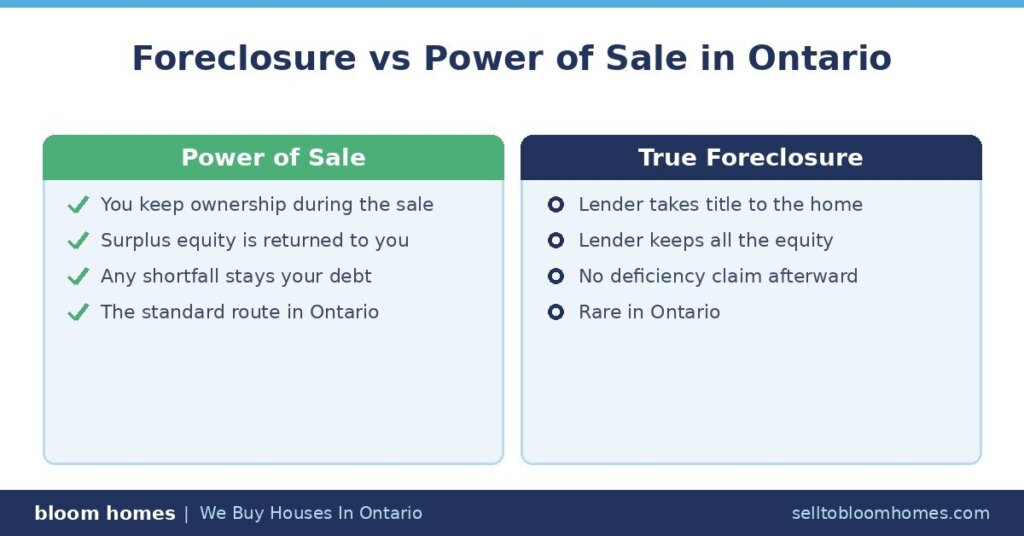
When the lender takes ownership through foreclosure, they take all the equity. Even if the lender later sells the home for a profit, the original homeowner receives nothing. The benefit for the homeowner is that the lender generally cannot pursue them for any deficiency after foreclosure is complete; the debt is considered settled. So foreclosure offers one cold comfort: no lingering liability. But you walk away with nothing, regardless of how much equity you’d built up over the years.
What Is Power of Sale and How Is It Different From Foreclosure?
Given that lenders almost never choose the court-heavy foreclosure route, the process facing most Ontario homeowners in default is power of sale, and the two are genuinely different animals.
Power of sale is governed by Ontario’s Mortgages Act (R.S.O. 1990, c. M.40). Section 24 grants lenders the statutory right to sell a property once the mortgage debt becomes due, without requiring a court order. This distinguishes it from foreclosure and makes it the preferred recovery method for Ontario lenders.
Under power of sale, the borrower retains ownership of the property throughout the sale process. The lender acts as a vendor to sell the property and collect the outstanding debt. After the sale, the lender pays off the mortgage debt and returns any remaining funds to the homeowner. That’s the critical difference. Your equity doesn’t automatically disappear. If the sale price doesn’t cover everything you owe, you’re on the hook for the shortfall, and lenders can pursue collection or sue for the balance. This is the risk that makes acting early so important.
A couple of years ago I bought a property from a longtime landlord in Barrie who’d been transferred for work and had five weeks to be out. He’d fallen behind on two months of payments while scrambling to arrange the move, and his lender had already sent an initial warning. We closed on a Wednesday, the payoff cleared by Friday, and he walked away with the equity he’d spent twelve years building. Acting fast was the only thing that made that possible.
How the Foreclosure and Power of Sale Process Works in Ontario
Most homeowners burn their best options by misreading the timeline and thinking they have more time than the law actually gives them.
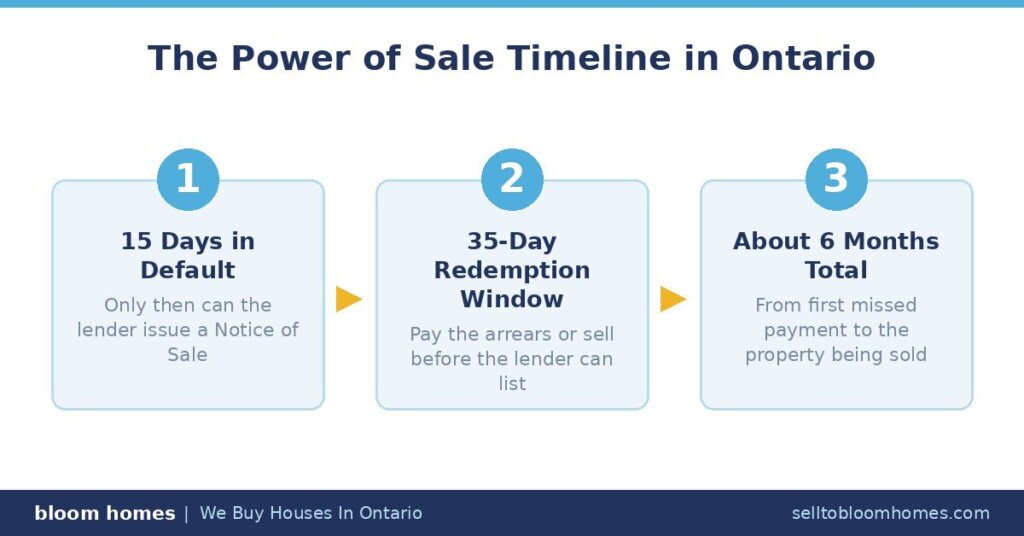
Delivery of the Notice of Sale cannot occur until the default has continued for at least 15 days, and the lender is then barred from selling for at least another 35 days (40 days when the notice is mailed for a matrimonial home). Those weeks are called the redemption period, which means you still have a real window to act. Under section 42 of the Mortgages Act, the lender cannot take further steps to enforce the mortgage during this waiting period.
During this period, the homeowner has the right to redeem the mortgage by paying only the arrears, the missed payments plus the lender’s legal costs, to bring the mortgage back into good standing. After that window closes, the lender can list the property. A typical power of sale timeline runs about six months from the first missed payment to the property being sold, though court scheduling, service issues, and market conditions (title searches slow things down too) all affect that figure.
Do you know exactly which stage your lender has reached? One single piece of information determines every option available to you right now.
Can You Sell Your House During Foreclosure or Power of Sale in Ontario?
A woman in Oshawa inherited her father’s property and discovered a Notice of Sale buried in a stack of unopened mail. The house was full of thirty years’ worth of belongings, her siblings wanted a clean exit, and the lender was already past the redemption window. She called our office on a Tuesday. We made an offer by Thursday, and the sale closed in time to stop the power of sale from completing. The garage alone took two days to sort through; she kept his tools and left us the rest.
Yes, a homeowner in Ontario can often sell their home before the lender sells it. You retain the right to sell until the lender takes possession or signs an agreement of purchase and sale. Voluntary sales still preserve more equity than lender-led ones, even under time pressure, because you control the timeline and can shop for a real offer.
A firm offer that pays off the mortgage debt may stop the power of sale entirely. Once that offer closes and the lender is paid out, the process ends. A cash buyer can close an Ontario property in as little as five days, eliminating lender delays, financing conditions, and the risk of a deal collapsing at the last moment. The sale proceeds pay out the existing mortgage and any registered arrears, the power of sale process is stopped, and the homeowner receives whatever equity remains.
That’s the path that protects your credit score and keeps money in your pocket. Teams like Bloom Homes work directly with Ontario homeowners in exactly these situations, moving fast enough to beat the lender’s listing date when the timing is still on your side.
What Are Your Options If You Are Facing Foreclosure or Power of Sale in Ontario?
For years I thought the only real option for someone deep in a power of sale was refinancing. That’s wrong. Refinancing is one path, but it’s not always available, and it’s not always the best one.
Depending on your situation, stopping a power of sale may involve paying the arrears, refinancing, arranging a private mortgage, selling the property voluntarily, negotiating with the lender, or defending the claim in court. Here’s an honest look at each:
Reinstate the mortgage. Pay the missed payments, interest, and the lender’s reasonable legal and administrative fees during the notice period, bringing the loan fully current rather than refinancing or selling. This is your right of redemption under the Mortgages Act, and once you exercise it, the Notice of Sale is set aside and your mortgage returns to good standing.
Refinance. If you have equity but not cash, an alternative lender may be able to pay out the existing mortgage. The new rate will be higher, but it buys time. Your credit score likely took a hit from the default, so don’t assume a major bank will move quickly enough; private lenders are usually the realistic option (and they can close in days).
Sell voluntarily. If the situation isn’t recoverable, selling voluntarily before things escalate almost always preserves more equity than a lender-led sale. This is where reaching out to a trusted local buyer like Bloom Homes makes real sense. No listings, no open houses, no waiting for financing conditions to clear.
Negotiate with your lender. Some banks will consider a payment deferral or restructured plan, especially early in the process. Ask specifically for a workout agreement in writing.
Inaction is the option too many homeowners accidentally choose. Once the redemption period expires, homeowners lose control over the final sale price. If sale proceeds are insufficient to cover the whole mortgage balance, arrears, fees, and legal costs, the homeowner remains liable for the deficiency.
How to Stop a Power of Sale or Foreclosure Before It’s Too Late
Miss this window and your choices collapse to almost nothing.
If you’ve already received a Notice of Sale, the 35-day window is your best opportunity. After several weeks, options narrow but don’t disappear. Once the property is listed, your options become more limited, acting immediately is critical before the property is sold.
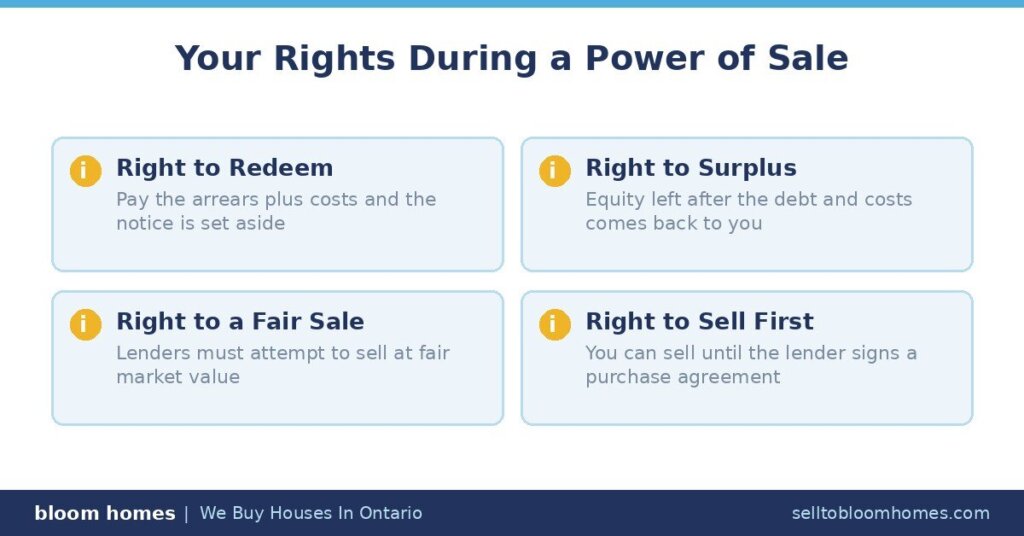
Your legal rights during this period include the right to redeem by paying arrears and costs before the sale closes, the right to any equity remaining after the mortgage and costs are paid, and the right to a fair sale, since lenders must attempt to sell at fair market value and can’t undersell intentionally.
Hiring a real estate lawyer the moment a Notice of Sale arrives is the single best investment you can make. They can review whether the notice was served correctly. The notice must be served via prepaid registered mail and contain specific details, including the mortgage date, the total amount due, and a clear warning that the property will be sold. Any errors or omissions can render it invalid and stall the entire process.
Ontario is the only province expected to see price declines in 2026, with prices likely to keep falling in the most expensive urban centres due to high inventory and muted sales. Selling on your own timeline, before prices slide further in cities like Toronto, Hamilton, or Ottawa, is a decision worth making sooner rather than later. Bloom Homes can give you a no-obligation offer fast, which at minimum tells you what your equity position looks like right now.
Frequently Asked Questions
How Long Does It Take to Foreclose on a House in Ontario?
The typical power of sale timeline in Ontario is about six months from the first missed payment to the property being sold. True judicial foreclosure, which is rare, takes considerably longer, often a year or more, because it moves through the court system. Most Ontario lenders choose power of sale specifically to avoid that delay. If you’re mid-process, your best strategy is to confirm which remedy your lender is actually pursuing; your lawyer or the Statement of Claim will tell you.
How Long Are You Liable After Selling a House in Canada?
Your liability after a voluntary sale generally ends when the mortgage is paid out and title transfers to the buyer. Under a power of sale, if the sale price falls short of the total debt owed, you remain on the hook for the shortfall, and lenders can pursue collection or sue for the balance. Selling on your own terms, for a price that clears the mortgage, is how you cut that liability cleanly. Speak with a real estate lawyer before signing anything so you understand exactly what obligations carry forward.
Do You Get Any Money If Your House Is Foreclosed in Ontario?
Under true foreclosure, no. When the lender takes ownership through foreclosure, they take all the equity, and even if the lender later sells the home for a significant profit, the original homeowner receives nothing. Power of sale is different: the lender applies the sale proceeds toward the mortgage debt, legal costs, and other valid claims, with any remaining funds paid to the person entitled to them. That’s why selling before the lender does, or at least triggering a power of sale rather than a foreclosure, matters so much for protecting your equity.
Can You Stop a Foreclosure Once It Starts in Canada?
Yes, a power of sale in Ontario can be stopped at any point before the sale closes. True court-ordered foreclosure is harder to interrupt once a judge has issued the order, but power of sale, the far more common process in Ontario, stays stoppable right up until the closing date. The homeowner remains the owner until the sale closes and can stop the process by paying the arrears or the full mortgage debt before key deadlines. Selling the property yourself and paying out the lender from the proceeds is one of the cleanest ways to stop it without needing cash you may not have.
If you’re facing a Notice of Sale or just trying to figure out where you stand, talking to someone who actually buys houses in Ontario is a good first step. Bloom Homes works with homeowners across the province who need to move quickly and want a fair offer without the stress of a traditional listing. No pressure, no obligation. Just a real conversation about your options while you still have them.