Someone is sleeping in your vacant Scarborough rental. Or your neighbour’s shed crept two feet past your property line years ago and nobody said a word. These situations feel urgent, and the law around them in Ontario is genuinely confusing, so let’s get into what’s actually real and what most people get wrong.
What Are Squatters’ Rights in Ontario, Canada?
The concept known as squatters’ rights is legally called adverse possession, an old common law principle that allows someone occupying land without permission to eventually gain legal title if they meet very specific conditions, governed in Ontario by the Real Property Limitations Act. That sounds alarming. In practice, it’s far narrower than the scary headlines suggest.
A person must have used the land as their own, openly and continuously, for at least ten years, without the registered owner’s permission, to claim adverse possession. It’s now rare and hard to establish, because almost all Ontario land sits in the Land Titles system (registered decades ago for exactly this reason), which blocks new claims, so most live disputes today are about fences and boundaries rather than classic squatters.
Think about what that means for a homeowner in Brampton or Oshawa whose property is already registered under Land Titles. A random squatter moving into a vacant house isn’t quietly building a legal claim to it. They’re trespassing. Residential properties in this province almost never give the ten-year clock a chance to run anymore.
Misunderstanding this law can cost you. I’ve worked with sellers who let boundary encroachments sit for years because they figured the law would sort itself out. It doesn’t. Acting first usually leaves a person better off. A quick call to a real estate lawyer will tell you in minutes whether your property is still under the older Registry system or has been converted to Land Titles.
Why Do Squatters’ Rights Exist in the First Place?
Adverse possession exists because land that sits unused and unclaimed creates problems for communities. Historically, courts wanted land productive and disputes resolved. A registered owner who genuinely abandoned property and someone else who spent a decade maintaining it and treating it as their own (I’ve seen this happen with overgrown lots) created a situation where the law saw some justice in rewarding that stewardship.
Practically speaking, the takeaway isn’t “ten years and it’s gone.” It’s that your inaction has legal consequences. Responding early, even just sending a written notice, resets the clock and documents that you never consented to the occupation. Owners who catch these situations at year two or three have every advantage over those who wake up at year nine, which means the timing of your response matters as much as the response itself.
Not long ago, I helped a widow in Etobicoke who hadn’t visited her late husband’s secondary lot for several years. A neighbour had extended their garden fence well past the property line and treated the strip as their own. She was three months behind on her primary mortgage, an auction date was already set, and she didn’t realize the encroachment existed until we walked the property together (survey pins buried under overgrowth). Sorting out the boundary was straightforward once she acted quickly, and we were able to get her house sold before the auction date arrived.
How Does Adverse Possession Work Under Ontario Law?
Some owners hear “ten years” and assume a squatter just shows up, waits a decade, and gets a deed. Ontario’s Land Titles Act blocks new adverse possession claims against any parcel registered in the Land Titles system, and Ontario has converted nearly all its land to that system. A claim can only succeed against the small amount of land still under the old Registry system (genuinely rare in practice today), and only if the ten-year period of open, exclusive, continuous, adverse possession was already completed.
Genuinely occupying someone else’s house without permission is trespass, and in most cases the owner or police can act on it well before any possession period matters.
The cases where adverse possession still bites Ontario homeowners typically involve old rural properties that haven’t been migrated to Land Titles, or boundary disputes where a neighbour built a fence or shed slightly over the line years before either party noticed. The real-world version of this law in 2026 is that, not a stranger squatting in your basement.
What Are the Legal Requirements for an Adverse Possession Claim in Ontario?
A seller I worked with had inherited a rural property near Barrie. A neighbouring farmer had been mowing and planting a strip along the east edge of the lot for well over a decade, and nobody in the family had thought much of it. When the heir finally went to list the property, the surveyor’s report (boundary dispute, already documented) created a real problem.
Where adverse possession still applies, the claimant must prove open, notorious, exclusive, continuous, and adverse possession for ten years under Ontario’s Real Property Limitations Act, and Ontario courts also require the use to be inconsistent with the true owner’s intended use. Every single one of those conditions must be met.
Shared use or intermittent control by the true owner would defeat the exclusivity requirement. The occupation must last at least ten consecutive years without significant interruption. Possession also has to be “open and notorious,” meaning it can’t be hidden or secretive, and the occupant must not have had the owner’s permission. A squatter who asked permission once, even casually, may have destroyed their own claim. Documenting any communication with an unauthorized occupant matters so much for this reason.
Do Squatters’ Rights Apply Under Ontario’s Land Titles System?
Ontario has eliminated adverse possession claims for any property registered under the Land Titles Act. The vast majority of properties across the GTA, Hamilton, Ottawa, and most mid-sized Ontario cities are already registered under Land Titles, leaving this door quietly closed for most urban and suburban owners. For those owners, a squatter or encroaching neighbour cannot file a successful adverse possession claim, period.
A property converted to the Land Titles Act in, say, 1999, where a squatter had been using the land since 1985, could still be subject to an adverse possession claim because the ten-year limit was fulfilled before the conversion. Any property converted to the new system can still face squatting claims if the squatter fulfilled the adverse possession criteria before the change.
This is exactly the kind of scenario where getting legal counsel before listing makes the difference between a clean sale and a title dispute that derails your closing. If you’re carrying an older rural property or an estate property anywhere in Ontario, verifying your registration system with a real estate lawyer (registry vs. land titles matters here) is worth every minute.
How to Protect Your Property From Adverse Possession in Ontario
Passive ownership is the fastest route to a boundary problem.
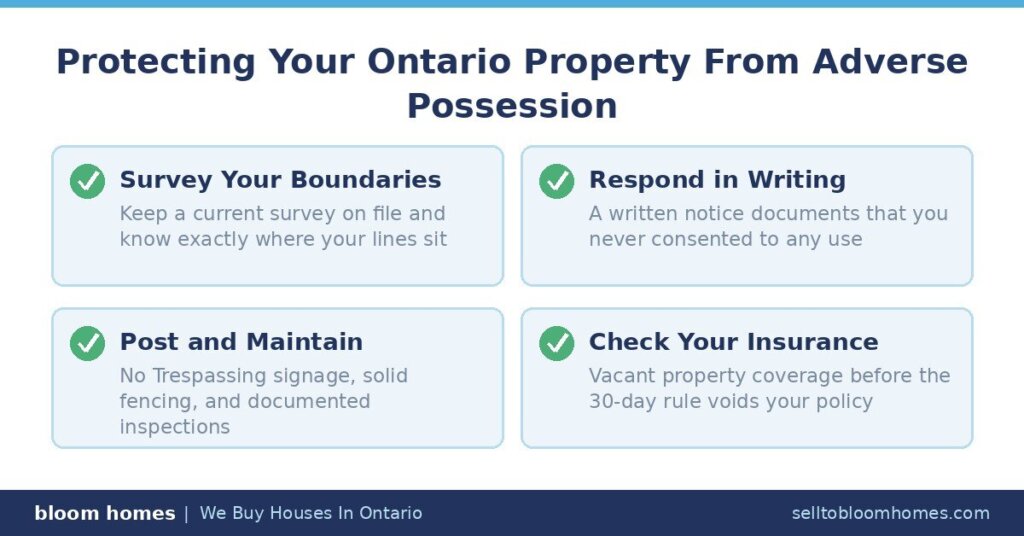
You protect yourself best through vigilant property maintenance, clear boundary documentation, and prompt response to any unauthorized use. Have your boundaries surveyed and keep the report on file. If a neighbour’s fence creeps over your line, address it in writing right away. Written notice creates a record that you never consented to the use, which is the single most effective way to stop a future claim. Ontario’s Trespass to Property Act provides a legal framework for addressing unauthorized entry and occupation, and property owners can use it to support their case when dealing with squatters, including issuing trespass notices and seeking law enforcement assistance (officers respond faster with documented notices).
For vacant or seasonal properties especially, periodic visits and documented inspections carry real weight. Put up clear “No Trespassing” signage. Maintain fencing along your perimeters. If the property is going to sit vacant for any stretch of time, those physical steps are your first line of defence.
What to Do If Someone Is Squatting on Your Property in Ontario
If the squatter is simply trespassing, law enforcement can remove them. However, if it’s a civil issue involving a former tenant, the police may not intervene, and you’ll need to proceed through additional legal steps. Whether a tenancy ever existed marks the difference between a trespasser and a former tenant, and that distinction changes everything about which process applies.
For a straightforward trespasser on vacant land, police can often assist. When the situation involves someone who held a tenancy and won’t leave, the path goes through Ontario’s Landlord and Tenant Board or the Ontario Superior Court of Justice. Depending on the Board’s caseload, the process can take anywhere from a few weeks to a few months. All eviction notices must be served by a Sheriff in Ontario.
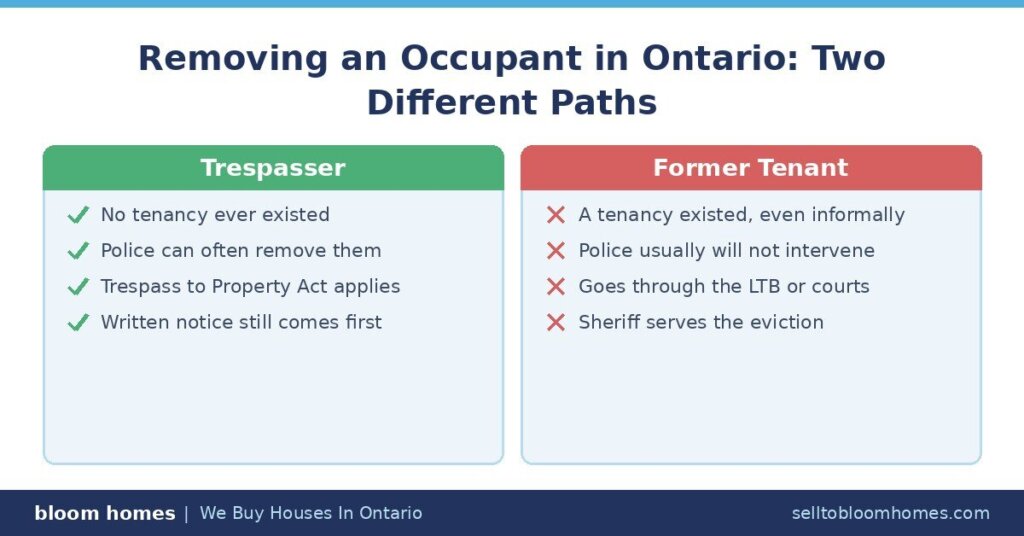
Put your demands in writing. Send a written notice clearly stating that they are trespassing and must vacate by a certain date, which creates a formal record that you did not grant permission and that you object to their presence.
An heir I worked with inherited a townhouse in Mississauga and had to be out by a Friday five weeks away because of a job transfer to Calgary. The garage was packed with the previous tenant’s belongings, and the tenant had stopped paying rent but hadn’t left. Getting legal counsel in place quickly and filing immediately with the LTB gave her a realistic path. We connected with Bloom Homes to assess a direct sale so she’d have certainty on her end, regardless of how the tenant process played out. Having a buyer lined up while the legal process ran its course (something I’ve seen calm even the most stressed sellers) took a massive amount of pressure off her.
How Does Home Insurance Factor Into Squatter and Adverse Possession Situations?
Thirty days. That’s the number Ontario homeowners often don’t know about until it’s too late.
In Ontario, the 30-day home insurance rule applies when a home is left unattended for more than 30 days. When this happens, your home may be considered vacant, and your existing home insurance might be voided. A voided policy during a squatter situation means damage caused by unauthorized occupants comes out of your pocket. Even if a trespasser gets injured on the premises, you as the homeowner may still bear responsibility.
One of the best ways to protect yourself is with comprehensive landlord or vacant property insurance. This type of policy can cover damages, legal costs, and lost income resulting from unauthorized occupancy or property disputes (coverage gaps here are common and costly). Read your policy carefully and ask your broker directly about coverage for unauthorized occupation.
The provincial median sold price across Ontario sat at $700,000 as of March 2026, with an average of 38 days on market. A squatter situation can stretch that timeline considerably, especially if a title dispute needs resolving before the listing can go active. Owners dealing with a messy squatter situation who also need to sell quickly often find working with a buyer like Bloom Homes cuts through the complexity, since a direct sale doesn’t require the property to be vacant, tenant-free, or in perfect condition (I’ve seen offers close with occupants still inside) before an offer is made.
Frequently Asked Questions
Can You Kick Out Squatters in Ontario?
Yes, but the right method depends on how they got there. If the person is simply a trespasser, law enforcement can remove them. If it’s a civil issue involving a former tenant, the police may not intervene, and you’ll need to go through the Landlord and Tenant Board or the courts. Either way, do not attempt to remove anyone yourself by force or by changing locks without proper legal authority, as that creates its own liability for you.
How Long Does It Take to Gain Squatters’ Rights in Ontario?
To qualify for adverse possession, a squatter must prove exclusive, continuous, and open use of the property for at least ten years without the owner’s consent, criteria rarely met, especially under the current legal framework. And that’s only possible on land still under the old Registry system, not modern Land Titles. For most Ontario properties, a squatter cannot gain ownership rights at all, regardless of how long they stay.
What’s the Fastest Way to Get a Squatter Out of Your Property in Ontario?
Speed depends entirely on the situation. For a random trespasser on vacant land, police involvement under Ontario’s Trespass to Property Act is the fastest route. For a former tenant, filing promptly with the Landlord and Tenant Board or Superior Court and serving documents through the Sheriff is your path. Either way, your first move is always putting it in writing: send a written notice stating they are trespassing and must vacate by a specific date.
Can Police Remove Squatters in Canada?
Police can remove squatters in Canada when the situation is clearly trespassing on private property, but their role becomes limited when a tenancy relationship ever existed, even informally. While police can remove trespassers in some cases, they may advise filing a formal application with the court instead. If there’s any ambiguity about whether someone was a tenant, officers will often step back and leave it to the civil process. Your best move is to have your ownership documentation ready and consult a real estate lawyer if police indicate the matter is civil rather than criminal.
If you’re dealing with a squatter situation on top of everything else that comes with owning property in Ontario, and you’re wondering whether selling might just be the cleaner path forward, Bloom Homes is worth a conversation. They buy houses as-is, work around complicated occupancy situations, and don’t require you to have everything resolved before making an offer. No pressure, no obligation, just a straightforward look at your options when you need one.