Selling a property from a distance sounds manageable on paper. You sign a few things, your lawyer handles the rest, money lands in your account. This is the version people imagine. What most sellers find is a process with moving parts they never saw coming: tax withholdings that can freeze a big portion of your sale proceeds, CRA deadlines that carry real penalties, and buyers who hesitate the moment they learn the seller is out of province.
None of that means you’re stuck. But going in without the full picture costs you time and money.
Selling From Away Is Simpler Than You’ve Been Told, Until It Isn’t
Circulating freely online, the idea that you just need a good realtor and a power of attorney isn’t exactly wrong. It just leaves out a lot. Provincial home sales across Ontario rose 5.5% year over year as of June 2026, reaching 18,051 units, so there is demand out there. Median days on market for a Toronto home sat at 33 days as of August 2026, which sounds encouraging. But days on market only matters once your deal is in motion, and if your legal paperwork isn’t in order before closing, those timelines can stretch or collapse.
Out-of-province sellers often learn midway through a transaction that their buyer’s lawyer is asking questions they weren’t prepared for, or that a holdback they didn’t plan for is sitting with the Canada Revenue Agency (CRA). A seller who moved to Vancouver two years ago and inherited a Barrie bungalow from a parent is in a very different legal position than a Toronto buyer assumes going in.
One thing that gets overlooked: whether you moved to British Columbia last spring or you’ve been living in Phoenix for a decade, Ontario real estate law treats you differently depending on your tax residency status, not your mailing address. The distinction shapes everything from how closing funds are handled to what forms your lawyer files, so getting it wrong early creates real problems at the table.
Can You Sell Your Ontario Home Before or After You Move Away
Sit across from me at the kitchen table and I’ll tell you the same thing I tell every seller who calls from out of town: yes, you can absolutely sell. Timing is worth thinking through carefully, because it changes your tax position in ways that matter (sometimes by tens of thousands).
Owning and ordinarily inhabiting the Ontario property as your principal residence during the years you lived there means that when you sell your home you may realize a capital gain, but if the property was solely your principal residence for every year you owned it, you do not have to pay tax on the gain. The Principal Residence Exemption (PRE) is, for many sellers who simply relocated for work or family reasons, their single biggest financial protection.
Starting in 2016, for later tax years, the CRA will only allow the principal residence exemption if you report the disposition and designation of your principal residence on your income tax and benefit return, and that is the catch. Filing is not optional, even if your gain is fully sheltered. Failing to report the sale can lead to a late-filing penalty of $100 per month, up to $8,000, and the CRA can deny the exemption entirely. I’ve seen sellers lose a protection worth far more than any realtor’s commission because they assumed a zero-tax situation meant zero paperwork.
If you can sell before you formally lose Canadian residency for tax purposes, you preserve more flexibility. Once the CRA considers you a non-resident, a separate and more demanding set of rules kicks in.
Why Selling Ontario Real Estate From a Distance Is More Complicated
Managing a transaction from 3,000 kilometres away turns ordinary delays into expensive ones.
Early last year, I worked with an heir who was also splitting assets in a divorce and needed the Mississauga property gone fast. We closed in about three weeks, but only because we moved quickly on every document the moment it arrived, and because she had a lawyer who understood non-resident compliance. A finished basement suite in the property added a wrinkle to the depreciable property question (separate unit classification matters here). Had she waited on any single step, the deal would have pushed into a new quarter and her tax filing window would have tightened.
The MLS benchmark price in Ontario came in at $753,300 as of June 2026, with apartments posting the steepest year-over-year decline at 8.0% and townhouses down 6.6%. Those paying carrying costs from out of province feel every month of delay directly. Mortgage, property tax, insurance, utilities: those bills don’t care where you live, and they don’t pause while you wait for a better offer.
A traditional listing also requires coordination you can’t easily do remotely. Showings need access, repairs need supervision, and offers need your response within hours. A different time zone or a demanding job means the standard listing process was not designed with you in mind.
What Out-of-province and Non-resident Sellers Need to Know Before Closing
A seller living in Calgary who owns a rental condo in Toronto is in a completely different situation from a seller living in the United States who owns that same condo. They’re not interchangeable, and confusing the two can send someone to the wrong professional with the wrong questions.
Moving from Ottawa to Calgary, a Canadian citizen who still holds an Ontario rental property is a Canadian resident for tax purposes. The CRA’s withholding rules that apply to non-residents do not apply to them in the same way. A Canadian who has lived in Florida for five years and cut ties with Canada for tax purposes is in a fundamentally different position. So is a US citizen who inherited an Ontario property through an estate, which means the buyer’s lawyer will treat that transaction very differently at closing.
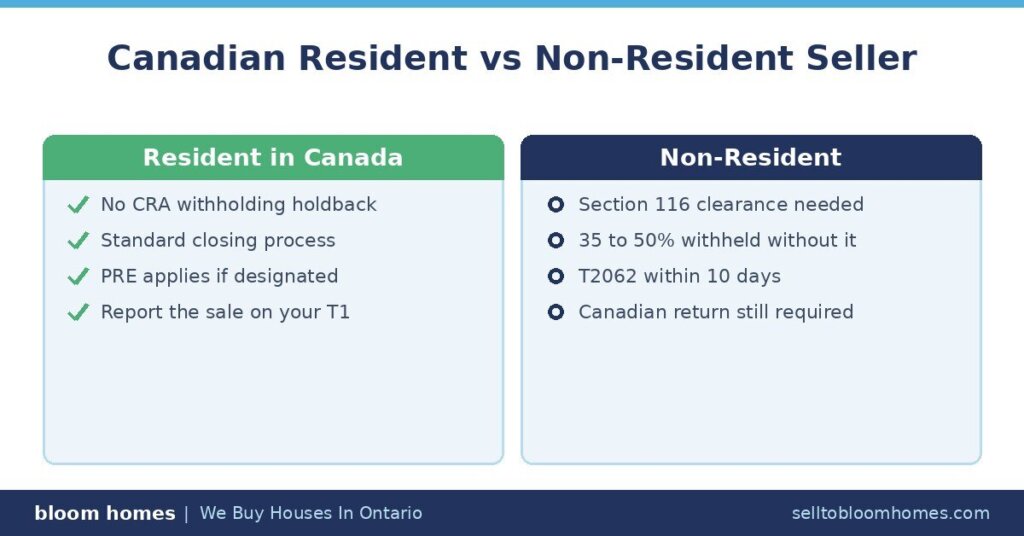
If you are looking to sell your house, condo, or any other property as a non-resident, you are subject to Canadian non-resident withholding tax. Canada has the right under its tax laws, and under most Income Tax Treaties with other countries, to tax the sale of your Canadian real estate. Because you are not a resident in Canada, the CRA wants to ensure it has sufficient security from you to cover your taxes owing.
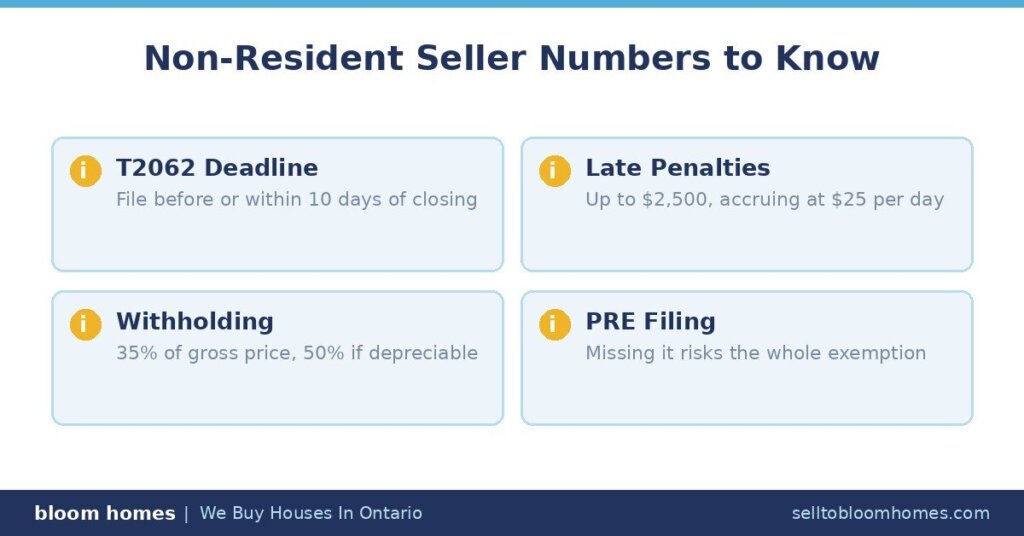
Non-resident sellers must notify the CRA by filing Form T2062 before or within 10 days of the sale closing. If the seller fails to file on time, they may face late penalties of up to $2,500. That penalty accrues at $25 per day with a minimum of $100 (easy to overlook in closing chaos), per the CRA’s own guidance on Section 116 compliance.
Without a Clearance Certificate, the buyer is required to withhold 35% of the gross sale price, or 50% if the property is depreciable, and submit it to the CRA. The money is held with your lawyer until CRA releases it. On a property selling for $750,000, that holdback is real money sitting idle for months. Getting your Canadian real estate lawyer and a cross-border tax accountant working together before closing, not after, is how you avoid that crunch. The CRA’s Section 116 procedures page lays out the full notification process in detail.
What Makes Selling to a Cash Buyer the Right Move When You’re Far Away
“Why would I take a cash offer if I can list and get more?” Fair question. The honest answer is that the difference in net proceeds is usually smaller than most sellers assume, and the cost of delay when you’re managing a sale from out of province is usually larger.
A traditional listing requires a property that shows well, buyers who can secure financing, and a seller who can respond to requests quickly. When financing falls through at the last minute, which happens more often than agents like to admit, the seller restarts from zero. From out of province, that restart means more carrying costs, more months of exposure, and another round of negotiations you’re managing by phone and email across time zones.
A cash buyer like Bloom Homes eliminates most of that friction. No financing conditions, no showings to coordinate, no repair demands before closing. For a seller in Alberta who needs a Kitchener property off their books without flying back twice, or for a family in the UK dealing with a Windsor estate home, that certainty has real dollar value that I’ve watched sellers underestimate until they price out what two extra months of carrying costs actually adds up to.
Some sellers push back and say a cash offer is always a lowball. That’s not necessarily true when you factor in what a listing actually costs: agent commissions typically run 4 to 5 percent of the sale price in Ontario, plus closing adjustments, carrying costs during the listing period, and any repairs a buyer negotiates after inspection (and those negotiated repairs add up fast). Cash buyers skip most of that friction and close on a timeline you control.
How a Remote Sale of an Ontario Property Works Step by Step
Get this part wrong and you’ll be chasing paperwork long after the deal should have closed.
Your first call should be to a real estate lawyer licensed in Ontario, not in your current province. Property law is provincial. The lawyer who handled your BC purchase knows nothing about Ontario’s land transfer process, and the differences matter at closing. A power of attorney is also worth discussing early; it allows a trusted person in Ontario to sign documents on your behalf if you can’t appear in person.
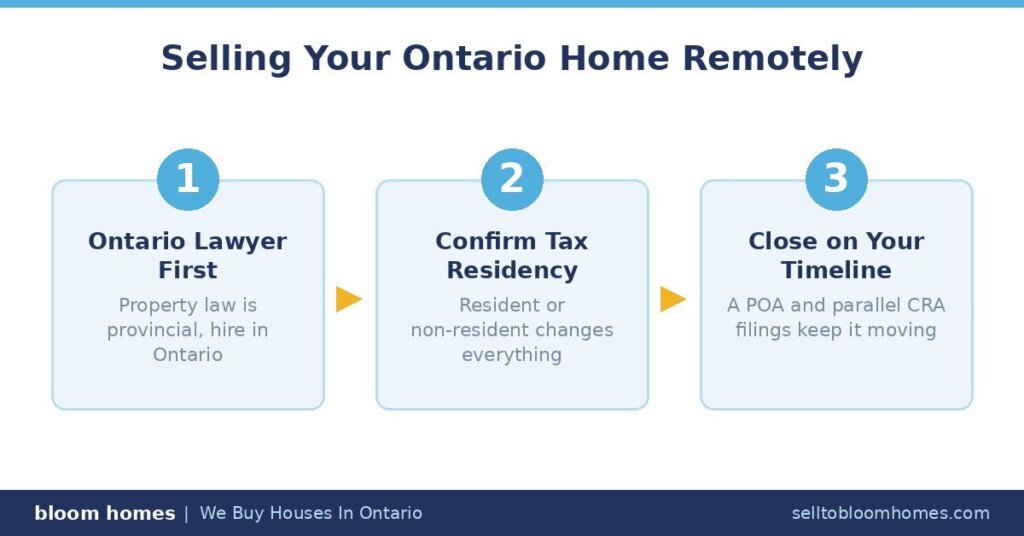
From there, the process runs roughly like this. An offer is accepted. Your Ontario lawyer reviews the agreement, confirms residency declarations, and flags the Section 116 requirements if you’re a non-resident. If a Clearance Certificate is needed, CRA takes a few months to process these requests, so there may be reason to start the process earlier than the closing of the property to minimize the impact on cash flow. Sellers who apply for the certificate before closing, using a proposed disposition notice, often receive it in time to avoid any holdback. The CRA’s information on the T2062 form process explains how principal residence designations interact with this.
For sellers working with Bloom Homes, much of this coordination happens without you being present. A straightforward offer, a clear timeline, and a team familiar with Ontario real estate closes deals without the back-and-forth that a traditional listing requires.
After closing, you still need to file a Canadian tax return reporting the disposition in most cases, even if your gain is sheltered. In 2026, a portion of any taxable capital gain is added to income, as the proposed increase to a two-thirds inclusion rate was cancelled in March 2025. Your accountant can tell you what that means for your specific situation once the sale price is confirmed.
How Long a Remote Ontario Property Sale Takes From Start to Close
Most guides on this topic quote days on market and call it a timeline, leaving out almost everything that takes time. Add offer negotiation, conditions, lawyer review, the closing date itself, and the CRA certificate process for non-residents, and a remote sale routinely runs six to twelve weeks from first contact to funds in your account. Sellers who have not retained an Ontario lawyer before listing often add two or three weeks to that timeline just in the setup phase.
A cash buyer compresses that window. Offers can come within 24 to 48 hours of an initial inquiry. Closing can be set to your schedule, in as few as two to three weeks. For non-residents who need the Clearance Certificate in place before proceeds are released, the overall timeline is tied to CRA processing, which the seller’s lawyer can usually run in parallel rather than in sequence.
The man I spoke with on a Thursday afternoon had been quietly carrying two mortgage payments for almost eleven months, one on a Hamilton semi-detached he’d moved out of and one on his new place in Alberta. The property needed the eavestroughs replaced and had a packed garage full of the previous tenant’s furniture. He wasn’t looking for a record price. He needed out. We had an offer to him within two days of that call, and his Ontario lawyer confirmed everything in writing by end of week.
Frequently Asked Questions
How Long Do You Have to Live in a Home to Avoid Capital Gains in Ontario?
If the property was solely your principal residence for every year you owned it, you do not have to pay tax on the gain. But if at any time during the period you owned the property it was not your principal residence, you might not be able to benefit from the principal residence exemption on all or part of the capital gain. There is no fixed minimum number of years; what matters is whether you “ordinarily inhabited” the home during the years you designate it. Your tax accountant can calculate the partial exemption if the property was your principal residence for only part of your ownership period.
Can I Sell My House If I Live in Another Province?
Yes, and many Ontario homeowners do it every year. Your residency in another Canadian province does not trigger non-resident withholding rules, since you remain a Canadian resident for tax purposes. You will still need an Ontario-licensed real estate lawyer to handle the transaction, and your principal residence designation on your tax return needs to be handled carefully if the property has been vacant or rented since you left.
What Happens When a Us Citizen Sells Property in Canada?
Any property owner looking to sell a house, condo, or any other property is subject to Canadian non-resident withholding tax. Canada has the right under its tax laws, and under most Income Tax Treaties with other countries, to tax the sale of your Canadian real estate. The buyer’s lawyer is required to withhold a portion of the sale price and remit it to the CRA unless a Clearance Certificate has been obtained. After closing, a Canadian income tax return reporting the gain is also required, and a refund of excess withholding may be available depending on your actual capital gain and the deductions your accountant can claim.
How Can You Reduce or Avoid Capital Gains Tax in Canada When Selling a House?
If the property was solely your principal residence for every year you owned it, you do not have to pay tax on the gain. For years when the property was not your principal residence, the capital gain is calculated on the sale price minus your adjusted cost base, which includes your original purchase price, eligible closing costs, and the cost of any capital improvements. Keep your records of the purchase price, selling costs, and any major improvements in case the CRA asks you to support the numbers. A Canadian tax professional familiar with cross-border real estate is the right person to work through your specific situation before you close.
If you’re holding an Ontario property from out of province or abroad and you want a straightforward conversation about your options, reach out to Bloom Homes. No pressure, no obligation, just a clear picture of what a sale could look like for your specific situation.