
Somewhere between thirty and forty percent of homes sold across Canada carry some form of renovation that never saw a building inspector. Back deck, finished basement, in-law suite off the kitchen. Work got done, life moved on, and nobody pulled a permit. Now you’re trying to sell, and that history is sitting in the room with you whether you acknowledge it or not.
Covering what Ontario sellers actually face, what the law requires, and how to make a clean exit regardless of how complicated the paper trail looks, the article lays it all out clearly.
Unpermitted Work Shows Up Everywhere in Ontario Real Estate
Ontario’s average resale price in July 2026 sat at $797,486, a modest step back from a year earlier. At that price point, buyers and their lenders are not guessing. They’re ordering inspections, reviewing municipal records, and sometimes hiring their own legal counsel before they sign anything. A property with unauthorized construction isn’t invisible in that environment. It gets flagged.
I’ve bought houses across Ontario where the seller inherited the problem. An heir we worked with in Scarborough early last year had a contractor walk through a finished basement on a Thursday afternoon. Getting the plumbing and electrical up to code ran higher than what the original renovation had cost altogether. She hadn’t added the work herself, but the liability transferred with the deed. A pattern I keep seeing: people discover the issue right when they need to sell, not years before.
Unpermitted work does not automatically kill a sale. Properties in places like Hamilton, Barrie, Kitchener, and across the Greater Toronto Area see buyers moving forward every week. Your outcome depends almost entirely on what kind of work was done, how you handle disclosure, and which sale path you choose.
What Is Unpermitted Work and Why Does It Matter in Ontario Canada
I used to think the permit question was mostly about paperwork. It isn’t.
A building permit exists so a municipal inspector can verify that construction meets the Ontario Building Code before walls get closed in. Structural additions, finished basements, plumbing changes, electrical panels, decks above a certain height, garage conversions: these all require permits in most Ontario jurisdictions. Renovations involving structural changes or plumbing generally require permits from the local municipality. When that step gets skipped, there’s no record that anyone ever verified the work was safe, which means you’re essentially taking the previous owner’s word for it.
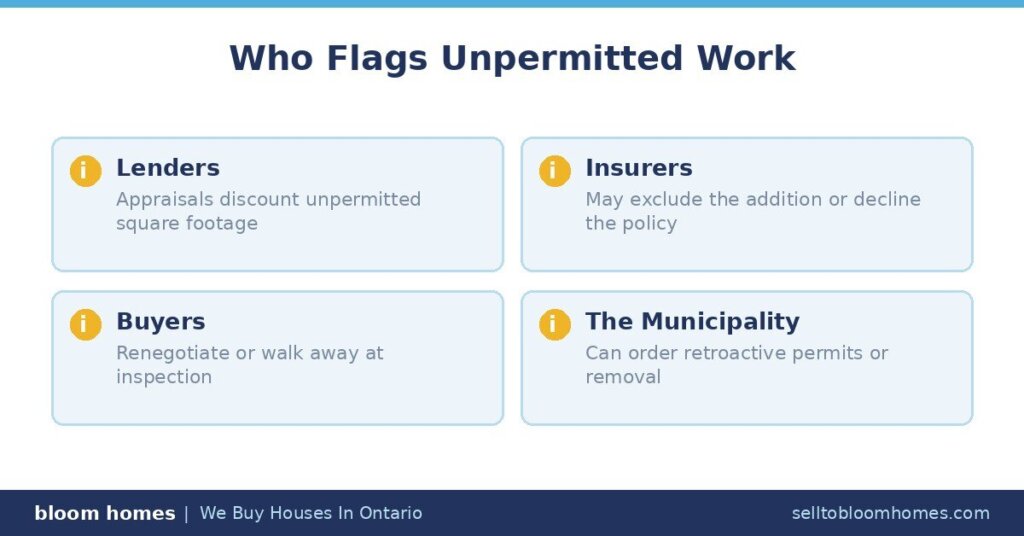
Four groups of people feel that gap: buyers, lenders, insurance carriers, and municipal building departments. Each has its own angle on the risk. Lenders and insurers may hesitate to approve a loan or policy if unpermitted work affects the home’s value, safety, or compliance with regulations. Hesitation can kill financing, and dead financing kills deals (I’ve watched closings collapse over a single unpermitted addition). Unpermitted structures can lead to orders for demolition or costly retroactive permits.
Your jurisdiction matters too. Municipalities across Ontario set their own permit fee schedules and penalty structures, so what a retroactive permit costs in Mississauga will differ from what it costs in Kingston or Windsor. Your local building department can tell you exactly what you’re facing before you list.
How Does Unpermitted Work Affect Your Home Value in Ontario Canada
Many sellers figure that a freshly renovated space adds value, even without the permits. This logic breaks down the moment a buyer’s appraiser walks through.
An appraiser working for a mortgage lender cannot assign full value to square footage that isn’t permitted as livable space. A 1,000-square-foot finished basement might look like a family room, but if it was built without permits, the lender’s appraisal may not count it toward the home’s total area. That pulls the appraised value down, sometimes by more than the cost of the renovation itself, and lenders base their loan amounts on the appraised figure, not the asking price.
Home insurance compounds this. Unpermitted work can affect mortgage approval, appraisal, homeowners’ insurance, resale value, and local code compliance. Insurance companies writing policies on properties with unauthorized construction face coverage gray areas. Some insurers will write the policy but exclude the unpermitted addition from coverage. Others will decline the property outright until the work is brought into compliance. Sellers who haven’t disclosed this tend to find out mid-sale, when the buyer’s insurance company raises the flag.
Price reductions in negotiation are common too. Buyers who discover unpermitted additions during inspection routinely come back with requests for a credit, a price drop, or they simply walk away. According to the Ontario Real Estate Association for June 2026, provincial home sales rose 5.5% year over year to 18,051 units. More transactions in the market means more competition, but buyers with choices won’t absorb risk they didn’t sign up for.
What Do Ontario Canada Disclosure Rules Require When Selling a House with Unpermitted Work
Can you just stay quiet about the unpermitted deck and hope nobody notices?
No. Ontario’s real estate rules are clear. Any unpermitted additions or renovations to the property must be disclosed by sellers. This falls under the category of material facts: information a reasonable buyer would want before making a purchase decision. The Trust in Real Estate Services Act (TRESA), updated as of December 1, 2023, introduced stricter disclosure rules for sellers and their agents in Ontario.
If a seller is legally required to disclose a fact, and their real estate agent is aware of it, the agent must disclose it to all potential buyers. This rule is designed to protect consumers and prevent misinformation during real estate transactions. So even if you say nothing, your Realtor can’t stay silent once they know. The disclosure obligation runs through both of you.
Sellers must disclose knowledge of open building permits, stop-work orders, or concealed unpermitted structural changes. The Seller Property Information Statement gives you a formal place to record this. Skipping it doesn’t eliminate your liability; Ontario courts look at what you knew, not just what you signed.
Approximately 28% of property disputes in Canada stem from incomplete or misleading disclosures. Sellers who hide unpermitted work and get caught post-closing face litigation, price clawbacks, and in some cases, voided transactions. Getting it on paper upfront is protection for you, not just the buyer. You can find RECO’s guidance on material fact disclosure at reco.on.ca.
How to Document and Assess Unpermitted Work Before You Sell in Ontario Canada
A seller in Newmarket had a finished rec room, a backyard workshop, and a second-floor bathroom all added by the previous owner. None were permitted. She came to us not knowing where to start.
Start by pulling your permit history. Ontario municipalities maintain searchable building permit records. Your local building department or municipal office will show every permit ever issued on the property. Compare that list against what’s physically in the house. Gaps in the record are your starting point.
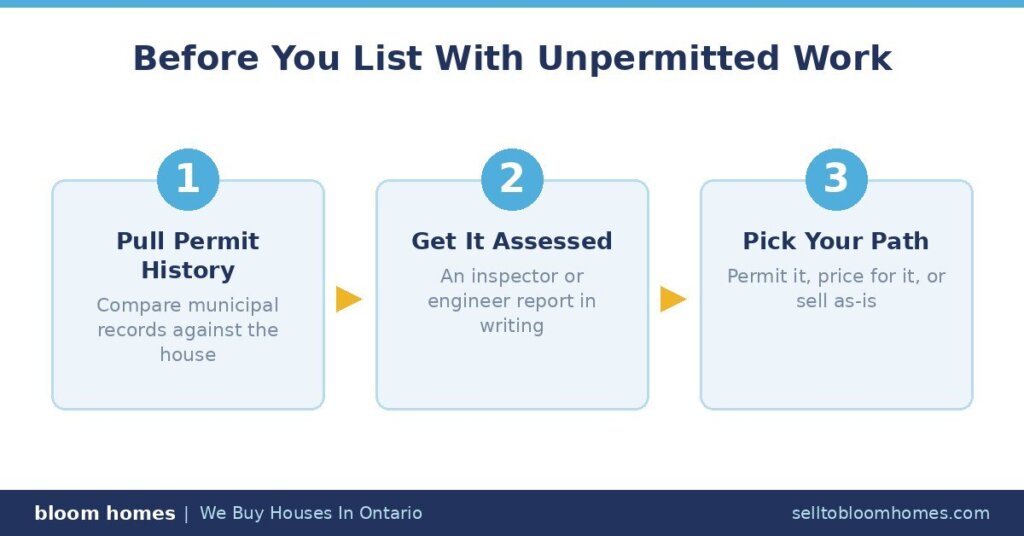
From there, bring in a licensed home inspector or a registered engineer to assess each unpermitted element. Their written report becomes a document you can share with buyers, your insurance company, and any Realtor representing the deal. Gathering old permits, invoices, warranties, engineering reports, past insurance claims, and remediation records can often turn red flags into routine disclosures (the paper trail does the heavy lifting). If the inspector also flags older materials like vinyl floor tile or pipe wrap, that same paper trail is how you sell a house with asbestos in Ontario.
Do you know exactly what was done and when? Photos, contractor invoices, even old email chains can support your position that the work was completed competently even without permits. That supporting record doesn’t replace a permit, but it gives buyers and their lenders something concrete to evaluate rather than an unknown risk (unpermitted work creates real lending friction). A team like Bloom Homes can help you think through what documentation matters most before you list.
What Are Your Options: Fix It, Permit It, or Sell As-is in Ontario Canada
Once you know what you’re working with, three real paths open up, and the right one depends on cost, time, and how motivated you are to maximize the sale price.
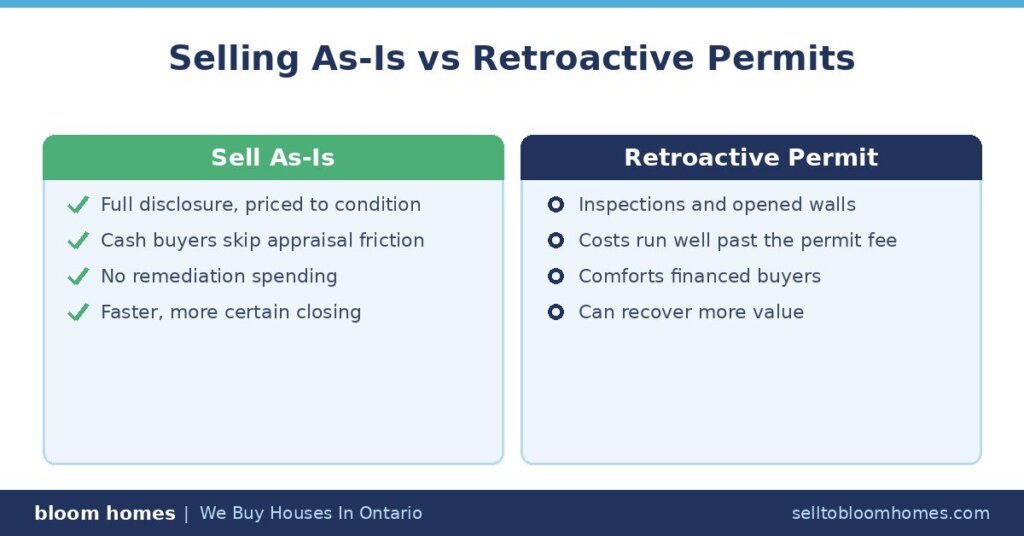
Retroactively permitting the work means opening walls, scheduling inspections, and potentially rebuilding portions that don’t meet current code. This route makes sense when the work is close to compliant and the cost of remediation is low relative to the value it adds. Get a detailed contractor quote before committing, because the permit fee itself is just the beginning; remediation costs can run well past it depending on what inspectors find once drywall comes down.
Selling as-is is the other option many Ontario homeowners take. This path requires full disclosure, clear pricing that reflects the property’s condition, and buyers who either don’t need traditional mortgage financing or who are experienced enough with the process to take it on. Buyers do move on as-is properties. Cash buyers and investors active throughout Ontario, including groups like Bloom Homes, purchase homes in exactly these situations without requiring sellers to spend money on remediation first.
Before committing to a sale, homeowners may wonder, can the seller back out of a contract if unpermitted work becomes an issue? In Ontario, the answer depends on the terms of the agreement, any applicable conditions, and whether the buyer and seller have legal grounds to terminate it. Review the contract carefully and consult a real estate lawyer before taking action, as backing out without a valid basis could have legal and financial consequences.
A price reduction in lieu of repairs is a middle path that works in some negotiations. The seller discloses everything, prices accordingly, and offers a credit at closing, leaving the buyer to coordinate repairs themselves. This keeps more of the transaction’s complexity in the buyer’s hands post-closing.
Should You Price a House with Unpermitted Work Lower in Ontario Canada
Across the kitchen table, here’s what I’d tell you: pricing is where sellers most often hurt themselves.
Some homeowners overprice because they’re counting the unpermitted addition as full livable square footage. Buyers and their appraisers disagree, and the deal dies after three weeks on market and two failed financing conditions. Other sellers swing the opposite way and underprice out of fear, leaving money on the table that careful positioning could have recovered (sometimes tens of thousands of it).
Pricing a property with unpermitted work correctly means pricing to the permitted square footage and condition, then factoring in what it would cost a buyer to remedy or accept the unauthorized work. Buyers will do this math themselves during negotiation; do it first so your list price leads the conversation rather than chasing it. The average days on market in Ontario in March 2026 sat at 38 days. A mispriced listing in a market with that kind of timeline will sit longer, attract lower offers, and give buyers more negotiating leverage, not less (and they’ll use every extra day against you).
The Realtor you work with needs to understand how to present the property honestly without underselling it. Not every agent is experienced with unpermitted work situations, leaving you at risk of working with someone who either panics or prices the home wrong from the start. Ask directly whether they’ve sold a property with unauthorized construction in the past year.
Can You Sell a House with Unpermitted Work in Ontario Canada
A landlord in Oshawa came to us on a Wednesday with a rental property they’d been trying to offload for two years. The garage had been converted to a living space without permits sometime in the nineties. Three different tenant placements later, they were done with the property and just wanted out. The garage conversion was the first thing we talked about, because in my experience that unpermitted work shapes every other decision in the sale.
Yes, you can sell a house with unpermitted work in Ontario. The sale is legal as long as you disclose what you know. If you’re looking to sell a house with a lien, it’s also important to understand how the lien may affect the sale proceeds and closing process. What changes is the buyer pool and the process. Traditional buyers relying on bank financing may run into trouble if their lender or appraiser flags the unpermitted space as a safety or compliance concern, making cash buyers the more realistic audience.
Cash buyers, real estate investors, and direct buyers take on these properties regularly because they’re not dependent on mortgage lending approvals tied to appraisal conditions. That’s a meaningful distinction when your property has a finished basement, a converted addition, or a workshop that was never inspected (and those are extremely common). Teams like Bloom Homes work with sellers in exactly this position, buying the property as-is without requiring permits to be pulled before closing.
For Ontario sellers who want a clear picture of their options, the Ontario Building Code and RECO’s material fact bulletins are worth reading before you commit to any path.
Frequently Asked Questions
Can You Sell a House with Unpermitted Work in Ontario?
You can sell, and the transaction is legal provided you disclose the unpermitted work to buyers. The challenge is that traditional buyers using bank financing may hit roadblocks if the lender’s appraiser flags safety or compliance concerns tied to the unauthorized construction. Cash buyers and direct purchasers are often the cleaner path because they aren’t bound by mortgage lending conditions that depend on a clean appraisal.
Do Sellers Need to Disclose Unpermitted Work?
Yes, without exception. Ontario’s TRESA framework treats unpermitted structural changes as material facts that sellers are legally required to disclose. Your Realtor carries the same obligation independently: if they know about the unpermitted work, they must disclose it to potential buyers even if you’d prefer silence. Failing to disclose opens you up to post-closing litigation and potential voiding of the sale.
Should I Buy a House with an Unpermitted Addition?
That depends on what the addition is, what it would cost to remedy, and whether your financing can survive the appraisal. Minor cosmetic work rarely poses a problem. Structural additions, basement apartments, and plumbing or electrical work done without inspection carry real risk because you inherit the liability when the deed transfers. Get a licensed inspector and review the permit history with your local building department before you commit.
Can I Sue My Previous Owner for Unpermitted Work in Ontario?
If you purchased a property and later discovered unpermitted work that the seller knew about and failed to disclose, you may have grounds to pursue a legal claim for misrepresentation or breach of disclosure obligations. Whether that leads to a successful outcome depends on what was known at the time of sale, how clearly the defect qualifies as a material fact, and what evidence exists of the seller’s knowledge. Speaking with a real estate attorney is the right starting point; general guidance here can’t substitute for legal advice specific to your situation.
If you’re sitting on a property with unpermitted work and trying to figure out what’s realistic, we’re here to talk it through. No pressure, no obligation. Reach out to Bloom Homes and tell us what you’ve got; we’ll give you a straight answer on what your options look like.