A missing handrail can sink your sale. I don’t mean a cracked foundation or a failed septic bed. It’s a handrail on the basement stairs. Appraisal required repairs in Ontario tend to show up like that. Most sellers first hear the phrase when a conditional offer starts to wobble two weeks before closing.
You priced the house well, you found a buyer, and you finally let yourself relax. Then your agent calls about the report.
What Are Appraisal Required Repairs in Ontario Home Sales?
Here’s the part that surprises people. The appraiser doesn’t work for you, and usually doesn’t work for the buyer either. It’s the lender who hires them, even when the buyer pays the fee. That one fact shapes how appraisal required repairs get handled in Ontario.
So what counts? Say the appraiser walks through and spots something that threatens the home’s safety, soundness or resale appeal. The report can then be issued “subject to” that item being fixed, and the value comes with strings attached. Your buyer’s mortgage financing won’t fund until the work is done, and in most cases someone has to come back and confirm it.
Think of it this way. An appraiser tells the bank what your place is worth. Repairs on the report are the short list of defects big enough to move that number or put the loan at risk.
Nobody doing the flagging is guessing. Appraisers in Canada hold the AACI or CRA designation and carry the Professional Appraiser mark. They follow the Canadian Uniform Standards of Professional Appraisal Practice, and the Appraisal Institute of Canada explains how that works. Here in Ontario they value everything from city condos to farms and special-use buildings, all under that same national rulebook.
Last year I bought a duplex in Oshawa from a landlord who’d just moved his mother into assisted living and couldn’t keep up with both. His detached garage held thirty years of tools. An earlier buyer had walked after the appraisal came back tied to exterior work. Until that week, he’d never heard of appraisal required repairs.
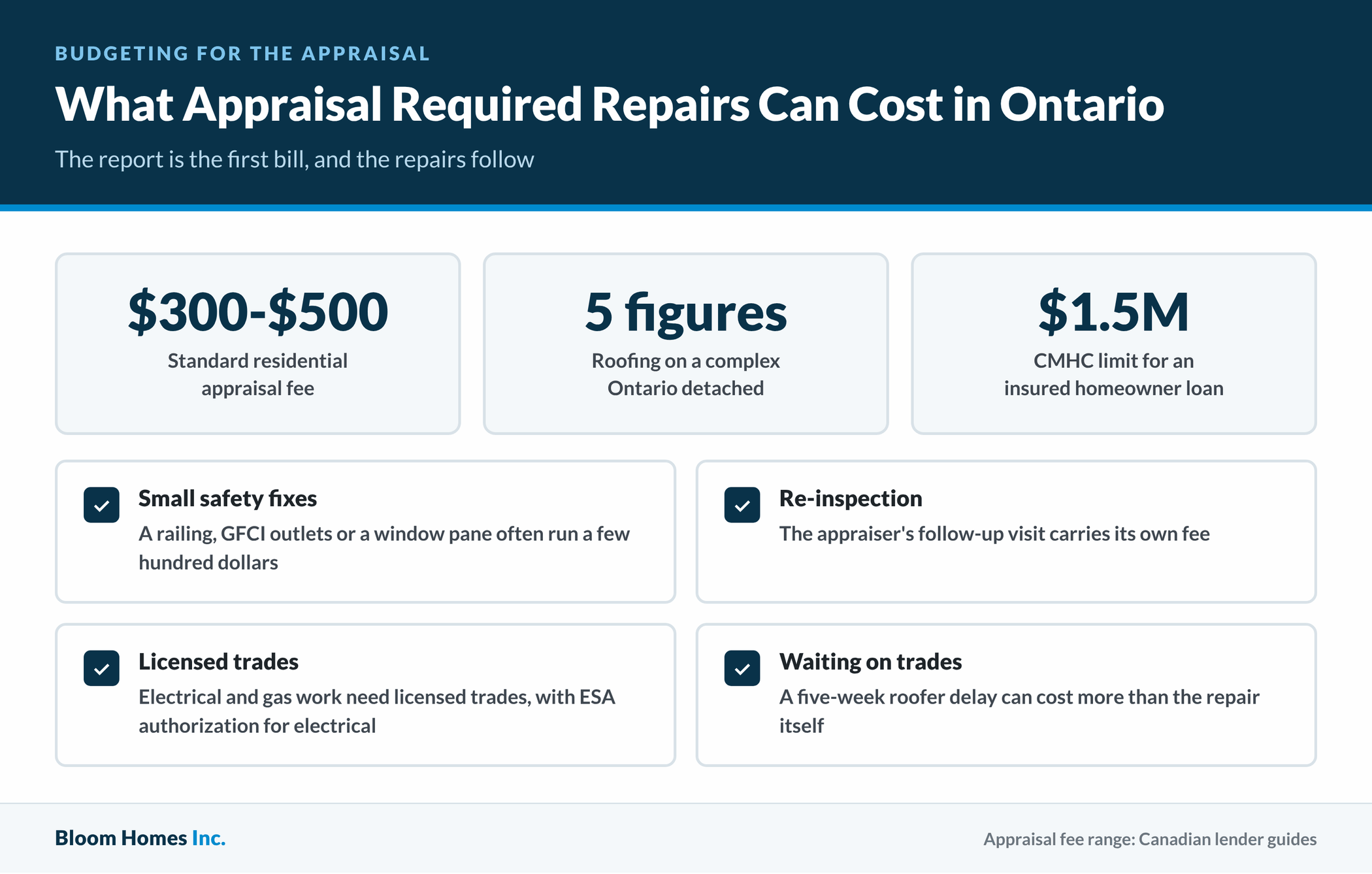
Lenders here don’t bend much. For a CMHC-insured homeowner loan, the price or as-improved value has to stay under $1,500,000, per the Canada Mortgage and Housing Corporation. Insured mortgages also get a closer look at the property’s condition than uninsured ones do.
Which Repairs Do Appraisers Flag Most Often in Ontario?
I once looked at a century home in Hamilton’s Kirkendall neighbourhood with knob-and-tube wiring in the attic. Its asphalt roof was close to thirty years old. After the seller put on a new roof and had an electrician sign off on the panel, the same lender funded without another question.
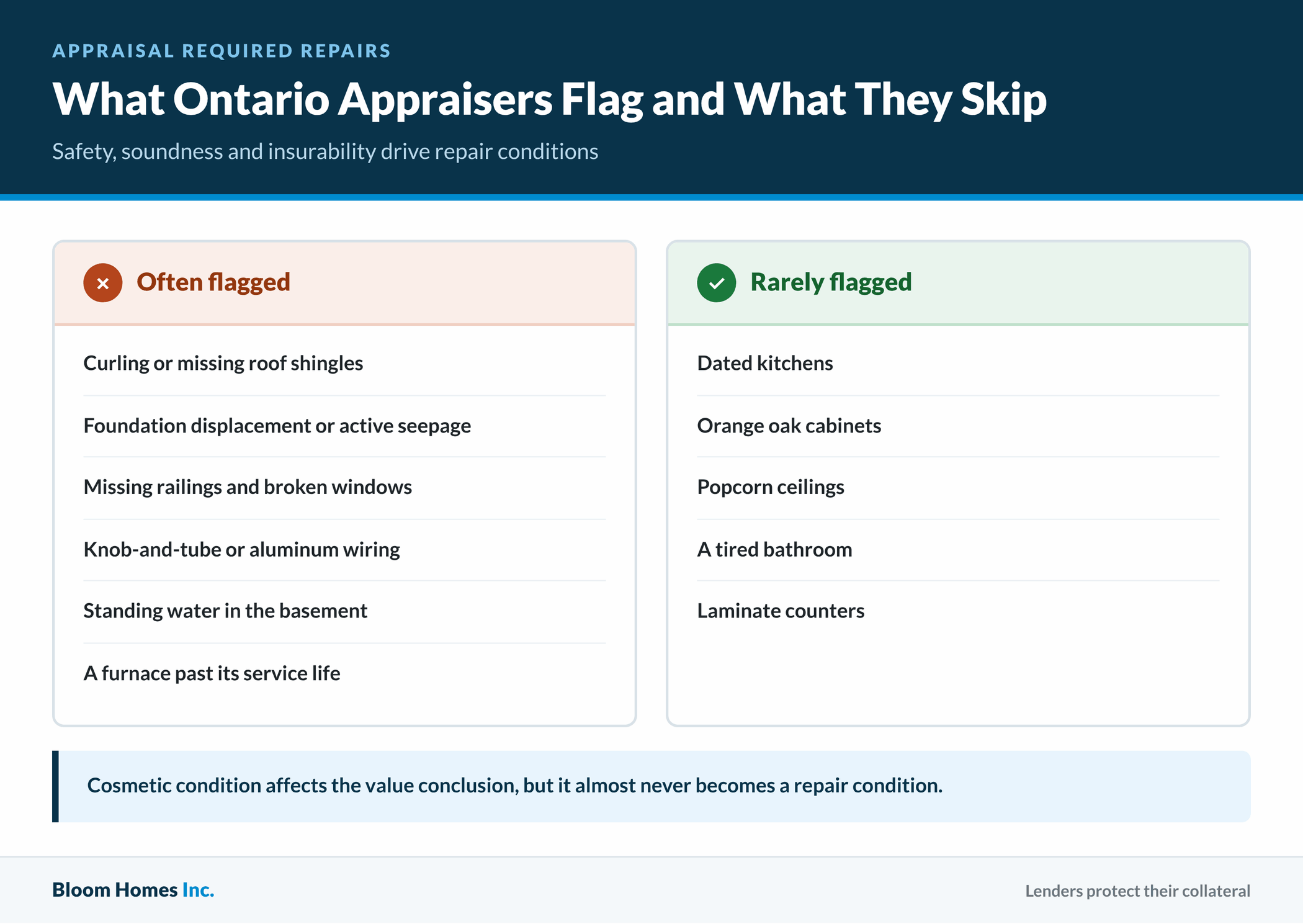
Roofs top the list of appraisal required repairs I see. Ontario winters are hard on shingles, so curling edges, missing tabs or moss tend to end up in the report.
Foundation cracks in older stone basements around Ottawa and Kingston get written up when the wall has shifted or water is coming through.
Safety items trip up more Ontario sellers than any big structural problem. Think missing stair railings, a broken basement window or a gas appliance with no vent. Knob-and-tube or aluminum wiring makes the list too, because insurers won’t cover it. A house nobody will insure is a house no lender wants to lend against.
Water is another common one, along with a furnace that’s past its useful life in a place where January drops well below freezing. Appraisers also note peeling paint on pre-1980 homes, rotted trim and untested septic or well systems on rural Ontario properties. Up in Muskoka and Grey County, they look hard at those last two.
Some agents won’t like this, but cosmetic condition almost never triggers repairs the appraisal requires. Dated kitchens, orange oak cabinets, popcorn ceilings or a tired bathroom in a Scarborough bungalow won’t create a subject-to condition. Those things can pull the value down, yet no lender is going to make you replace a laminate counter.
With a CRA designation, an appraiser covers homes of up to four units, from detached houses and semis to townhouses, condos and residential land. So a triplex in Etobicoke and a detached place in Burlington fall under the same rules.
How Much Do Appraisal Required Repairs Cost in Ontario?
“The bank will probably let it slide.” It won’t. I’ve watched that hope cost Ontario sellers more sales than I can count.
Begin with the appraisal itself, since it’s the first bill. Standard residential appraisals run roughly $300 to $500 in most of Ontario, and rural acreage or unusual homes cost more. If the buyer’s lender needs the report in a hurry, expect to pay extra for the rush.
Repairs are where budgets break. On a detached Ontario home, a new roof is usually the biggest line. It can reach five figures when the roofline is complex or old layers have to come off. Replacing knob-and-tube wiring in a pre-war Toronto semi lands in a similar range once you add the drywall patching.
Plenty of fixes are small. Railings, a few GFCI outlets, a cracked window pane or a dryer vent can cost a few hundred dollars and a Saturday afternoon.
Time is often the bigger cost. Good trades across Ontario are booked weeks out. A roofer who can’t start for five weeks means an extended closing, bridge financing or a buyer who gives up. I’ve seen sellers spend more carrying the house than they spent on the fix.
Doing the work yourself is sometimes allowed. Lenders on insured mortgages tend to want invoices from licensed contractors and photos as proof, though. Any electrical or gas work in Ontario needs a licensed trade either way, and the electrical side also needs ESA sign-off.
Lenders also tend to send the appraiser back to confirm the work is done, and that second visit has its own fee.
When the quotes come in higher than you can cover, selling as-is stops feeling like giving up and starts looking like simple math. Bloom Homes buys Ontario homes in their current condition, and with no lender in the picture, the repair list doesn’t apply.
How Do You Prepare Your Home for Appraisal Required Repairs?
Lots of sellers skip this step. Yet the cheapest hour you’ll spend is a slow walk through your own home. Look at it the way a stranger with a clipboard would.
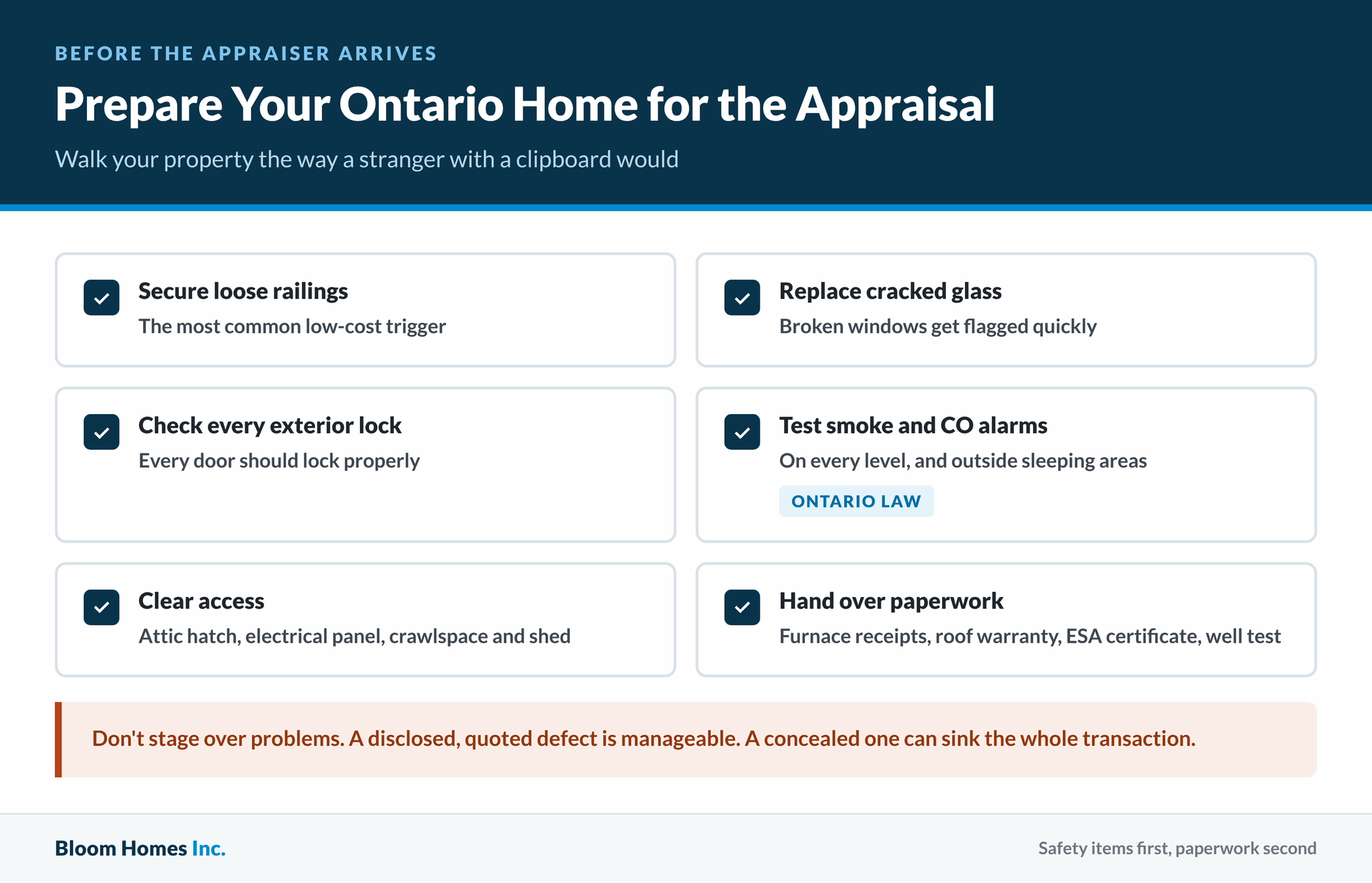
Safety items come first, because they’re the most common triggers and the cheapest to fix. Tighten loose railings, swap out cracked glass and make sure every outside door locks. Test the smoke and carbon monoxide alarms on each floor too. Ontario law requires CO alarms outside sleeping areas when a home has fuel-burning appliances or an attached garage.
Access matters more than you’d guess. Say the appraiser can’t reach the attic hatch, the electrical panel or the crawlspace. The report will note it, and a note like that often turns into a must-fix item. Clear the stored bins away from the panel in that Brampton basement and open up the shed before the visit.
Paperwork helps a lot. Keep receipts for a new furnace, a roof warranty, an ESA certificate or a recent well water test from a Simcoe County lab on the counter. Proof lets the appraiser confirm the work instead of guessing at it, and confirmed work rarely gets flagged.
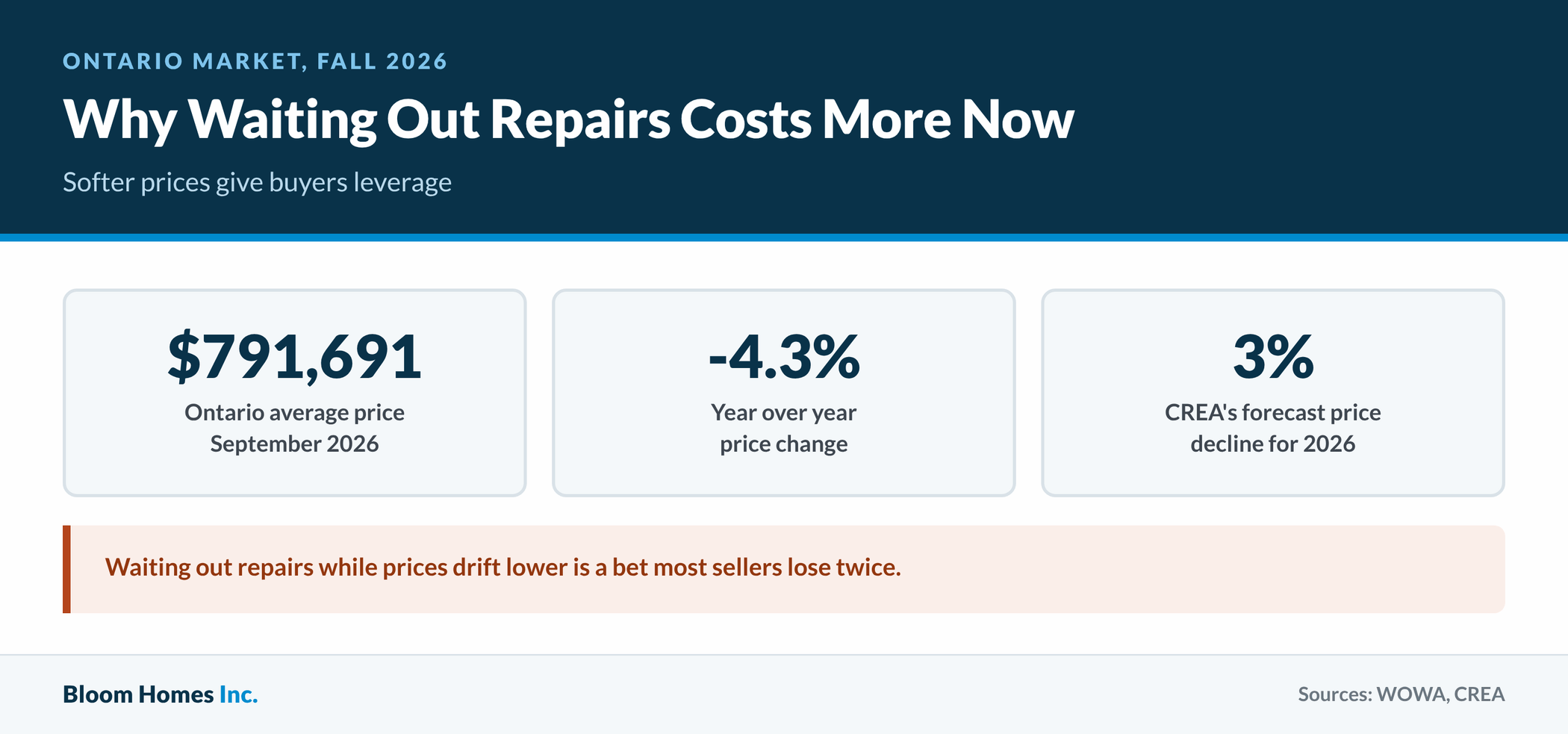
Ontario’s market gives you more reason to prepare than it did two years ago. Average prices across the province fell 4.3% year over year to $791,691 in September 2026, based on WOWA’s Ontario market report. When prices soften, buyers gain leverage, and an appraisal with strings hands them an easy reason to ask for less.
Please don’t hide problems behind the furniture. Pushing a bookcase in front of a water stain is the most common mistake I see Ontario sellers make, and appraisers spot it every time. Once you’ve disclosed and priced a defect, it’s manageable. One you tried to hide can poison the whole file.
Tidiness helps a little and clutter hurts a little, yet neither one creates appraisal required repairs by itself. Put your effort into things that work.
Can You Negotiate Appraisal Required Repairs with a Lender?
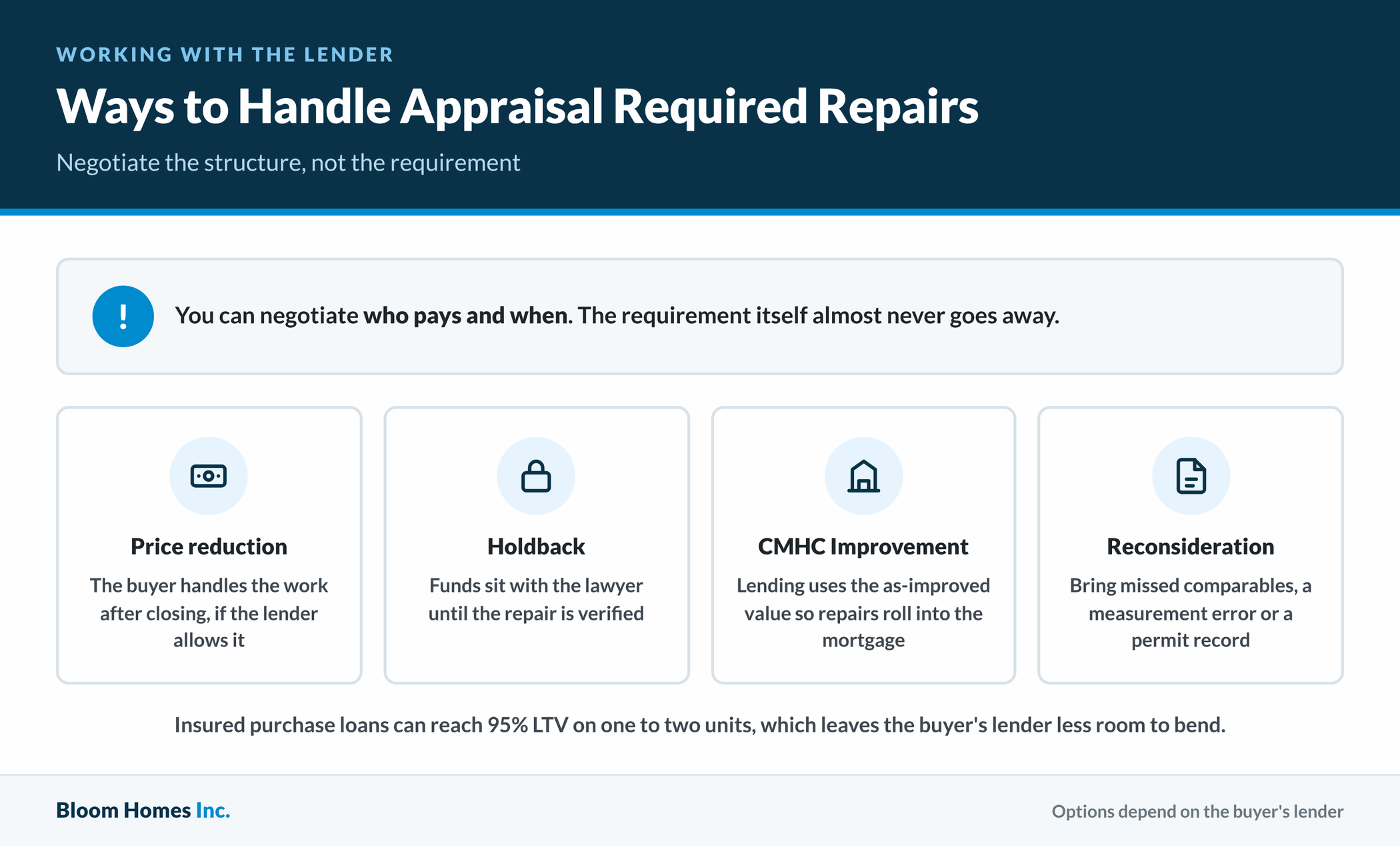
You can negotiate who pays and when, but you almost never negotiate the requirement itself away.
Lenders are protecting their collateral. If the borrower ever stops paying, a house in Thunder Bay with a failing roof is worth less than the report assumed. So the fix stays on the list.
How the repair gets handled is open for discussion. Many Ontario buyers and sellers agree on a lower price and let the buyer do the work after closing. That only works if the lender allows it. Some lenders accept a holdback, where the lawyer keeps money in trust until the repair is confirmed, and others allow a similar escrow.
There’s also a financing option a lot of Ontario sellers have never heard of. CMHC’s Improvement product looks at the home’s value as it is and its value after the work. It then lends on the lower of the improved value or the current value plus the repair cost, as the CMHC Improvement program page explains. With a good broker, a motivated buyer can sometimes fold your appraisal required repairs into their mortgage instead of asking you to finish them first.
You can also push back on the appraisal itself through a reconsideration of value. It only works with real evidence, such as comparable sales the appraiser missed, a measuring mistake or a permit showing the basement unit is legal. Simply disagreeing won’t change anything.
The buyer’s loan-to-value ratio decides how much room the lender has. In Canada, insured home loans can go up to 95% LTV on one or two units. Someone borrowing that much gets far less flexibility on appraisal required repairs than a buyer with thirty percent down. Ask your agent about the down payment early.
In a slower Ontario market, I’d offer the credit before anyone asks for it. Buyers who feel looked after usually close. Squeeze them, and they start browsing other listings in Waterloo or Windsor.
What Happens If You Skip Appraisal Required Repairs?
Many Ontario sellers assume a motivated buyer will just find another lender. The plan holds until the second appraiser flags the same item. By then the buyer has paid a few hundred dollars more to learn what the first report already said.
In Ontario, a failed sale doesn’t simply reset the clock. The listing goes back up carrying extra days on market, and sharp agents in Mississauga and Oakville will ask what went wrong. Your next offer typically comes in lower than the one you lost.
Another way around it is selling to a buyer who doesn’t need a mortgage. Doing so removes the appraiser, and the appraisal required repairs go with them. At the end of September 2026, active listings across Ontario sat 17.8% above the five-year average and 39.8% above the ten-year average, per CREA’s provincial statistics. With that much competition, a dead financing condition is costly to recover from.
Mortgages that need default insurance get the toughest look at condition. If you won’t do the work, you’re left mostly with cash buyers and people putting a lot of money down. In most Ontario neighbourhoods, that’s a small slice of the market.
Disclosure follows you as well. Once an appraiser has put a defect in writing, acting as if it isn’t there with the next buyer is a risk you don’t need. Talk to an Ontario real estate lawyer about what you have to disclose in your situation.
How Do Appraisal Required Repairs Affect Your Home’s Value and Equity Options?
One Thursday afternoon a homeowner called me from Peterborough, three months behind on his mortgage and with an auction date already on his calendar. His late father’s woodworking bench still sat in the garage. Water had come into the basement twice that spring, which is exactly what produces appraisal required repairs on any financed sale.
Open repair items shrink the group of people who can buy your home. Fewer buyers means a lower price in any Ontario market.
Look at what the lender is really measuring. Loan-to-value is worked out against the appraised value, so a home with open appraisal required repairs gets valued as it stands. Your equity shrinks on paper even though nothing about the house changed that week.
Ontario homeowners who try to refinance and pull out equity often find the appraiser has added fix-first items. No money gets released until they’re done. That’s a rough spot when you needed the cash to pay for the repairs.
Other equity options shrink along with it. HELOCs, second mortgages and private loans all start with a property appraisal, and each appraiser reads the same list of fixes. I’ve met Ontario owners with plenty of equity who couldn’t touch a dollar of it because of a roof.
CREA’s October 2026 outlook called for Ontario average prices to fall 3% this year, in its revised forecast release. Waiting on appraisal required repairs while prices slide is a bet most sellers lose twice.
Run the arithmetic honestly. Add up the repair quotes, what it costs to carry the house during the work, the second inspection and the chance the buyer walks anyway. Then compare that with a direct sale where no appraiser is involved. For some Ontario sellers the repair route clearly wins, while for others facing a deadline it isn’t close.
Your numbers may land differently, and that’s fine. Knowing both totals beats guessing.
Frequently Asked Questions
Can an Appraisal Actually Require Repairs Before a Mortgage Funds?
Yes. An appraiser can make the report subject to specific work, and the lender treats that as binding. Until the work is finished and confirmed, the mortgage money doesn’t move. It’s the most common reason a well-priced Ontario home stalls between an accepted offer and closing.
How Much Does a Home Appraisal Fee Cost in Ontario?
Most standard appraisals in Ontario fall within the range mentioned earlier, with condos and city homes at the lower end. Rural acreage, waterfront, heritage homes and anything unusual cost more, because comparable sales take longer to find. The buyer or borrower tends to pay, even though the lender orders the report.
What Counts as a Red Flag on an Appraisal Report?
Anything tied to safety, the structure or insurability can be a red flag. Water coming in, a moving foundation, unsafe wiring and a dead furnace in an Ontario winter all qualify. So do missing railings and a worn-out roof. Dated finishes aren’t a red flag, though they do shape the appraiser’s view of market value.
Who Pays for Appraisal Required Repairs, the Buyer or the Seller?
It’s up for negotiation. In most sales the seller finishes the work before closing. You and the buyer can also agree on a lower price, a holdback with the lawyer or a credit, as long as the buyer’s lender accepts it. Whatever you settle on belongs in writing in the agreement.
Can I Sell an Ontario Home Without Clearing Appraisal Required Repairs?
Yes, as long as your buyer isn’t relying on the lender that ordered the report. Cash buyers and investors buy properties with open conditions across Ontario every week and build the work into their price. You trade some of the price for a quicker, simpler close.
Will Fixing Appraisal Required Repairs Raise My Home’s Appraised Value?
Usually it protects your value more than it raises it. Finishing the work turns a report with strings into a clean one, which the lender needs, but you rarely get back more than you spent. Ontario sellers facing big repair bills should price both routes before choosing one.
If you’re looking at a repair list you didn’t plan for, we’re happy to talk it through with you. We can also give you a second opinion on fixing versus selling as-is. Our team at Bloom Homes knows Ontario homes and Ontario timelines, and a conversation costs you nothing. There’s no pressure, and no hard feelings if listing turns out to be the better fit.
Ontario Prices and Your Repair Math
Ontario’s MLS Home Price Index benchmark was $733,600 in October 2026, down 3.8 percent from a year earlier, based on CREA’s provincial figures. As prices drift lower, every dollar spent on repairs gets harder to win back at closing.
If you own in the capital, you can see how we buy houses in Ottawa as they sit, repairs and all.
Get a Second Opinion on Your Repair List
You don’t have to decide between fixing and selling as-is on a hunch. Send us a few details about your house and the repairs the appraiser flagged. We’ll look it over and share a fair cash offer for the house as it is, with no repair list and no lender conditions. Reach out to our team or use the short form below.
Helpful Ontario Blog Articles
- How to Find a Legitimate Cash Home Buyer in Ontario
- How to Sell Your House Fast in Any Condition in Ontario
- Can the Seller Back Out of a Contract in Ontario
- How Long a Real Estate Contract Lasts in Ontario Before It Expires
- How to Sell a House with Water in the Crawl Space in Ontario
- How to Sell an Ontario House That Needs Repairs Without Losing Money
- How Long Can a Seller Stay in the House After Closing
- How to Sell a House with Termites in Ontario
- Can You Sell a House with Mold in Ontario
- How to Sell a House with Title Issues in Ontario
- What Is the Best Time to Sell a House in Ontario
- What Appraisal Required Repairs Mean for Ontario Home Sellers
- Can You Sell a House in Ontario with a Pending Insurance Claim