A buyer’s lawyer once stopped a transaction four days before closing over a mortgage from 1994. It had been paid off years earlier, and nobody had registered the discharge. The money was sitting in trust and the moving truck was booked. The parcel register still showed a charge against the property, so everything stopped cold. Title issues in Ontario work like that, quiet for decades and then suddenly the only thing anyone cares about. If you’re selling and something on your deed looks wrong, you’re not stuck. You just need to move in the right order.
Common Title Issues Ontario Home Sellers Should Watch For
Miss one of these and your closing date slides, your buyer walks, and you’re relisting in a market that’s already dropped. In October 2026, the average resale price across Ontario was $801,634, down 3.5% from a year earlier, according to the Ontario Real Estate Association. Lose a buyer over a paperwork defect and you start over in a softer market.
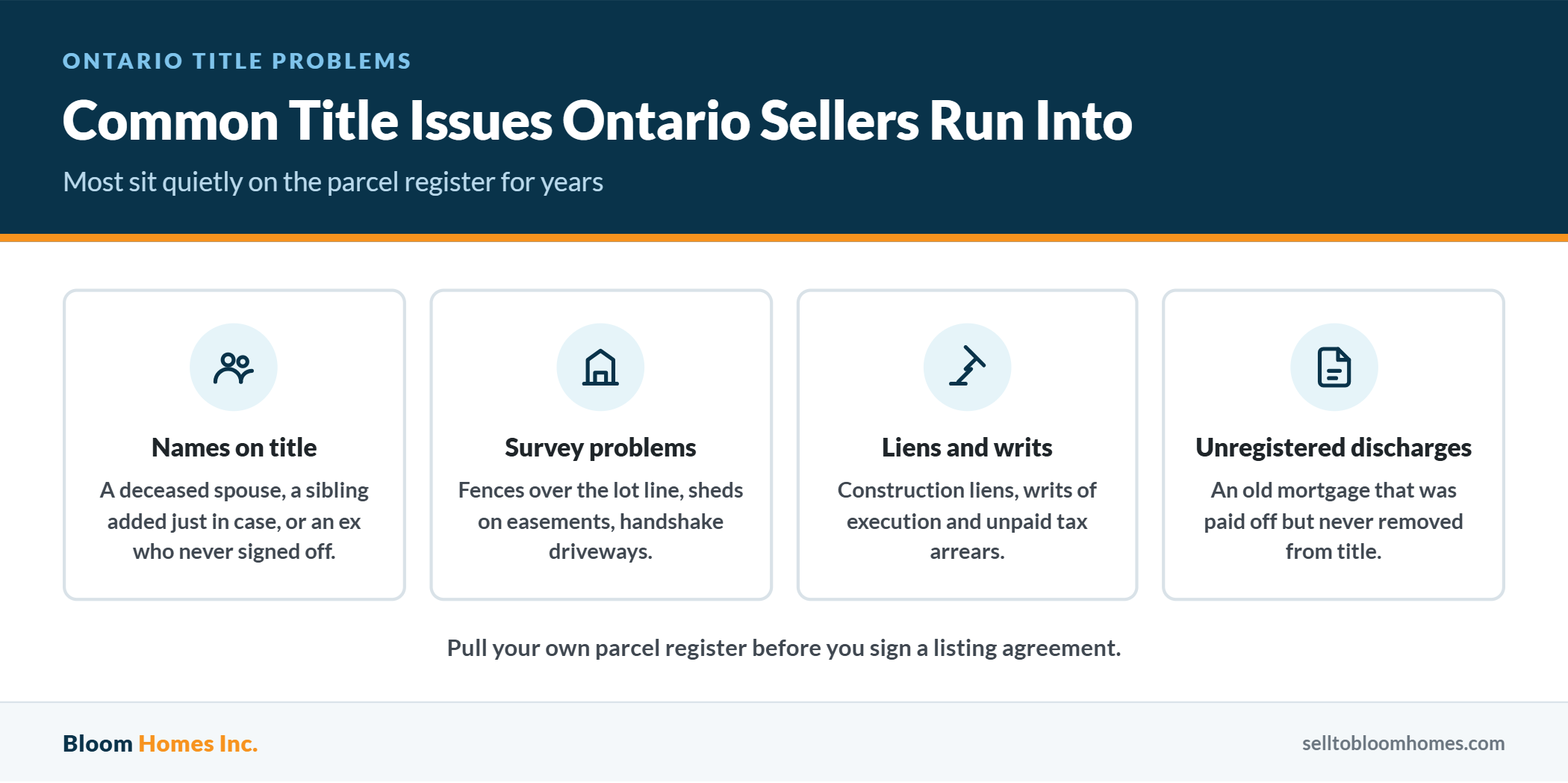
The snag I run into most often involves names. It might be a deceased spouse still on title, or a sibling who was added “just in case.” Sometimes it’s an ex who was supposed to sign off during the separation and never did.
Survey problems are their own category. Think of a neighbour’s fence sitting two feet onto your lot, a shed built over a utility easement, or a driveway shared on a handshake since 1978. Buyers in Ontario towns with older housing stock run into this constantly. In places like Hamilton’s North End or the village core of Elora, the lot lines predate anybody’s memory of them.
Then come the registered claims. A contractor who felt shorted may file a construction lien. A judgment creditor can file a writ of execution, and the municipality can register unpaid property tax arrears.
The Ontario land registry holds the official records of ownership, along with mortgages, transfers and leases. ServiceOntario notes it covers more than 7.4 million parcels across the province. Your defect lives in there somewhere, in writing, waiting. My view is that most sellers in Ontario should pull their own parcel register before they ever sign a listing agreement. Finding title issues on your own schedule costs a fraction of finding them on a buyer’s.
How Liens and Encumbrances Affect Your Title Issues
A lien doesn’t stop you from owning the property. It stops the money from moving cleanly at closing, because no lender in Ontario will advance mortgage funds onto a title with an unresolved charge sitting ahead of them.
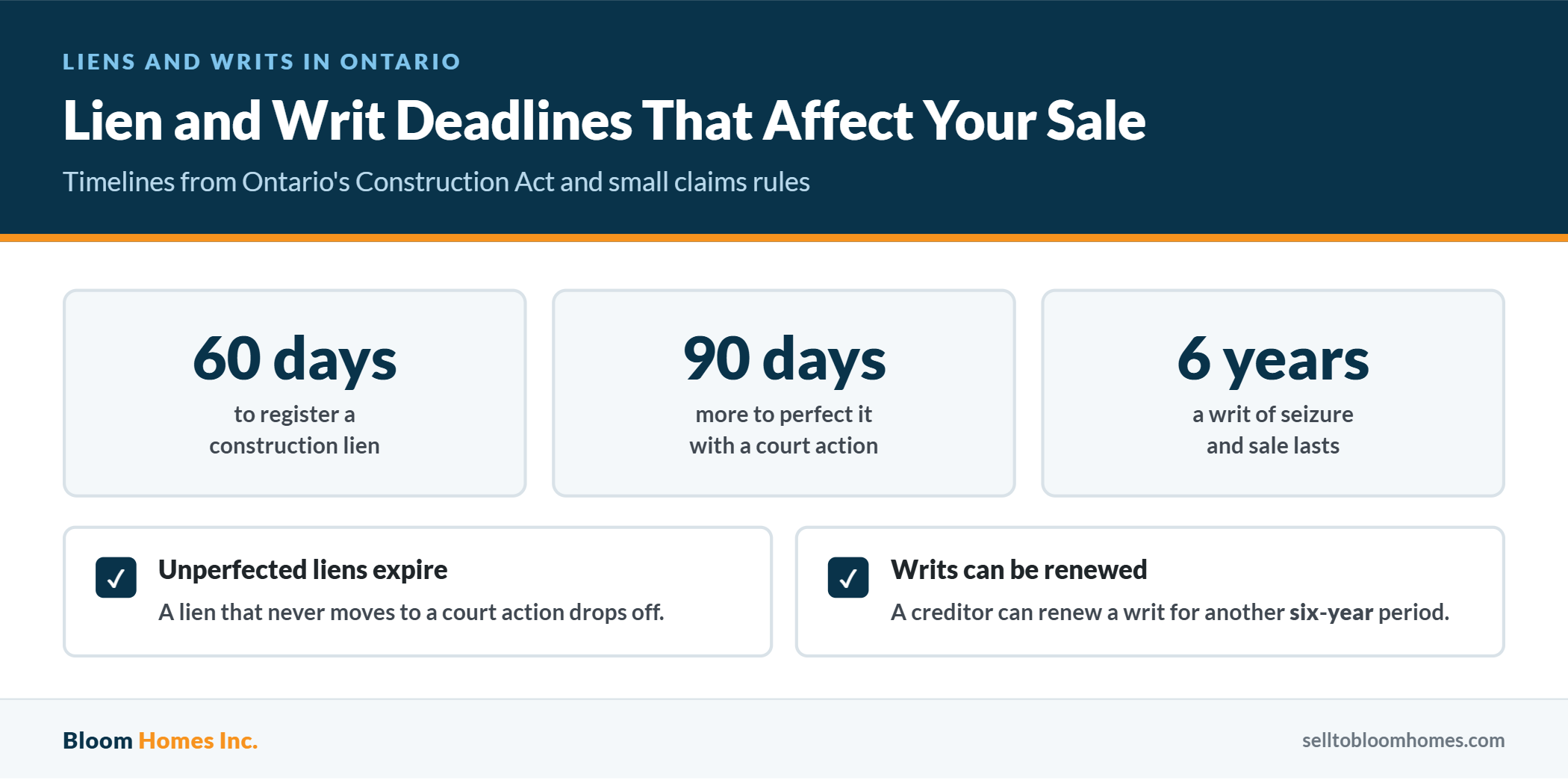
Construction liens run on a tight clock. Under Ontario’s Construction Act, a contractor has to preserve the lien by registering a claim against title within 60 days of the statutory trigger. Then they have a further 90 days to perfect it by starting a court action, as the Act’s deadlines are laid out here. An unperfected lien expires. A perfected one follows you to the closing table.
Judgment creditors work differently. A writ of seizure and sale is filed with the sheriff’s enforcement office in the county where you own land, and it binds that property. Ontario’s small claims guidance confirms a writ lasts six years from issue unless the creditor renews it for another six-year period.
A while back, three siblings in Whitby called me about a bungalow their mother had left them. None of them wanted to be landlords, and the tenant had stopped paying in the spring. Then an execution search turned up a writ against one brother from an old business debt he thought was long settled. Before that bungalow could close, the writ had to be paid out of his share or formally discharged.
Property tax arrears deserve a mention too. Municipalities in Ontario can register tax arrears certificates, and that kind of encumbrance tends to grow quietly as interest is added month after month.
What Title Issues Show Up at Closing in Ontario
For years I assumed the lawyer’s search was a formality, something that happened in the background while everyone focused on financing. I was wrong, and a couple of sellers I worked with paid for it.
Everything starts with the parcel register, which lists the current owner, the legal description and every active instrument registered against the property in Ontario’s land registration system. Your lawyer orders it, reads it line by line, and flags anything that shouldn’t be there.
Execution searches come next, and they’re run against the exact name of each registered owner. Picture a seller whose legal name is Margaret but who’s signed as Peggy for thirty years. That gap can trigger a false hit or, worse, a missed one.
What surfaces late in an Ontario closing tends to be small stuff with big consequences. Think of an unregistered discharge, or a spousal consent missing from a transfer signed years earlier. Estate transmissions never completed after a death show up often, and so do municipal work orders tied to the property.
Have you ever had a lawyer call you nine days before closing with a question you couldn’t answer?
Title insurance smooths over a surprising share of these. You pay a one-time premium at closing, and the insurer agrees to cover certain defects rather than demand they be cured first. Not every defect qualifies, though. Known title issues that you’ve already been told about generally sit outside coverage. That’s why early discovery beats late discovery every time in Ontario real estate.
Buyers in competitive pockets of Ontario still expect a clean parcel register, insurance or not.
Do You Have to Disclose Title Issues to Buyers in Ontario
“If I don’t mention the lien, does it just go away at closing?”
No. Trying that approach is the fastest route to a collapsed transaction plus a lawsuit. Ontario follows a buyer-beware tradition for many property conditions, though title works differently. Your agreement obligates you to convey good title on closing day.
During the requisition period, the buyer’s lawyer runs searches and raises any objections in writing. You either clear the defect or the buyer can refuse to close. Hiding title issues doesn’t buy you anything. It just moves the confrontation to a worse moment.
My advice runs against what some agents suggest. Rather than staying quiet and hoping the buyer’s lawyer finds nothing, disclose known title issues up front and price accordingly. Buyers who learn about an encumbrance on day one negotiate, and buyers who learn about it on day sixty walk. They tell their agent why, and that agent tells other agents in your corner of Ontario.
Estate sales are where disclosure gets delicate. If you’re selling as an executor in Ottawa or Sudbury and the probate certificate hasn’t been issued, say so in the listing. Everyone saves a wasted showing.
Protect yourself with written disclosure through your lawyer, not a verbal mention and definitely not a casual email. I’ve watched transactions fall apart simply because this step got skipped. Title issues should be described in the agreement itself, with language about what the seller will and won’t cure. Both sides then have a document to point at.
Can You Sell a House with Title Issues in Ontario?
So, to the question everyone’s been circling. Yes, you can sell. Thousands of Ontario properties change hands every year with something unresolved on the parcel register, and most of those close on time.
Usually it works as a payout at closing. Your lawyer works out what’s owed, holds that amount back from your proceeds, pays the lienholder or creditor directly, and registers the discharge. You net less, the buyer gets clean title, and everybody moves on.
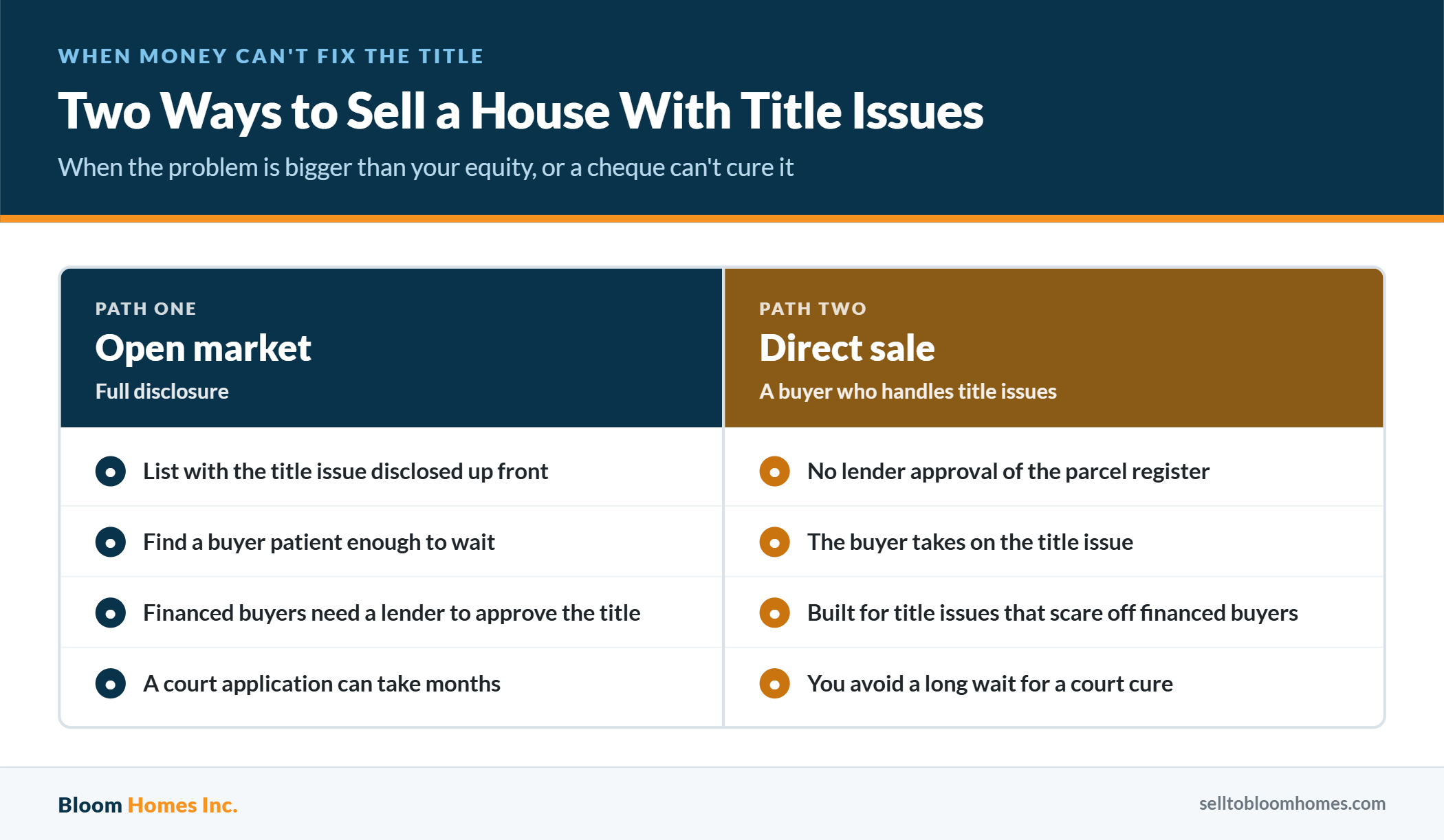
Trouble starts when the encumbrance is bigger than your equity, or when money can’t cure the defect at all. A cheque won’t fix a missing heir’s signature.
At that point you’ve got two paths. One is selling on the open market with full disclosure and a buyer patient enough to wait out a court application. The other is selling to someone who buys properties with title issues as a matter of routine, which is where we spend most of our time. Bloom Homes Inc. takes on title issues that would scare off a financed buyer, because we’re not waiting on a lender to approve the parcel register.
Sellers often underestimate how much timing matters in a softer market. Hamilton’s benchmark price was $667,500 in October 2026, down 4.3% from a year earlier. Homes across Cornerstone’s market areas, including Hamilton and Burlington, averaged 37 days on market, per the Cornerstone Association of REALTORS. Dragging a title problem through a slow Ontario market costs you carrying charges every month. I’ve seen those extra weeks quietly eat a seller’s margin.
Can a Quitclaim Deed Fix Title Issues When Selling
A parcel register pulled through OnLand costs about $37 and a few minutes. That’s less than one hour of a lawyer’s time spent guessing, so start there before you think about deeds.
Now, terminology. Ontario doesn’t use “quitclaim deed” the way American sellers do. Our closest instrument is a transfer, sometimes called a quitclaim transfer, registered electronically through Teraview against title. The idea is similar, since one party releases whatever interest they may hold without promising they hold anything at all.
A quitclaim transfer resolves title issues involving a person who shouldn’t be on the deed. That could be a former partner, an adult child added for estate planning, or a sibling who inherited a fractional share and wants out. It does nothing about a bank’s charge or a registered lien.
Where does it work well? Separated couples in Ontario where one spouse keeps the house are a classic fit. So are co-owners who bought a duplex in St. Catharines together in 2011 and are untangling it now.
Land transfer tax comes into play on some of these transfers, and Toronto adds a municipal layer on top of the provincial charge. Before anyone signs, have legal counsel confirm what’s payable in your situation.
Families often get a quitclaim transfer registered on its own and assume they’ve cleared the title issues. Then they learn at closing that an outstanding mortgage still names the person who signed away their interest. It happens because releasing an ownership interest and releasing a debt obligation are separate acts.
What to Do If You Discover a Title Issue on Your Property
A seller in Barrie found out her late husband’s name was still on title eleven years after he passed. She learned it three days after accepting an offer. Her lawyer handled the estate transmission, the buyer agreed to a two-week extension, and it closed.
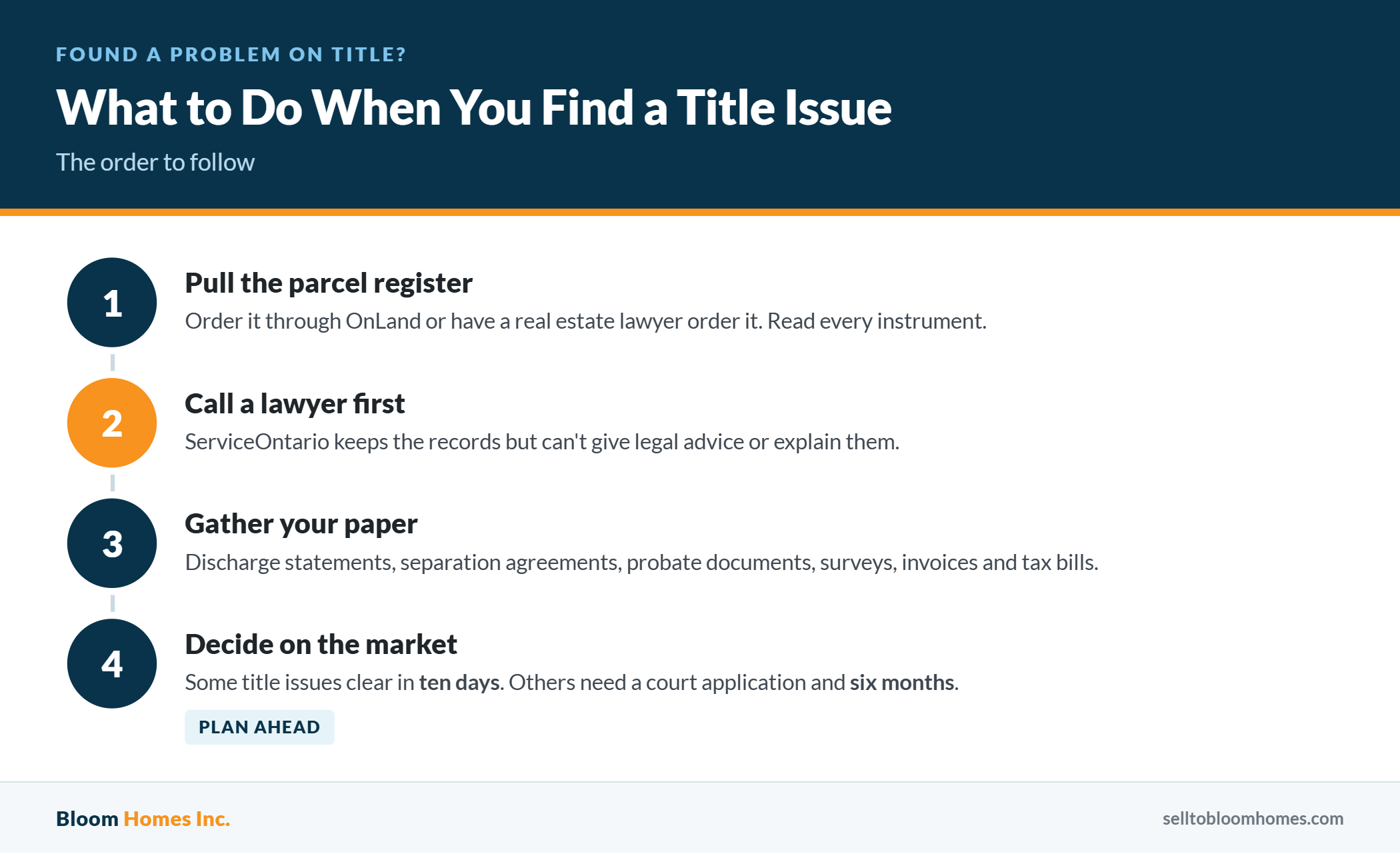
This is the order I’d follow.
Pull the parcel register first, through OnLand or by asking a real estate lawyer to order it. Read every instrument listed, including the ones from decades ago. A charge with a dollar figure beside it means an active mortgage is registered, whether or not you’ve been making payments on it.
Get a lawyer involved before you talk to anybody else about the title issues you found. ServiceOntario keeps the records, but it says plainly that it can’t search them for you, give legal advice, or explain what a property’s documents mean. You need someone who reads these for a living.
Gather your paper. That means discharge statements, separation agreements, probate documents, old surveys, contractor invoices and the municipal tax bill. Ontario lawyers clear title issues faster when they aren’t rebuilding history from scratch.
Then decide how you’ll handle the market. Some title issues clear in ten days, while others need a court application and six months. Ottawa’s median sale price was $622,000 in October 2026, and the median home took 25.5 days to sell, according to the Ottawa Real Estate Board. In a market like that, a six-month cure means carrying an empty house through most of an Ontario winter.
A landlord in Peterborough reached out when his mother moved into assisted living. The rental she’d owned since the eighties had a lien from a roofing job he knew nothing about. He was driving back and forth on weekends, sorting forty years of her things in the garage. Selling as-is with the title issues disclosed let him stop. Bloom Homes Inc. works with Ontario sellers in exactly that spot.
How to Price a House with Title Issues in Ontario
Before: a Windsor semi listed at market, four showings, zero offers once the lien surfaced. After: repriced with the encumbrance disclosed and the payout built into the numbers, it sold in under three weeks.
Pricing a property with title issues means pricing the uncertainty, not just the house. Buyers discount for risk, and the discount they apply is almost always bigger than what the cure actually costs.
Start with a clean comparable value for your neighbourhood. The London and St. Thomas area averaged $601,289 in October 2026, per the local real estate board. Your pricing conversation should begin with numbers that are specific to your own corner of Ontario.
Subtract the known payout amount. Then subtract a realistic holding cost for the delay the title issues will cause, like mortgage interest, property tax, insurance, utilities, lawn care in July and snow removal in February.
What’s left is your floor, and anything above it is money you’d never see if the sale collapsed anyway.
I’d push back on one common piece of advice. Agents sometimes suggest listing high and “seeing what happens” while the title issues get sorted in the background. That burns your best weeks of exposure.
Investors in Ontario will offer cash below retail, and they should, because they’re taking on risk your lawyer hasn’t measured yet. What that discount gets you is certainty and speed. For a property with a clouded deed and a seller who needs out, that trade is often the right one.
Frequently Asked Questions
Can I List My Ontario House Before the Title Issues Are Cleared?
You can, and plenty of sellers do. Your lawyer will want the cure underway before the closing date, so the smart move is starting the legal work the same week you list. Don’t wait for an offer. Tell your agent what’s on the parcel register so the listing timeline reflects reality.
How Much Does a Title Search Cost in Ontario?
Ordering a parcel register through the provincial system is cheap, usually a small fee per property. A full search by a real estate lawyer, including execution searches against every registered owner’s name, costs more. It’s typically folded into your closing legal fees, so ask for the fee in writing before you hire anyone.
Will Title Insurance Cover Title Issues I Already Know About?
Generally no. Title insurance is built for defects nobody found during the search, not for an encumbrance you were told about last spring. That’s a strong reason to clear known title issues properly rather than hoping a policy absorbs them later.
Does a Lien Mean I Lose My House?
Not on its own. A registered claim against your Ontario property blocks a clean transfer and gives the creditor a way to enforce, though it doesn’t hand ownership to anybody. Most liens get paid out of sale proceeds at closing and discharged the same day.
What If a Co-owner Refuses to Sign the Sale Documents?
Ontario law lets a co-owner apply to court for a partition and sale order, which forces the issue when talks fail. That path takes months and legal fees, so I’d exhaust every conversation first. A lawyer who handles co-ownership disputes can tell you quickly whether your situation qualifies.
Can I Sell an Inherited Property in Ontario Before Probate Is Finished?
You can sign an agreement, but you can’t transfer title until the estate paperwork is registered. Many Ontario buyers will accept a longer closing window if they know the estate is in progress and the executor is moving. Be upfront about where things stand so nobody’s surprised.
Title Issues in a Slower Ontario Market
Across the GTA, the average selling price was $1,024,108 in October 2026, down 2.7% from a year earlier, according to the Toronto Regional Real Estate Board. In a market like that, a buyer who finds a lien late has every reason to walk away.
Bloom Homes Inc. buys Toronto houses and homes throughout Ontario with title issues still on the parcel register.
Our Ontario office is in St. Catharines, and your lawyer can pay out what’s owed from the sale at closing.
Get a Straight Answer on Your Title Problem
You don’t have to clear the title before you call us. Tell us what’s on the parcel register, or what you think is there. We’ll explain how a direct sale would handle it next to listing with an agent.
Contact Bloom Homes Inc. or use the form below. There’s no cost to ask and no obligation to sell.
Helpful Ontario Blog Articles
- How to Find a Legitimate Cash Home Buyer in Ontario
- How to Sell Your House Fast in Any Condition in Ontario
- Can the Seller Back Out of a Contract in Ontario
- How Long a Real Estate Contract Lasts in Ontario Before It Expires
- How to Sell a House with Water in the Crawl Space in Ontario
- How to Sell an Ontario House That Needs Repairs Without Losing Money
- How Long Can a Seller Stay in the House After Closing
- How to Sell a House with Termites in Ontario
- Can You Sell a House with Mold in Ontario
- How to Sell a House with Title Issues in Ontario
- What Is the Best Time to Sell a House in Ontario
- What Appraisal Required Repairs Mean for Ontario Home Sellers
- Can You Sell a House in Ontario with a Pending Insurance Claim