
Pull back a floor hatch in a century home in Peterborough and you might find two inches of standing water that nobody’s looked at since 1998. Plenty of sellers find exactly that. Across Ontario, older homes on rubble foundations, post-and-beam piers, and poured walls that predate modern drainage all share the same vulnerability: a crawl space that collects groundwater every spring. Selling one isn’t a dead end. It just demands a different playbook than the one your neighbour used when she listed her dry bungalow last May.
Can You Sell a House with Water in the Crawl Space in Ontario?
Hide it, and you can be dragged back into court two years after you’ve spent the proceeds. Ontario real estate runs largely on buyer beware, but the courts carved out a sharp exception. A seller generally doesn’t have to volunteer a home’s flaws. Any known latent defect that renders the property dangerous or unfit to live in must be disclosed. Actively hiding any defect, though, can open a seller to a claim.
Yes, you can sell. Thousands of Ontario homes change hands every month with wet crawl spaces, failing weeping tile, and sump pumps that run eleven months a year.
What shifts is your buyer pool. Most CMHC-insured first-time buyers in Barrie or Oshawa drop out once they hear about a wet crawl space, because their lender wants an appraisal without a moisture flag on it. You’re left with renovators, contractors, and investors.
Pricing honestly from day one is the move I’d push, since I’ve watched the alternative play out too many times. Sellers who list at full retail, sit through two failed inspections, then drop twice end up netting less than sellers who priced it in from the start. Buyers read price-drop history on Ontario MLS systems like a medical chart.
Not long ago, three siblings called me about a semi in Welland they’d been renting out since their mother passed. Their tenant moved out on a Thursday. By Friday they’d found standing water under the kitchen floor, and by Monday all three agreed they were done being accidental landlords in Ontario. We closed without touching a single repair.
Why Crawl Space Water Matters More Than Sellers Think It Does
A woman in Kingston once told me hers had “a bit of damp” every April. Her inspector found rot in three floor joists and a sagging subfloor under the bathroom. This turned a cosmetic listing into a structural one overnight.
The pattern holds across Ontario. Water under a house rarely stays a water problem.
Wood touching moisture for several winters loses load capacity. Insulation drops out of the floor cavity and sits in the mud. Ductwork corrodes. Air moves upward through a house naturally, so whatever’s growing down there is being pulled into bedrooms and living space above. Buyers in Ontario who’ve read anything about indoor air quality know this, and mold is the word they reach for first.
How badly that hurts you comes down to market conditions. Average resale residential prices across Ontario landed at $801,634 in October 2026, a 3.5% dip from October 2025. New listings dropped 8.8% year over year that month, with 33,510 homes hitting the market. Softer pricing with buyers holding leverage means problems get priced in hard.
Is your roof newer? Furnace replaced? None of it rescues an inspection report in the buyer’s mind, because water reads as uncertainty and uncertainty reads as risk.
I keep seeing deferred maintenance undervalued by sellers and overvalued by buyers. Once a report exists in writing, a $6,000 drainage fix frequently costs a seller $25,000 in negotiation. Ontario sellers with a wet one should decide their strategy before anyone walks through the door, due to that asymmetry.
What Buyers Are Really Reacting to When They See Crawl Space Water
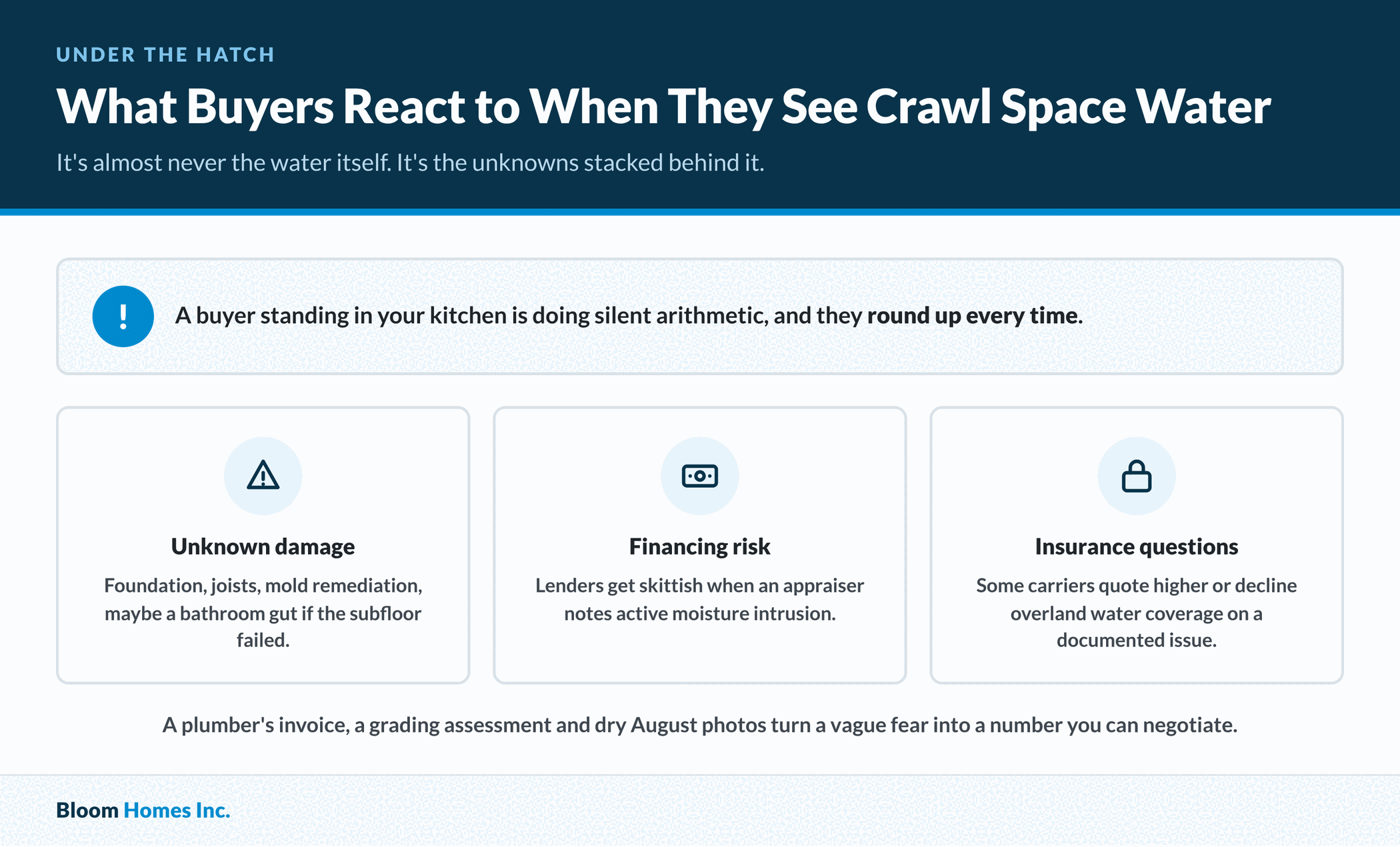
And it’s almost never the water itself.
Standing water signals unknown depth of damage, and unknown is the expensive word. Picture a buyer standing in your Ontario kitchen, doing silent arithmetic on foundation work, joists and mold remediation. If the subfloor failed, they’re pricing a bathroom gut on top of it. They round up every time.
Financing fear sits underneath that. Lenders across Ontario get skittish when an appraiser notes active moisture intrusion, and buyers know a conditional offer can collapse at the financing stage.
Insurance comes next. Water damage claims history attaches to a property. Some carriers in Ontario will quote a higher premium or decline overland water coverage entirely on a house with a documented issue there.
Paperwork changes the conversation. I’ve watched sellers transform a buyer’s reaction by handing over three things at the showing: a plumber’s invoice, a grading contractor’s assessment and photos of the space bone dry in August. Documentation turns a vague fear into a known quantity with a number attached, and a number is negotiable.
Ever notice how a house with an honest problem and a thick folder sells faster than a house with a vague problem and a shrug? Buyers in Ontario aren’t scared of repairs. They’re scared of surprises, and a damp crawl space with no history attached is pure surprise.
When a Septic Problem Is the Real Source of the Crawl Space Water
Before we talk price, let’s find out where the water’s coming from, because if it’s septic, everything changes.
Rural Ontario properties outside Lindsay, Bancroft, or anywhere in Hastings County often run on private systems. On clay soil with poor grade, a failed leaching bed can push effluent toward a crawl space. You’re no longer looking at groundwater. It’s a health matter, and it reframes the whole sale.
You should care about this because of cost. Replacing a standard Class 4 conventional system, meaning a tank plus leaching bed, runs $15,000 to $28,000 fully installed in Ontario in 2026, permit and stamped design included. Site complications come on top of that. Every onsite sewage system in Ontario needs a permit under Part 8 of the Ontario Building Code. You can read the breakdown at ocmexcavation.com if you want the detail.
Diagnosis is cheap by comparison, since a comprehensive septic inspection in Ontario typically runs $350 to $500 for a full assessment with a written report, per Kawartha Septic.
Getting that inspection yourself, before listing, is advice I give almost every rural Ontario seller, though plenty skip it anyway. The ones who follow it walk into negotiations knowing whether they’re arguing about a pump or an entire system, and that knowledge is worth far more than the inspection fee.
What Ontario Law Requires When You Disclose Crawl Space Water
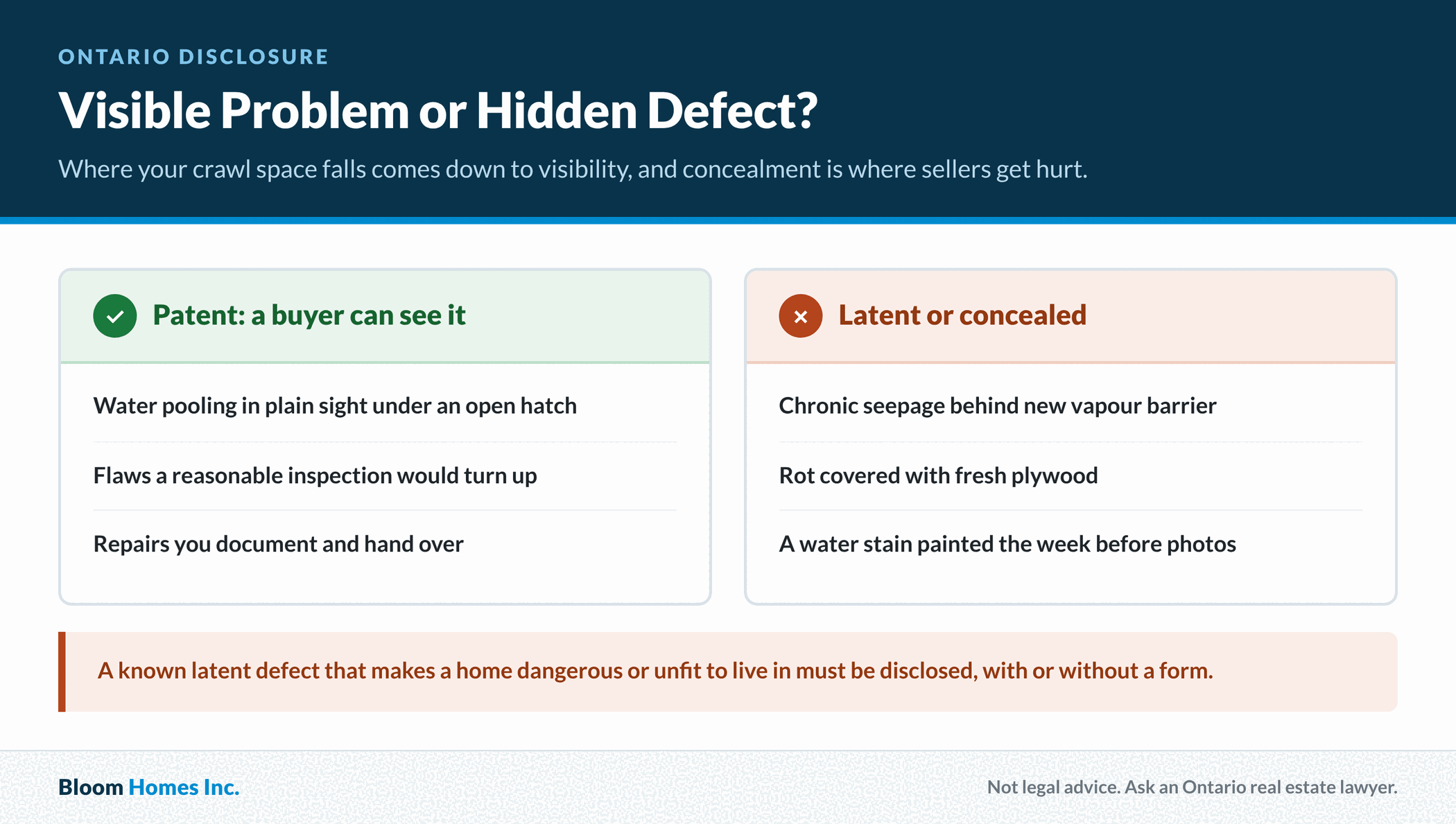
Staying quiet about a wet crawl space is the single worst financial decision an Ontario seller can make.
Ontario sellers don’t need to complete a formal disclosure form in standard resale transactions. The common law duty covered earlier still applies to hidden defects with or without one, and ZSM Law lays out the distinction clearly.
So where does yours fall? It comes down to visibility. Lawyers call a flaw that a reasonable inspection would turn up a patent defect, while a latent defect stays hidden through an ordinary viewing. Water pooling in plain sight under an open hatch is patent. Chronic seepage behind new vapour barrier, or rot you’ve covered with fresh plywood, is latent and dangerous territory.
Concealment is where Ontario sellers get destroyed. Hiding known water damage and selling “as is” gives sellers no legal protection, and courts have repeatedly held sellers liable for concealing it. Painting a water stain the week before photos is not staging. It’s evidence.
One clarification worth making: a repaired crawl space issue still carries weight. Past water damage generally meets the standard if a reasonable buyer would want to know, even when fully repaired, and documentation of that repair should come along with it.
Don’t take legal direction from a blog, including this one. An Ontario real estate lawyer reviewing your specific situation costs a few hundred dollars and settles the question properly.
Where Crawl Space Water and Mold Show Up on the Seller Disclosure Form
Ontario’s version is the Seller Property Information Statement, the SPIS, which isn’t legally mandatory but shows up in plenty of transactions. The Ontario Real Estate Association standardized it, and it gives sellers a formal place to declare both patent and latent defects. Plenty of Ontario lawyers advise skipping it, because an incomplete or sloppy answer creates liability that silence wouldn’t.
Skipping the form doesn’t erase your duty, though. Your common law obligation around a dangerous latent defect survives with or without paperwork.
If you do complete an SPIS, the crawl space surfaces in several places. These statements cover water penetration, flooding, drainage, and, on rural property, well and septic details.
Partial answers are the trap. Writing “minor seepage, repaired 2019” when you’ve pumped water out every April since is worse than writing nothing. One of the grounds that supports a claim is a false answer on a signed disclosure form.
My standing recommendation: whatever you write, attach proof. Invoices, dated photos, remediation certificates, the sump pump warranty. Buyers across Ontario settle down fast when they can see the work. Sellers who hand over a file folder at the kitchen table almost never face a last-minute price grab, because there’s nothing left to discover about the crawl space.
How Do Your Options Compare for Selling an Ontario House with a Wet Crawl Space?

Time on market is the variable nobody factors into the repair-versus-sell math. Fixing a crawl space properly in Ontario means scheduling a contractor, waiting for dry conditions, possibly waiting on a permit, then waiting again for mold clearance. You’d be paying weeks of carrying costs on a house you’ve already decided to leave.
Three realistic paths exist.
Full repair then retail listing gets you the highest gross number. You’re waterproofing, replacing damaged joists, remediating mold, and restoring whatever flooring came up. The upside is real in strong markets. In the GTA, though, the MLS HPI composite benchmark fell 4.3% year over year in October 2026, according to TRREB’s Market Watch, and the average selling price slid 2.7% to $1,024,108. Sinking $30,000 into a softening market is a bet, not a guarantee.
Listing as-is on MLS is path two. You disclose it, price below comparables, and accept that your buyer pool shrinks to renovators and investors. Showings still happen. Your house still gets photographed, and strangers still peer through its hatch with flashlights.
Selling direct to a local buyer is the third, and it comes with no repairs, no staging, no financing condition, and a closing date you pick. Our team at Bloom Homes buys Ontario houses with active water issues because we’ve already budgeted the remediation.
Which one suits you depends less on the crawl space and more on your timeline and your appetite for uncertainty. With twelve months and some savings, a seller can usually justify fixing it. Someone carrying an empty house in Ontario through a winter probably can’t.
Fixing the Crawl Space, Selling As-Is, or Taking a Cash Offer: Which Path Fits Your Situation?
A Guelph owner spent four months and a credit line waterproofing a crawl space, then sold for barely above her original as-is offers. Another owner in the same situation took a direct offer in week one and moved on. Both were defensible choices; only one of them involved contractor scheduling.
Run the numbers before you run the project. If fixing it costs $20,000 and lifts your sale price by $18,000, you’ve paid for the privilege of waiting four months. Ontario sellers consistently overestimate how much a repair adds back, partly because buyers discount repaired work they didn’t supervise themselves.
Repair makes sense when the source is simple. Downspouts dumping against the foundation, a grade that slopes toward the house, a dead sump pump: those are cheap, fast, and genuinely add value in any Ontario market.
Selling as-is on the open market fits sellers with patience and no mortgage pressure. You’ll wait longer, because softer conditions mean buyers browse. The London and St. Thomas area average slipped to $601,289 in October 2026, down 0.7% from a year earlier. That tells you something about momentum in mid-size Ontario markets right now.
Direct sale fits people with a deadline. Divorce, estate settlement, a job starting in Alberta, a tenant who left damage behind. You trade some gross price for certainty, speed, and zero contractor involvement, and plenty of Ontario sellers find that trade worth making once they’ve priced out the alternative honestly.
An heir I worked with in Trenton inherited a house with thirty years of accumulation inside. It had a garage packed to the rafters with lumber and paint cans. Underneath, the crawl space had been seeping since before anyone noticed. Her siblings wanted it finished by spring, so we bought it as it stood, contents and all, and she kept just a few boxes of photographs.
Frequently Asked Questions
Can I Fix the Crawl Space While Tenants Still Live in the House?
Usually, yes, as long as your tenants keep their vital services. Ontario counts hot and cold water as a vital service, and no landlord can withhold it. The Landlord and Tenant Board does allow short shutoffs while repair work is underway, and you can read its guidance at Tribunals Ontario. Give tenants written notice before a sump pump install or drainage dig, then restore water as fast as the work allows.
Will a Home Inspector Always Find Water in the Crawl Space?
Almost certainly, yes. Any competent Ontario inspector opens the hatch, checks for moisture staining on joists, probes soft wood, and notes standing water or active seepage in writing. Assuming a dry August showing will hide a chronic water issue is wishful thinking, and the written report is exactly what your buyer will use to renegotiate.
Does Mold in the Crawl Space Have to Be Disclosed in Ontario?
If you know about it and it makes the home unfit or unsafe to live in, you’re obligated to disclose it, with or without a form. Mold growing out of sight under the floor is the textbook example of a hidden defect a buyer wouldn’t catch during a normal walkthrough. Document what you know, hand over any remediation paperwork, and let your lawyer review the wording.
Can I Just Install a Sump Pump and Call the Crawl Space Fixed?
Occasionally that genuinely solves it, particularly when the water is seasonal groundwater and the structure is sound. More often a pump manages the symptom while the source keeps working on your joists. Get a drainage contractor to identify where the water enters before you spend money, because a pump under rotted framing doesn’t fix anything a buyer cares about.
Do Cash Buyers Pay Fairly for a House with Crawl Space Water?
Direct buyers price the property as it sits, subtracting remediation cost and a margin, so the number is below retail for a dry comparable. What you get back is no repairs, no showings, no financing condition, and a closing date you choose. Compare that offer against your realistic as-is listing price minus carrying costs and commission, not against a fantasy renovated number.
What If the Crawl Space Water Is Coming From a Neighbouring Property?
Surface drainage disputes happen constantly in older Ontario subdivisions where regrading on one lot pushes runoff onto another. Your municipality’s bylaw or engineering department can usually tell you whether a drainage bylaw applies. Either way, you still disclose the condition of your own crawl space to buyers, regardless of who caused it.
Selling a House with Crawl Space Water in the Toronto Area
GTA agents reported 5,603 home sales in October 2026, down 7.9% from a year earlier, according to the Toronto Regional Real Estate Board. Fewer buyers are shopping, so the ones who are have every reason to negotiate hard on a wet crawl space. We buy houses across the GTA and the rest of Ontario, and homeowners across Toronto can get a cash offer without fixing the drainage first.
Talk to Us About Your Crawl Space Before You Decide
Maybe you’re sitting on an Ontario property with water under the floor, unsure whether to fix it, list it, or just be done with it. We’re happy to walk through the math with you. No pressure and no obligation; sometimes the right answer is to keep the house and fix the grading, and we’ll tell you that if it’s true.
When you’re ready, contact us and we’ll go through your numbers together. You can also fill out the form below for a no-obligation cash offer.
Helpful Ontario Blog Articles
- How to Find a Legitimate Cash Home Buyer in Ontario
- How to Sell Your House Fast in Any Condition in Ontario
- Can the Seller Back Out of a Contract in Ontario
- How Long a Real Estate Contract Lasts in Ontario Before It Expires
- How to Sell a House with Water in the Crawl Space in Ontario
- How to Sell an Ontario House That Needs Repairs Without Losing Money
- How Long Can a Seller Stay in the House After Closing
- How to Sell a House with Termites in Ontario
- Can You Sell a House with Mold in Ontario
- How to Sell a House with Title Issues in Ontario
- What Is the Best Time to Sell a House in Ontario
- What Appraisal Required Repairs Mean for Ontario Home Sellers
- Can You Sell a House in Ontario with a Pending Insurance Claim