A burst pipe on a January morning in Barrie, Ontario, can turn into eight months of paperwork, and the house can still sell. That surprises people. Somewhere along the way, homeowners picked up the idea that an open file with their insurer freezes everything. It doesn’t. Your pending insurance claim is a money matter between you and your insurer. Handing over the title is a separate step, and across Ontario the two run side by side every month.
Can I Sell My House in Ontario with a Pending Insurance Claim?
Yes. Anyone who tells you otherwise is mixing up a claim with a lien.
Your insurer has no power to stop a closing. The policy covers a loss that already happened, and selling the house afterward doesn’t make that loss go away. An open claim isn’t meant to block a sale. What changes is the paperwork about who collects the money.
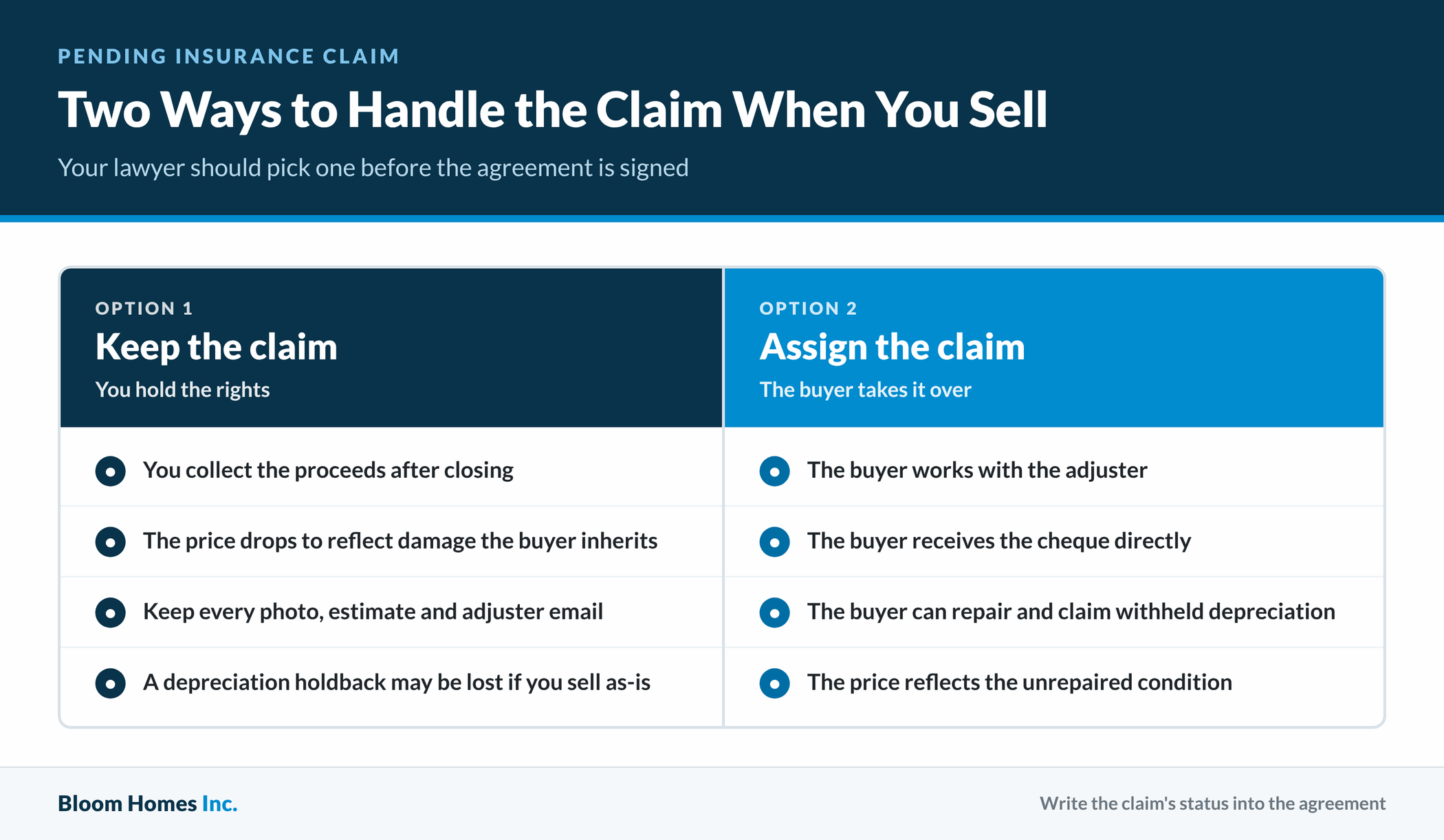
You have two routes, and your lawyer should pick one before you sign. One is to keep the rights to the pending insurance claim and lower the price to reflect the damage the buyer takes on. The other is to assign the claim, so the buyer handles the adjuster and gets the cheque.
Either route works. Both get messy fast when nobody writes them down properly. If the transfer wording is vague, the buyer may never collect, and they may come after you instead.
One wrinkle matters a lot in Ontario: the building stays at your risk until the sale completes. The insurance clause in the standard OREA sale agreement makes keeping it insured the seller’s job until closing. It also has you hold the policies and any payout in trust for both sides. So don’t cancel coverage the day the moving truck pulls away.
A retired couple in Whitby called me after carrying two mortgages for close to a year, because their sewer backup file kept getting reopened. They’d bought a bungalow near their daughter early the year before and figured the old place would sell by spring. We closed on a Thursday with the claim assigned to us, and their carrying costs stopped that afternoon.
Does a Pending Insurance Claim Scare Off Ontario Buyers?
A homeowner in Kitchener lost a porch roof in a windstorm and sat on her listing for five months, because her agent said buyers would run. She was half right. Retail buyers did run, yet the people who actually buy damaged houses, the ones I work with every week, never saw the listing.
Financed buyers are the real constraint, not buyers generally. Any lender funding a mortgage in Ontario wants an appraisal that supports the price, and visible damage puts that in doubt. Add a deadline for mortgage approval and a claim with no settlement date, and the sale gets shaky.
The market matters here too. Ontario’s average resale price was $801,634 in October 2026, and CREA now expects the provincial average to finish the year down 3%. Softer prices give buyers choices. Given a dozen similar listings, few will pick the one with an adjuster involved.
Does that leave you stuck? No. Your buyer pool simply shifts from families at open houses to investors and contractors who treat damage as a cost to price in.
I see the same pattern over and over. Sellers hide the damage in the photos, get an offer, then watch it fall apart at the inspection. Being upfront only costs you the buyers who were never going to close anyway.
Waiting has its own cost. Homes across Hamilton and Burlington averaged 41 days on market in July 2026, and a damaged house rarely keeps that pace on the open market. Buyers like Bloom Homes step in for exactly this situation, which is why so many of these claims end up with local buyers instead of on MLS.
Non-renewal vs Cancellation: How Does Each Affect Your Claim?
For years I lumped these two letters together and told sellers it didn’t matter which one they got. I was wrong, and it cost a couple of people time.
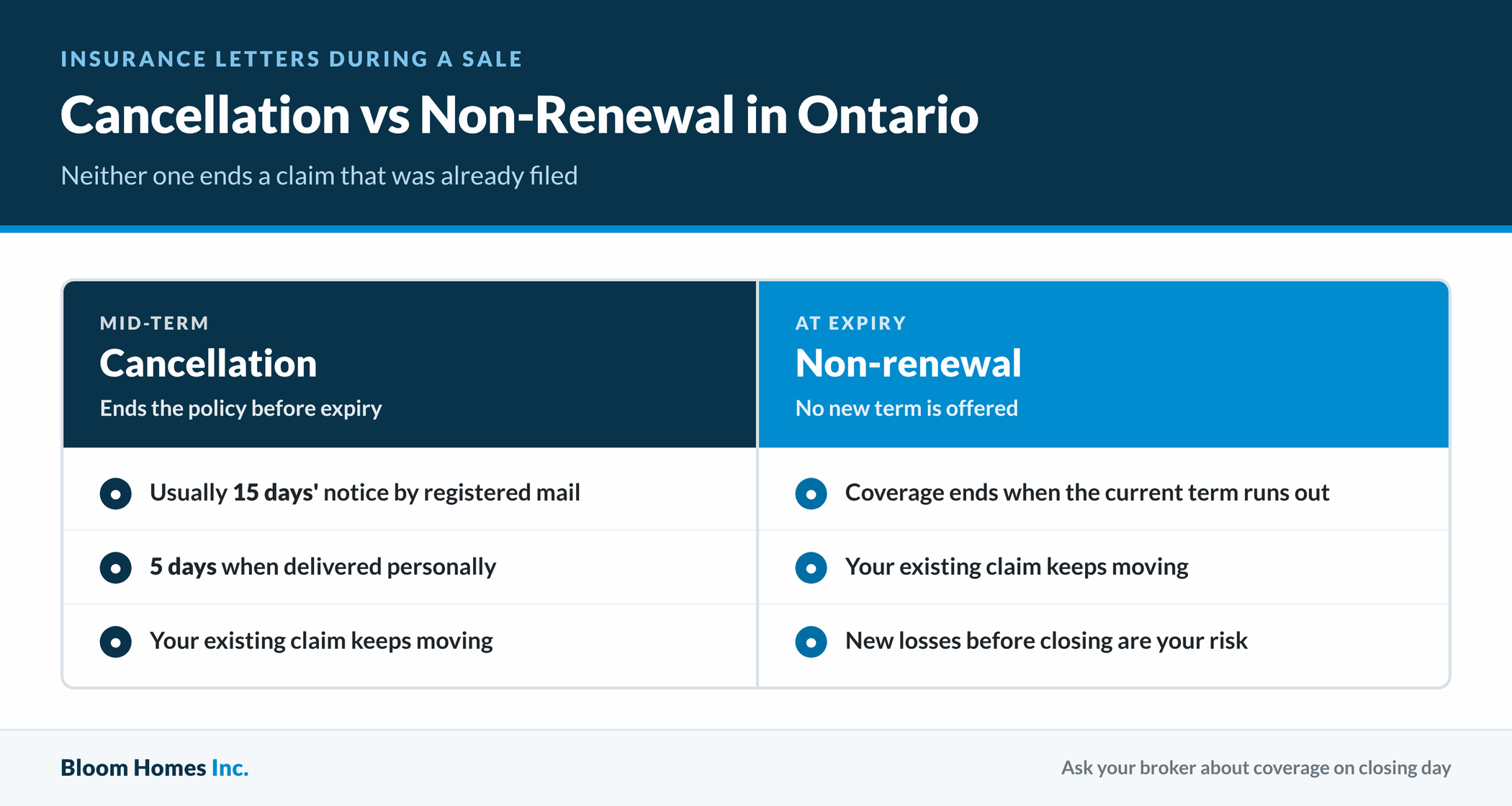
Cancellation ends your policy partway through the term. Ontario’s statutory conditions generally call for 15 days’ notice by registered mail, or 5 days if the notice is delivered in person. So the clock starts differently depending on how it reaches you. Non-renewal works another way, since the insurer just declines to write a new term when the current one ends.
Neither one kills a pending insurance claim that was already filed. The loss happened while you had coverage, so the file keeps moving through adjustment. What you lose is coverage for anything new, and that’s the part that bites during a sale.
Picture a Windsor house with a half-settled water loss and a non-renewal letter dated for next month. Your pending insurance claim keeps moving. If a pipe freezes in February before closing, though, no policy stands behind it, and the insurance clause puts that risk on you as the seller.
Finding new coverage after a claim isn’t always easy in Ontario. FSRA says on its site that it can’t make an insurer sell you a policy or step into a denied claim, so there’s no regulator to appeal to if carriers turn you down. Its June 2024 review of the twenty largest property insurers in Ontario also found that insurers didn’t track their reasons for denying claims consistently. FSRA’s property insurance page for consumers has more detail.
Call your broker the day a letter arrives and ask one thing. Will I have coverage on my closing date? Everything else follows from that answer.
Should You Settle the Insurance Claim Before Listing in Ontario?
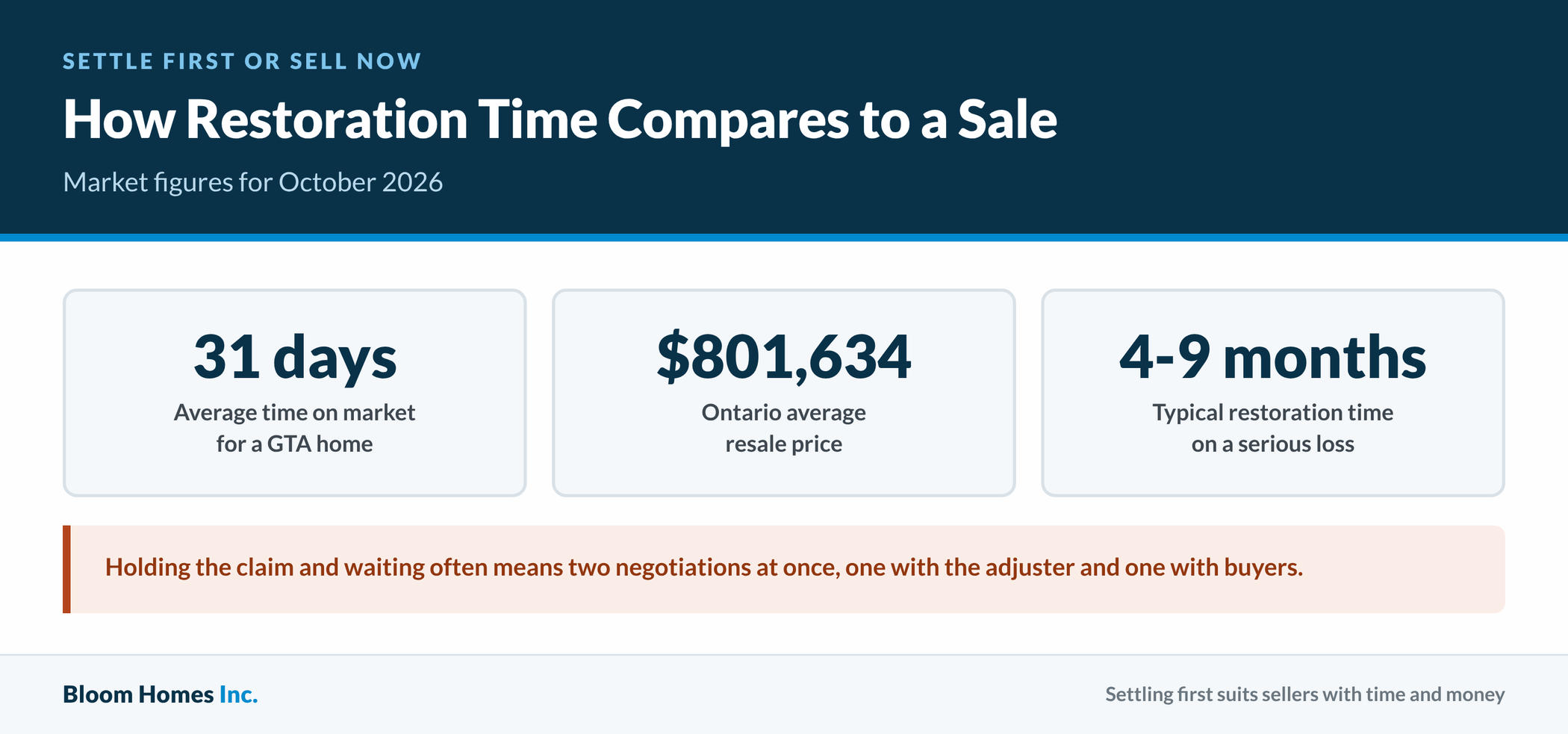
Thirty-one days. That’s how long the average GTA home sat on the market before selling in October 2026, according to TRREB. Now set that next to a restoration schedule. A serious water or fire loss in Ottawa or Thunder Bay can easily take four to nine months once you add adjuster approval, contractor schedules and permits.
So here’s my view. Settling first makes sense only if you have time and money, and most sellers who call me have neither.
Repairing before listing does get you the highest price. You collect the full claim, fix the house and sell to a regular buyer at market value. This route suits someone with a second home and no mortgage pressure.
It falls apart when you’re paying a mortgage on a house nobody can live in and renting somewhere else. Add a rising deductible and contractor deposits, and the math flips.
Holding the claim and waiting usually means two negotiations at once, one with the adjuster and one with buyers. Could you handle both for six months without losing your patience or your equity?
A partial settlement adds another wrinkle. Some policies pay the actual cash value first and hold back the rest until the repairs are done. Where the pending insurance claim was assigned, the buyer can finish the repairs and claim that holdback. Keep the claim and sell as-is, and you may lose the holdback, since you no longer own the building to repair.
Hold on to every photo, estimate and adjuster email. Sellers who keep the claim need those records, because once the house changes hands there may be no getting back inside.
Does Selling with an Open Claim Make Financial Sense?
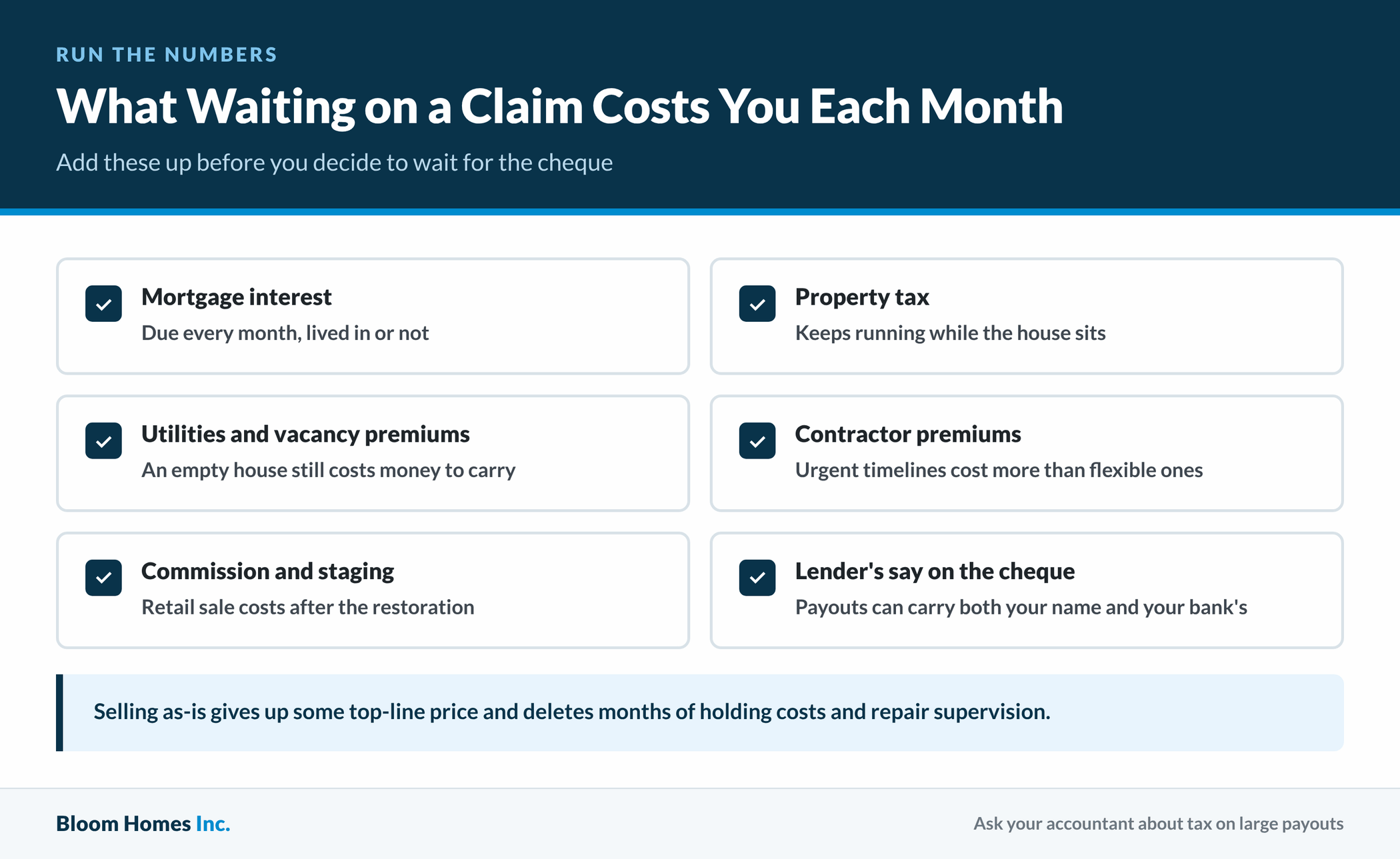
Your mortgage lender has a stake in any insurance money, and most sellers learn this at the worst moment. The bank holds an interest in the house, and through it, in the payout. Any cheque may arrive with both your name and your bank’s on it, and the bank gets a say in how it’s released.
Run the numbers honestly. A detached house in Ontario’s Niagara region with a mortgage at today’s rates burns real money every month it sits empty. Niagara’s benchmark price was $566,100 in October 2026, and a few months of carrying costs on a home at that price add up fast.
Then take off what a retail sale costs after the restoration. Count agent commission, staging, utilities and the premium contractors charge when your timeline is tight.
Selling as-is with a pending insurance claim changes the math. You give up some of the top price. In return you skip months of holding costs, repair supervision and the risk of the project running over budget.
Here’s where I disagree with common advice. Agents often tell sellers to “wait for the cheque, then list.” For a small claim on a sound house, that’s fine. For structural damage in a softening Ontario market, it assumes prices hold steady for nine months. London and St. Thomas posted a sales-to-new-listings ratio of 34.7 per cent in September 2026, which is buyer territory, and that market doesn’t reward patience.
Taxes deserve a quick word. Insurance money for property damage generally isn’t treated as taxable income when you use it to repair or replace what was lost. Any large payout collected apart from a sale can be handled differently, so ask your accountant.
Selling directly to an experienced local buyer such as Bloom Homes lets the pending insurance claim travel with the house and takes the deadline pressure off.
How Do You Disclose a Pending Insurance Claim to Buyers in Ontario?
Sellers hear “buyer beware” and decide they can stay quiet about everything. The rule is real, yet it cuts both ways. Ontario follows caveat emptor, so a seller generally doesn’t have to point out defects a buyer could find through their own inspection.
Disclosure has a limit, though. A known latent defect that makes the home dangerous or unfit to live in must be disclosed. You also can’t hide a problem or lie when a buyer asks you directly.
Water damage behind a wall, fire damage inside the roof structure or a failed repair that’s likely to come back are the kinds of problems behind a pending insurance claim. Courts have treated them as latent, hidden defects. The Real Estate Council of Ontario’s bulletin on seller disclosure obligations lays out how agents are told to handle the difference.
In Ontario, the Seller Property Information Statement, OREA Form 220, is optional, and no residential seller has to fill one out. Optional doesn’t mean harmless. Ontario courts have held that sellers who volunteer information or answer a buyer’s questions must be truthful and accurate.
My own preference, and plenty of lawyers disagree, is to disclose the pending insurance claim in writing. Attach the adjuster’s scope of loss to the listing package too. Experienced buyers price in damage they know about. They punish surprises.
Selling as-is doesn’t change any of this. A seller who hides a known dangerous defect gets no cover from an as-is note in the MLS remarks. Ownright’s Ontario disclosure guide goes further into the difference between patent and latent defects.
Put the claim’s status in the agreement itself. Spell out who owns it, who gets paid and what happens if the settlement lands after closing.
What Should Ontario Sellers Do This Week About Their Claim?
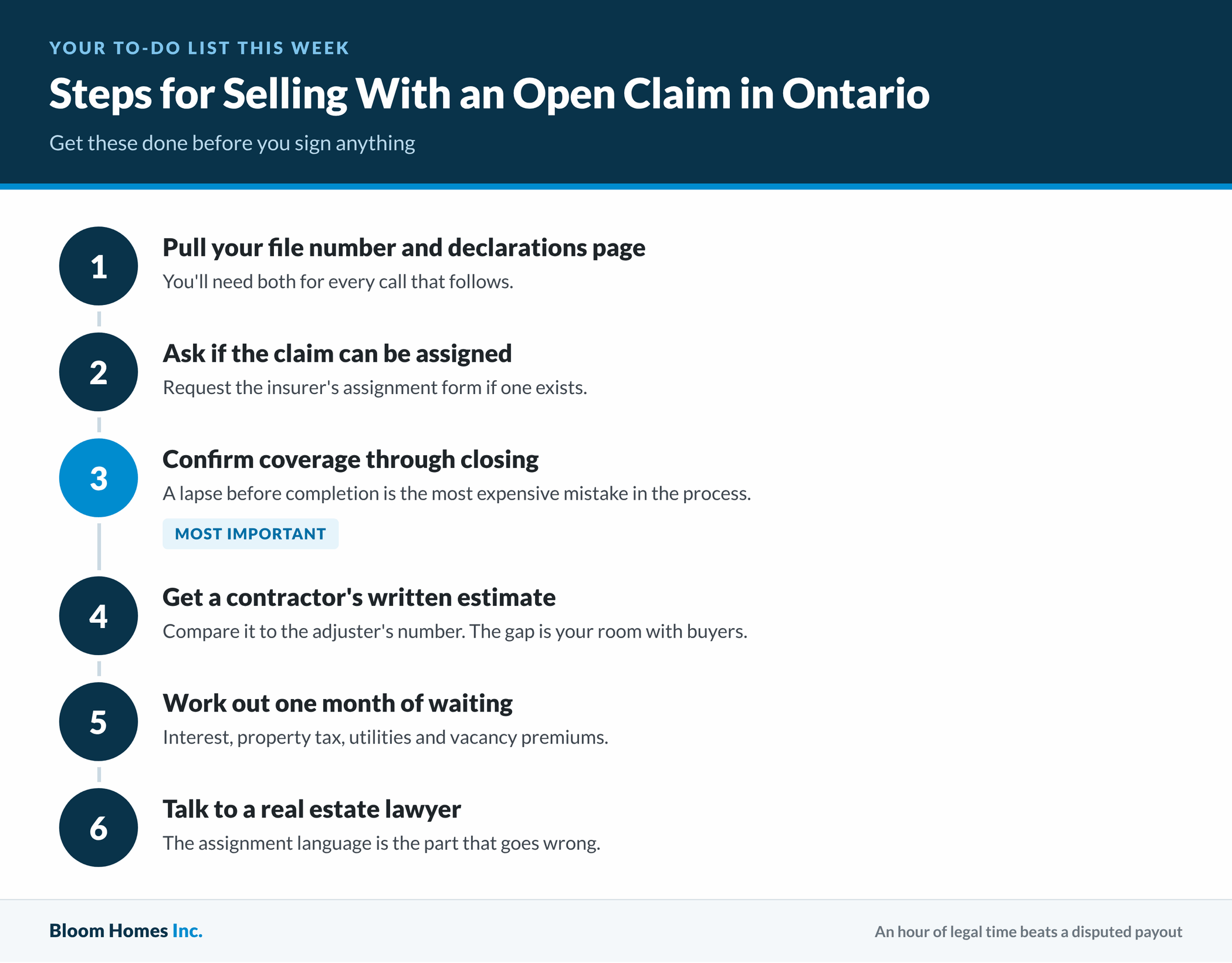
“My adjuster told me not to sell until the file closes.” Adjusters say that because it makes their job simpler, not because the law requires it. Ask them to show you the policy clause that forbids a sale. They won’t find one.
Begin with your file number and your policy declarations page. Call the insurer, ask straight out whether your pending insurance claim can be assigned and request their assignment form if they have one.
Next, confirm you’ll have coverage right through closing. A gap between signing and completion is the most expensive mistake in the whole process, given that the standard Ontario agreement leaves the risk with you.
After that, get a written repair estimate from a restoration contractor, not just the adjuster’s number. Those two figures often differ by a lot, and the gap is your room to negotiate with any buyer in Ontario. Pull out your mortgage statement and work out what one more month of waiting costs in interest, property tax, utilities and vacancy insurance. Write that number where you’ll see it. It turns the decision from a feeling into a figure.
Finally, talk to a real estate lawyer before signing anything. The assignment wording is the part that goes wrong, and an hour of legal time is cheap next to a fight over a payout. Ontario’s Insurance Act and its statutory conditions are public if you’d like to read the rules yourself.
A couple in Guelph splitting assets in a divorce called after a kitchen fire left their house half-gutted and their lawyers stuck over who’d manage the repairs. We took the house with the pending insurance claim attached and closed in under three weeks. The restored motorcycle in the garage went to the husband without another argument.
What Happens If the Pending Insurance Claim Paperwork Goes Wrong?
Get the assignment paperwork wrong and the insurer pays nobody. Meanwhile the buyer’s lawyer holds funds in trust for months. That’s the real cost of treating this lightly.
Frequently Asked Questions
Will My Insurance Company Block the Closing Because of an Open File?
No. Your insurer isn’t part of the sale and has no right to delay the transfer of title in Ontario. It can refuse to release money to someone who isn’t properly named, so the assignment or retention wording in your agreement needs to be precise.
Who Gets the Money If I Sell Before the Claim Settles?
Whoever the sale agreement names. If you keep the rights, you tell your insurer the house sold and that the money should still come to you. Assign the pending insurance claim to the buyer instead, and they work with the adjuster and collect directly, usually for a price that reflects the damage.
Do I Have to Tell Buyers About a Pending Insurance Claim in Ontario?
You can’t lie about it or hide it. If the damage makes the home unsafe or unfit to live in, you have a duty to speak up. Beyond that legal floor, being open is simply smarter. Buyers who find out late walk away, and buyers who know upfront price the damage and close.
Can I Cancel My Home Insurance Once the House Is Sold?
Cancel it after completion, never before. The standard Ontario agreement keeps the buildings at your risk until the moment the sale closes, and closings slip by a day or two fairly often. A short overlap in coverage costs very little next to an uninsured fire during an extension.
Will a Recent Claim Make It Harder to Get Coverage on My Next Ontario Home?
It can. Insurers weigh recent claims heavily, and property insurance in Ontario leaves most of those decisions to each company. Start shopping for coverage on your next place early, use a broker who works with several insurers and mention the claim upfront.
Is Selling to a Cash Buyer Better Than Waiting for Restoration?
It depends on your holding costs and how long a project you can stand. With time, equity and no second housing payment, restoring first usually nets you more. When a pending insurance claim has already stalled twice and you’re paying for a house nobody lives in, a lower number today can leave you ahead of where waiting would.
If you’re sitting on a damaged house somewhere in Ontario and the claim keeps dragging, I’m glad to walk through the numbers with you, even if selling isn’t the right move. You can reach us through selltobloomhomes.com or just pick up the phone. There’s no pressure, and no hard feelings if you decide to wait the adjuster out.
Where Ontario Home Sales Stand Right Now
Ontario home sales reached 14,053 units in October 2026, down 8.7 percent from a year earlier, based on CREA’s provincial figures. With fewer sales, a damaged house on the open market can sit a while, and an open claim stretches that wait.
If your house is near Barrie, you can see how we buy houses around Barrie with damage and open claims.
Talk to Us About Your Open Claim
You don’t need a closed file to start planning your sale. Tell us about the damage, where the claim stands and when you’d like to be done. We’ll share a fair cash offer that accounts for the claim, and you decide from there. Contact our team or fill out the short form below.
Helpful Ontario Blog Articles
- How to Find a Legitimate Cash Home Buyer in Ontario
- How to Sell Your House Fast in Any Condition in Ontario
- Can the Seller Back Out of a Contract in Ontario
- How Long a Real Estate Contract Lasts in Ontario Before It Expires
- How to Sell a House with Water in the Crawl Space in Ontario
- How to Sell an Ontario House That Needs Repairs Without Losing Money
- How Long Can a Seller Stay in the House After Closing
- How to Sell a House with Termites in Ontario
- Can You Sell a House with Mold in Ontario
- How to Sell a House with Title Issues in Ontario
- What Is the Best Time to Sell a House in Ontario
- What Appraisal Required Repairs Mean for Ontario Home Sellers
- Can You Sell a House in Ontario with a Pending Insurance Claim