The furnace quit on a Tuesday in February, and the seller called me from her kitchen wearing a parka. She’d already spent her savings on a new sump pump. Her roof had two years left, maybe. The phone call I take most often in Ontario is that one: a homeowner sitting on a property that needs repairs. She’s doing math that won’t come out right no matter how many times she runs it.
Can You Sell a House That Needs Repairs in Ontario?
A cracked foundation or a 30-year-old roof used to scare buyers away entirely. For years I told sellers that a house that needs repairs had to be fixed first, at least the big stuff, before anyone would touch it. The current market proves that advice was wrong.
You can absolutely sell a property in this condition across Ontario. No law requires a seller to bring a home up to any particular standard before closing, but Ontario law does require honesty about what’s hidden. Sellers here must disclose latent defects they know about where those defects affect safety or habitability. Ontario courts have held that as-is language cannot shield a seller from liability for deliberate non-disclosure of known defects affecting safety or habitability. So the leaking foundation you patched over with drywall gets disclosed, while the cracked driveway everyone can see is the buyer’s problem to notice.
Ontario runs on caveat emptor, buyer beware, with that narrow carve-out for dangerous hidden problems. The common-law duty applies whether or not an agent is involved, and selling privately doesn’t erase it. You’ll find the detailed version of the rule in RECO’s bulletin for registrants. A real estate lawyer can tell you which bucket your particular issue falls into.
One landlord I bought from had a garage stacked to the rafters with tenant leftovers, and the back unit had a soft spot in the bathroom floor. He wasn’t a distressed seller. Mostly, he was tired of showings that went nowhere on a house that needs repairs, and I’ve watched that exhaustion wear down plenty of sellers before him.
What Does Selling As-is Mean for Ontario Homeowners?
Write “sold as-is” into the listing and most sellers picture a clean exit where nobody can come back at them. In Ontario, the clause doesn’t work that way. It governs who pays for repairs after closing, not whether you told the truth going in.
As-is means you’re not fixing anything and you’re not crediting anything. Buyers take a house that needs repairs in its current condition, defects included, and that’s all it means.
What trips people up is the gap between “I won’t fix it” and “I don’t have to mention it.” Ontario sellers often fill out a Seller Property Information Statement, the OREA disclosure form. Completing one is voluntary, but once you start answering questions, your answers need to be accurate.
Pricing an as-is listing in Ontario takes a different kind of comparative market analysis than a renovated home down the street gets. Your real estate agent should be pulling comps from sales of similar distressed properties, not polished ones.
Selling as-is genuinely buys you no contractor scheduling, no permit chasing, no surprise invoices mid-renovation. For an Ontario homeowner carrying a mortgage on a house that needs repairs while living somewhere else, that time savings is worth real money.
Does it cost you? Yes. You’ll trade some price for speed and certainty, and that trade is sometimes the smartest one on the table.
What Repair Issues Can Kill a Home Sale?
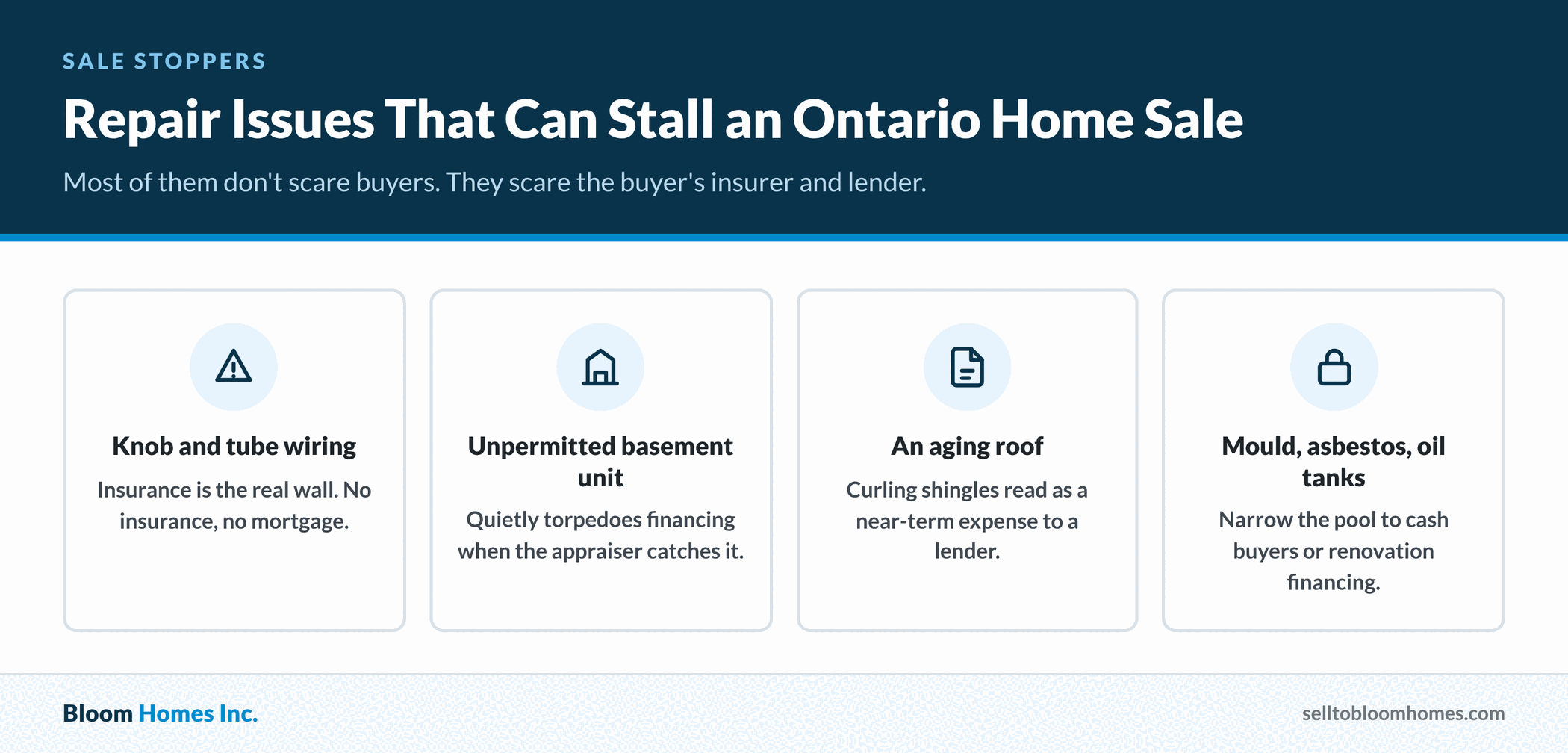
If your house has active knob and tube wiring, that’s the one we need to talk about before anything else. It stops sales cold in Ontario more reliably than a bad roof ever will.
Existing knob and tube isn’t illegal in Ontario. The Electrical Safety Authority treats properly maintained systems as acceptable, though the 2021 Ontario Electrical Safety Code no longer allows new installations. Insurance is the real wall. Roughly 40% of Ontario insurers won’t cover homes with active knob and tube, and many of the rest tack on a premium surcharge of 15 to 30%. No insurance, no mortgage. You can read more about how that chain works through Padi Electric’s Ontario breakdown.
An unpermitted basement apartment can stall a sale too. They’re everywhere in Hamilton and Scarborough, and one quietly torpedoes financing when the lender’s appraiser catches it.
Roof age gets underestimated constantly. A roof with visible curling shingles reads to a buyer’s lender as a near-term expense. Put it on a house that needs repairs and already carries other issues, and the appraiser starts stacking deductions.
Mould, asbestos insulation in a century home and oil tanks buried in the yard from the days before gas lines reached rural Ontario all narrow the buyer pool for a house that needs repairs. They narrow it to people who pay cash or carry renovation financing.
What’s the one thing in your house you hope nobody opens during the inspection? Your real negotiating problem is that, and pretending otherwise just moves the conversation to day thirty instead of day one.
How Do Needed Repairs Affect Buyer Financing?
A seller in Sudbury accepted a good offer on a bungalow with original wiring and a bathroom that had been gutted but never finished. Her buyer’s lender pulled out eleven days before closing because the insurer wouldn’t bind a policy.
Across Ontario, that sequence repeats every week. Lenders typically want proof of insurable wiring before they’ll approve financing. An unfinished bathroom with no fixtures can read as an incomplete dwelling to an appraiser. If the Agreement of Purchase and Sale carries a financing or inspection condition, and the condition can’t be satisfied, the buyer may be entitled to walk.
An appraiser assigns value based on condition. When a property needs repairs that affect habitability, the appraised number can land below the agreed price. Your buyer then has to cover the gap in cash or renegotiate. Most renegotiate.
Financed buyers have more leverage in Ontario’s current market than they had two years ago. Residential sales across the province totalled 14,053 units in October 2026. New listings came in at 33,510 for the month, down 8.8% from October 2025. More inventory than sales means a financed buyer who hits a snag on your house that needs repairs simply moves to the next listing.
Renovation mortgages exist, and a handful of Ontario buyers use them. They’re slow and paperwork-heavy, and they require contractor quotes before closing. I’d rather sell to someone whose money isn’t conditional on three other people’s signatures.
Which Repairs Should You Fix Before Selling?
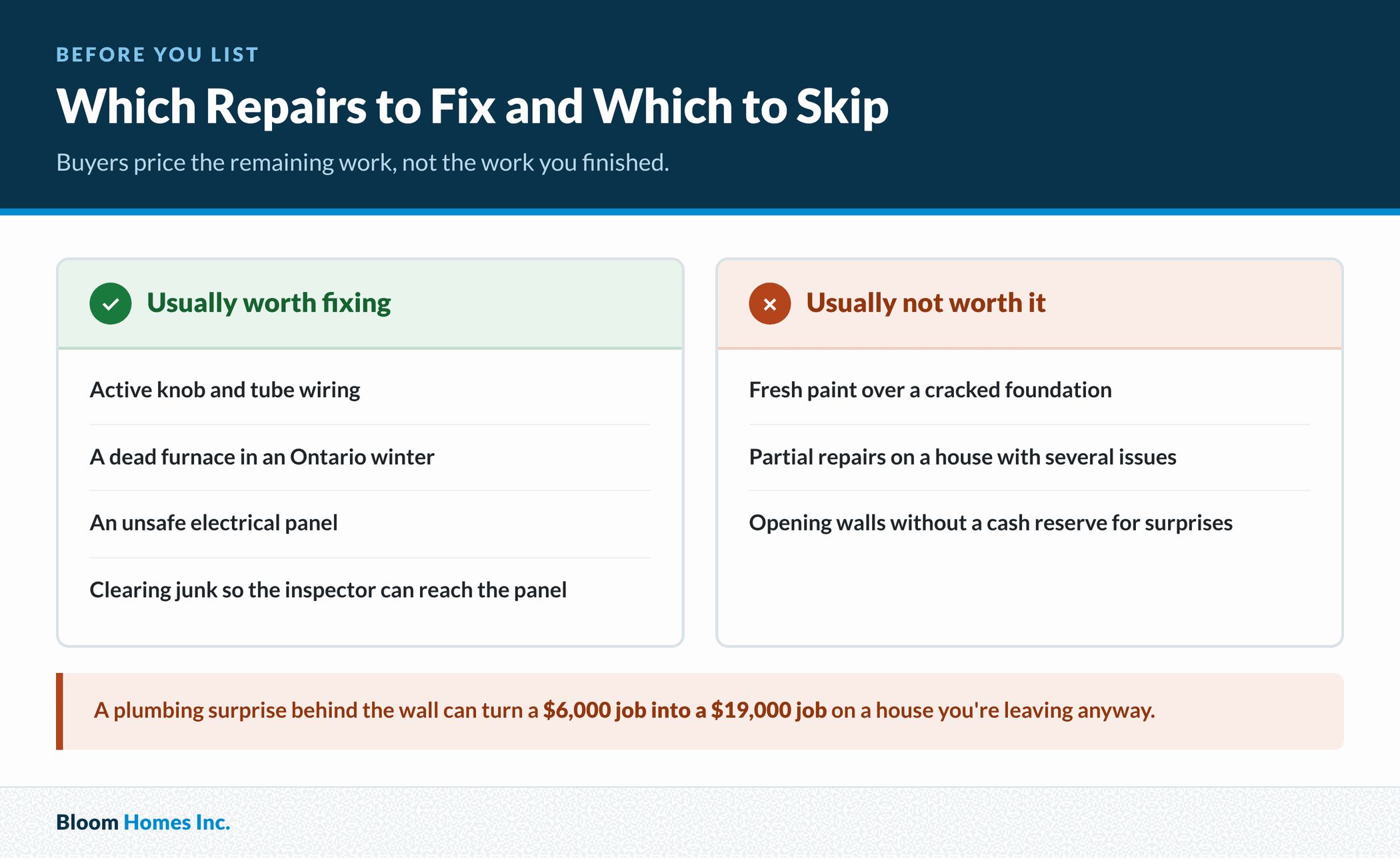
“So I should just fix the roof and the furnace and then list it, right?” I hear that one weekly, and usually the answer is no. Partial repairs on a house that needs repairs in several places rarely return what they cost. Buyers price the remaining work, not the work you finished.
A safety hazard that blocks insurance is worth addressing if you have the cash and the time. Think active knob and tube, a dead furnace in an Ontario winter or an unsafe electrical panel. Rewiring a knob and tube home in Ontario runs about $8,000 to $15,000 for an average house, and more for a larger one, so that’s real money. It also moves your property from “cash buyers only” to “anyone with a mortgage.”
Cosmetic work on a house that needs repairs is where sellers burn money. Fresh paint over a cracked foundation fools nobody and can edge toward concealment, which is exactly the thing Ontario courts don’t forgive.
Hauling junk out of a Windsor side-split so the inspector can actually reach the electrical panel costs a few hundred dollars. It also changes how every visitor reads the house.
One pattern I keep seeing: sellers who start repairs with a budget and finish with a credit line. A kitchen comes apart, a plumbing issue surfaces behind the wall, and suddenly a $6,000 job is a $19,000 job on a house they’re leaving anyway. If your cash reserve can’t absorb a surprise of that size, don’t open the wall.
Have you priced the full scope with an actual contractor, or are you guessing from a YouTube video? Your answer decides most of this section for you.
How Do You Price a House That Needs Repairs?
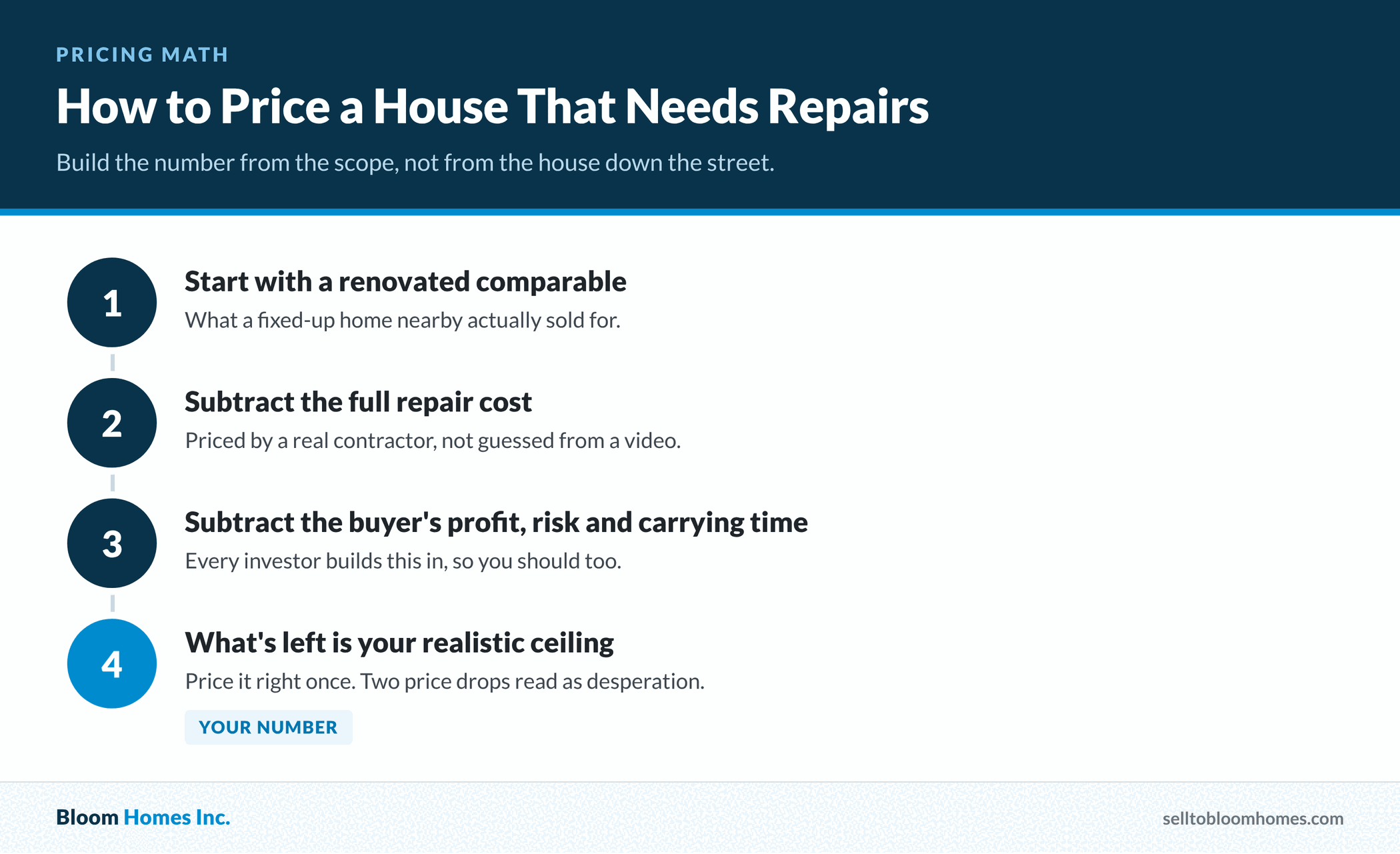
Everything starts from that scope number. Take what a renovated comparable sold for nearby, subtract the full repair cost, then subtract again for the buyer’s profit, risk, and carrying time. What’s left is your realistic ceiling.
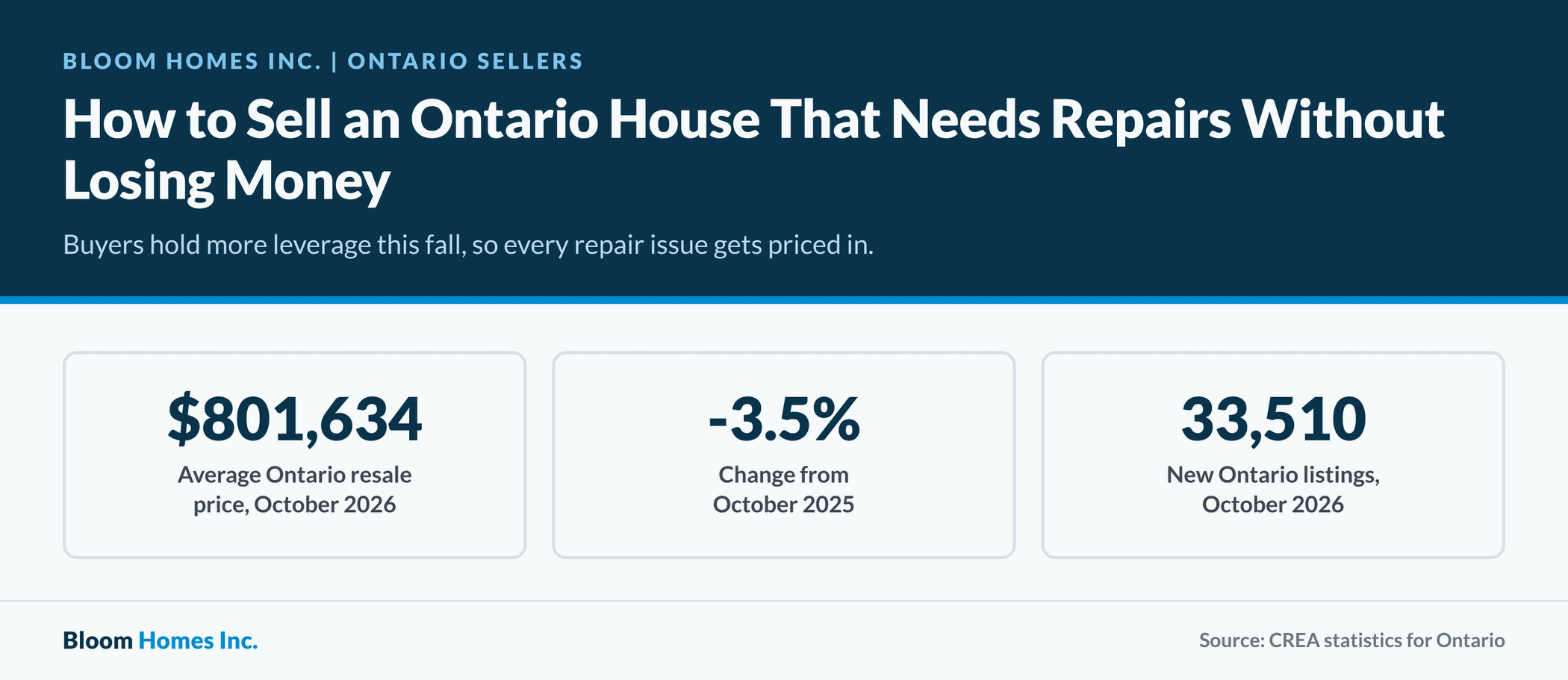
Looking at Ontario-wide numbers helps you sanity-check the top of that equation. The average resale price across the province was $801,634 in October 2026, down 3.5% from October 2025. Meanwhile, the MLS Home Price Index composite benchmark sat at $733,600 that month, off 3.8% year over year. Current provincial figures are published by the Ontario Real Estate Association’s statistics page.
You should weigh local numbers more than provincial ones. The London and St. Thomas area average for October 2026 came in at $601,289, about 0.7% under October 2025. Sellers in Vaughan or Markham are having a very different pricing conversation.
Speed is your other lever. Ontario listings that sold in October 2026 averaged 31 days on market, with a median sold price of $692,750. A house that needs repairs typically runs well past that average, and every extra month costs you mortgage interest, property tax, insurance, and heat.
The listing goes stale, you drop the price twice, and buyers read the history as desperation. Price it right once.
Investor buyers, including our team at Bloom Homes Inc., will usually walk you through their repair math line by line. That’s a free education even if you never sell to any of us.
Who Buys Houses That Need Repairs in Ontario?
Pick the wrong buyer and you lose six weeks, then start over with a listing that now looks damaged to everyone watching. In a slowing market, that cost compounds.
Four groups buy a house that needs repairs in Ontario. Local flippers want deep discounts and move fast. Small landlords building rental portfolios in Windsor, Thunder Bay, and Niagara Falls will tolerate more condition issues than a flipper, since they’re holding long term. Handy end users exist too, though they’re rare and they almost always need financing that the property can’t support.
Direct cash buyers are the fourth group. They skip the appraisal, skip the lender, and close on a date you choose.
You should vet the category more than trust it. Ask any buyer three questions: where’s the money coming from, how many Ontario closings have you done this year, and will you reduce your offer after inspection. Their answer to the last one separates the honest buyers from the rest.
A real estate broker can still sell a house that needs repairs well if they have genuine investor relationships. Some do. Many list the property conventionally, watch it sit, and then suggest you reduce the price, which was the plan all along.
I’ve bought houses where the seller got three offers from three different channels and the highest number came with the worst terms. Your net, after commission, repair credits and two extra months of carrying costs, is the only figure that counts.
Is Selling As-is the Right Move for Your Ontario Home?
Before: a Kingston homeowner with a flooded basement, a deceased parent’s estate, and no local contractor willing to quote until spring. After: closed in nineteen days, no repairs, no showings.
If your house needs repairs that are mostly cosmetic and you have six months, list it with a good Ontario real estate agent and get the retail price. You’ll come out ahead.
Selling as-is makes sense when three things line up: the repair bill is large, your timeline is short, and your cash reserve is thin. Miss one of those and conventional listing usually wins on price.
Run the arithmetic honestly. Commission, staging, repair credits, and two or three months of carrying costs on an Ontario property that needs repairs can eat a meaningful share of your sale price. A direct offer that looks low on paper sometimes nets the same or better once you subtract all of that.
Divorce, job relocation, an inherited property three hours away, a tenant who stopped paying: each of those changes what “without losing money” means for you.
An heir I worked with in Guelph got transferred to Alberta and had five weeks to be out of a house she’d never lived in. Her father’s woodworking shop filled the entire garage, the back deck was rotted through, and she couldn’t fly back for showings. We closed on her timeline and she left the table saw where it stood.
If you’re weighing a listing against a direct sale on a property that needs repairs, get both numbers in writing before you decide. Verbal estimates tend to shift once you’re further into the process. We’ll put our offer on paper with no obligation attached, and any reputable Ontario buyer should do the same.
Frequently Asked Questions
Do I Have to Tell Buyers About Problems in a House That Needs Repairs?
You have to disclose known hidden defects that make the home dangerous or unfit to live in. Visible problems a buyer could spot on a walkthrough are generally their responsibility to notice under Ontario’s buyer-beware approach. Writing “as-is” into your agreement doesn’t erase that duty. Unsure which category your issue falls into? Spend an hour with a real estate lawyer before you list.
Will a Bank Approve a Mortgage on an Ontario Property That Needs Repairs?
Sometimes, and it depends on which repairs. Cosmetic issues rarely bother a lender; anything that blocks home insurance or affects habitability usually does. Insurance approval and mortgage approval are linked in Ontario, so a buyer who can’t get a policy generally can’t close. Older wiring and structural issues kill more sales than worn flooring ever will for exactly that reason.
Should I Get an Inspection Before Selling a House That Needs Repairs?
A pre-listing inspection gives you a real scope instead of a guess, and that’s worth the few hundred dollars. The catch is that once you know about a serious hidden defect, your disclosure obligation in Ontario attaches to it. Most sellers I talk to are better off knowing. A surprise the buyer’s inspector finds costs far more in renegotiation than it would have cost to price in from the start.
How Fast Can I Close on an Ontario House That Needs Repairs?
With a cash buyer, two to three weeks is normal. The closing date is usually yours to pick, since there’s no lender setting the pace. A conventional listing on a property in rough condition usually runs well past the provincial average noted earlier, because financing conditions and insurance checks add time. If you need a specific date for a move or an estate deadline, say so early.
Is Selling As-is Going to Cost Me a Lot of Money?
You’ll give up some price compared to a fully renovated sale, but that comparison isn’t the honest one. Measure the as-is offer against what you’d net after commission, repair costs, overruns, and months of mortgage interest, taxes, and utilities. Plenty of Ontario sellers find the gap is narrower than they expected, and a few find there’s no gap at all.
Can I Sell an Ontario Rental Property That Needs Repairs with Tenants Inside?
Yes, and the tenancy comes along with the sale. Residential tenancy rules in Ontario limit showings and protect the tenant’s rights regardless of who owns the building, which makes conventional listings harder. Investor buyers often prefer an occupied unit since the rent starts on day one, so tenants in place are less of an obstacle here than they look.
Selling a House That Needs Repairs in the GTA
Across the Greater Toronto Area, the average selling price was $1,024,108 in October 2026, 2.7% lower than a year earlier, according to the Toronto Regional Real Estate Board. Buyers there still hold real negotiating power on price. That’s the market an older house in Scarborough competes in when it needs a roof, new wiring or a furnace. It’s also why we buy houses across the GTA just as they sit.
Get a Second Opinion on Your Repair List
If you want to talk through what your house is worth in its current shape, or just get a second opinion on a repair estimate, we’re here. No pressure, no obligation, and no hard feelings if you decide listing is the better path for you.
Contact us and we’ll walk through the numbers with you. You can also fill out the form below for a no-obligation cash offer.
Helpful Ontario Blog Articles
- How to Find a Legitimate Cash Home Buyer in Ontario
- How to Sell Your House Fast in Any Condition in Ontario
- Can the Seller Back Out of a Contract in Ontario
- How Long a Real Estate Contract Lasts in Ontario Before It Expires
- How to Sell a House with Water in the Crawl Space in Ontario
- How to Sell an Ontario House That Needs Repairs Without Losing Money
- How Long Can a Seller Stay in the House After Closing
- How to Sell a House with Termites in Ontario
- Can You Sell a House with Mold in Ontario
- How to Sell a House with Title Issues in Ontario
- What Is the Best Time to Sell a House in Ontario
- What Appraisal Required Repairs Mean for Ontario Home Sellers
- Can You Sell a House in Ontario with a Pending Insurance Claim