
A wet towel left on a basement floor in a Hamilton bungalow can start a colony in two days. Health Canada’s guidance says your house and its contents are far less likely to grow mold when everything dries within 48 hours. So I believe Ontario homeowners when they tell me it showed up out of nowhere. Two damp days is all it takes.
I’ve bought houses across Ontario for years. Mold turns up more often than anything else except a tired roof. Selling a house with mold in Ontario is legal, and it happens every single week in this province. What trips people up is rarely the mold itself. It’s what they disclose about it, or don’t. If you’d rather skip the cleanup altogether, we buy Ontario houses with mold as they are.
What Types of Mold Show Up in Ontario Homes?
Lab testing a mold sample for species almost never changes what you should do next. Health Canada’s position is plain: control the dampness and clean up visible mold, whatever type it is. So sellers can skip the species test and keep the few hundred dollars.
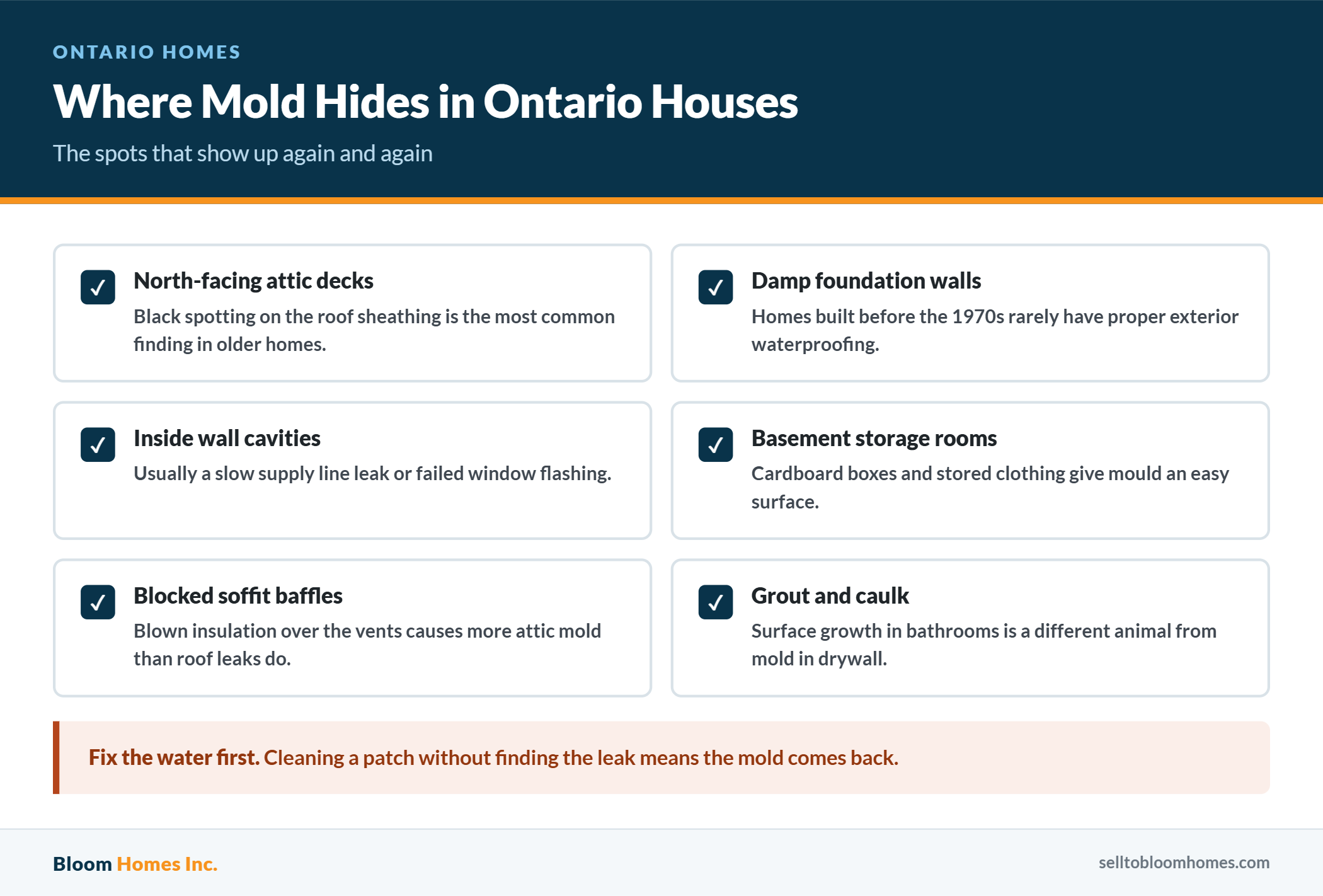
Ontario’s climate does something specific to houses. Warm, humid summers push moisture into cool basements, and then in winter condensation forms on cold window frames and uninsulated attic sheathing. Black spotting along a north-facing attic roof deck is the most common finding I see in older local stock. It’s especially common in post-war neighbourhoods like Scarborough’s Birch Cliff and on the pre-1960 streets of east London.
Homes built in Ontario before the 1970s rarely have proper exterior waterproofing. That means a damp foundation wall can feed mold behind finished panelling for years before anyone notices the smell. A buyer’s inspector will test that wall first, so learn what’s behind it before you list.
Hidden mold inside wall cavities usually traces back to a slow supply line leak or a failed window flashing. Health Canada points out that cardboard boxes and stored clothing are easy places for mold to colonize. No wonder so many Ontario storage rooms test worse than the living space upstairs. Hidden growth like this is exactly the kind of latent defect Ontario disclosure rules care about.
Bathroom grout and caulk growth is a different animal. Growth spreading through drywall paper is a building problem, and that distinction matters far more than the colour of the spots. Buyers shrug at the first one. The second lands in the inspection report and then in the price.
One pattern keeps repeating in Ontario houses I walk through. The owner scrubbed the visible patch twice, never found the leak, and watched the mold come back both times. Fixing the underlying water damage, humidity, or ventilation problem is what stops regrowth. No amount of bleach takes its place. It’s also the first thing a buyer will ask you about.
How Does Mold Affect Your Home’s Value in Ontario?
A couple of years ago a family in Oshawa called me. They were three months behind on their mortgage, and a power of sale deadline was already circled on the fridge calendar. Mold was creeping up two walls of their finished basement, behind a bar unit. The snowblower in the garage hadn’t moved in a year because nobody had the energy. Families in that spot can’t fix the basement first and wait to see what a buyer pays. They need to know what the house is worth as it sits.
Value in Ontario isn’t one tidy number right now, and a softer market changes the math compared with 2021. The average resale price across the province was $801,634 in October 2026, down 3.5% from a year earlier. Active listings that month sat 16.4% above the five-year average. Buyers have choices, and choices give them the leverage to discount a property with mold.
How big a discount? Retail buyers in Ontario tend to overcorrect. A $4,000 remediation scope routinely produces a $20,000 price reduction request, in my experience. They aren’t pricing the repair. They’re pricing their own worry about what sits behind the drywall.
An appraiser working a financed Ontario sale can flag active mold growth as a condition issue. When that happens, the lender may hold back funds until the remediation is documented.
Numbers also shift by city. Hamilton’s average sold price was $724,461 in October 2026, up 1.4% from September but 7.3% under the prior October. A mold discount in Hamilton eats a bigger share of your equity than the same dollar cut in Oakville. Sellers in lower-priced Ontario markets feel every deduction harder.
Do You Have to Disclose Mold When Selling a House in Ontario?
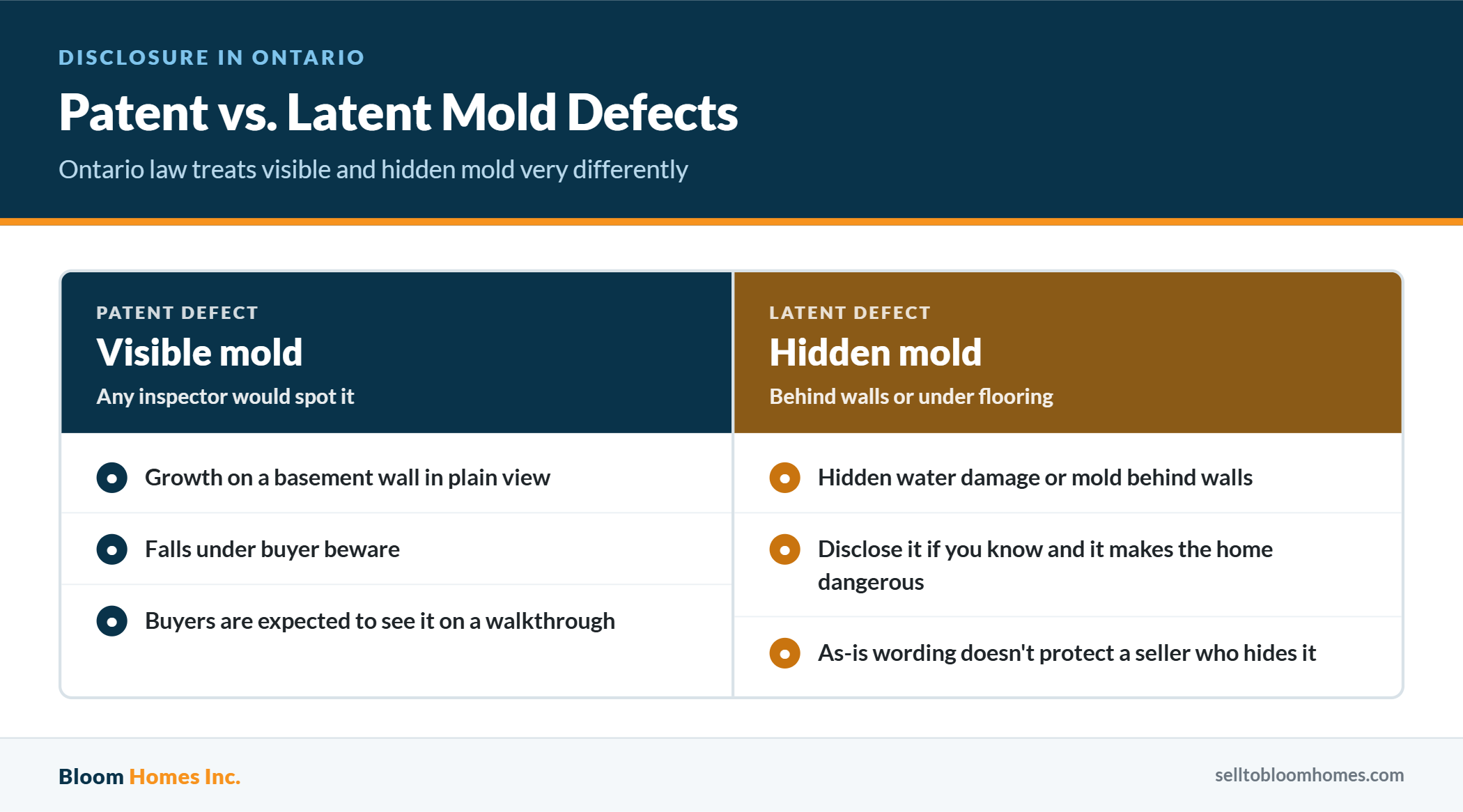
“It’s buyer beware here, so I don’t have to say anything.” I hear that one constantly, and it’s half right in a way that gets sellers sued. Ontario real estate does run on caveat emptor, which means a seller generally doesn’t have to point out a home’s flaws. The main exception is a known latent defect that makes the property dangerous or unfit to live in.
Hidden mold can land squarely in that exception. Water damage or mold behind walls is a textbook latent defect in Ontario. Visible growth on a basement wall that any inspector would spot is a patent defect, and the law treats those two situations very differently.
Your duty to disclose comes from case law, not real estate legislation. RECO says the obligation rests on current case law rather than TRESA. The form most agents mention, OREA’s Seller Property Information Statement, is voluntary in Ontario, and sellers aren’t required to fill one out.
Sellers get into real trouble through concealment. Ontario courts treat active concealment, like painting over mold or laying new flooring over damage, far more seriously than an honest failure to disclose something you never discovered. Fresh paint on one basement wall is the oldest tell in this line of work. I check that spot first on every walkthrough, and so does every home inspector in Ontario.
As-is wording won’t rescue you either. A seller who hides a known, dangerous latent defect doesn’t get a pass because the listing said as-is. Ownright’s Ontario disclosure guide lays out the rules in plain language, though your own real estate lawyer should review your facts before you sign anything.
Can You Sell a House with Mold in Ontario?
Sellers who get this wrong can see a closed sale come back as a lawsuit two years later, after the money’s already spent. That’s the real risk here, more than the mold.
Yes, you can sell a house with it in Ontario. No statute bars it, and no municipality requires a remediation certificate before closing. Properties with mold change hands here all the time. Residential property in Ontario is already sold as-is unless the purchase agreement says otherwise.
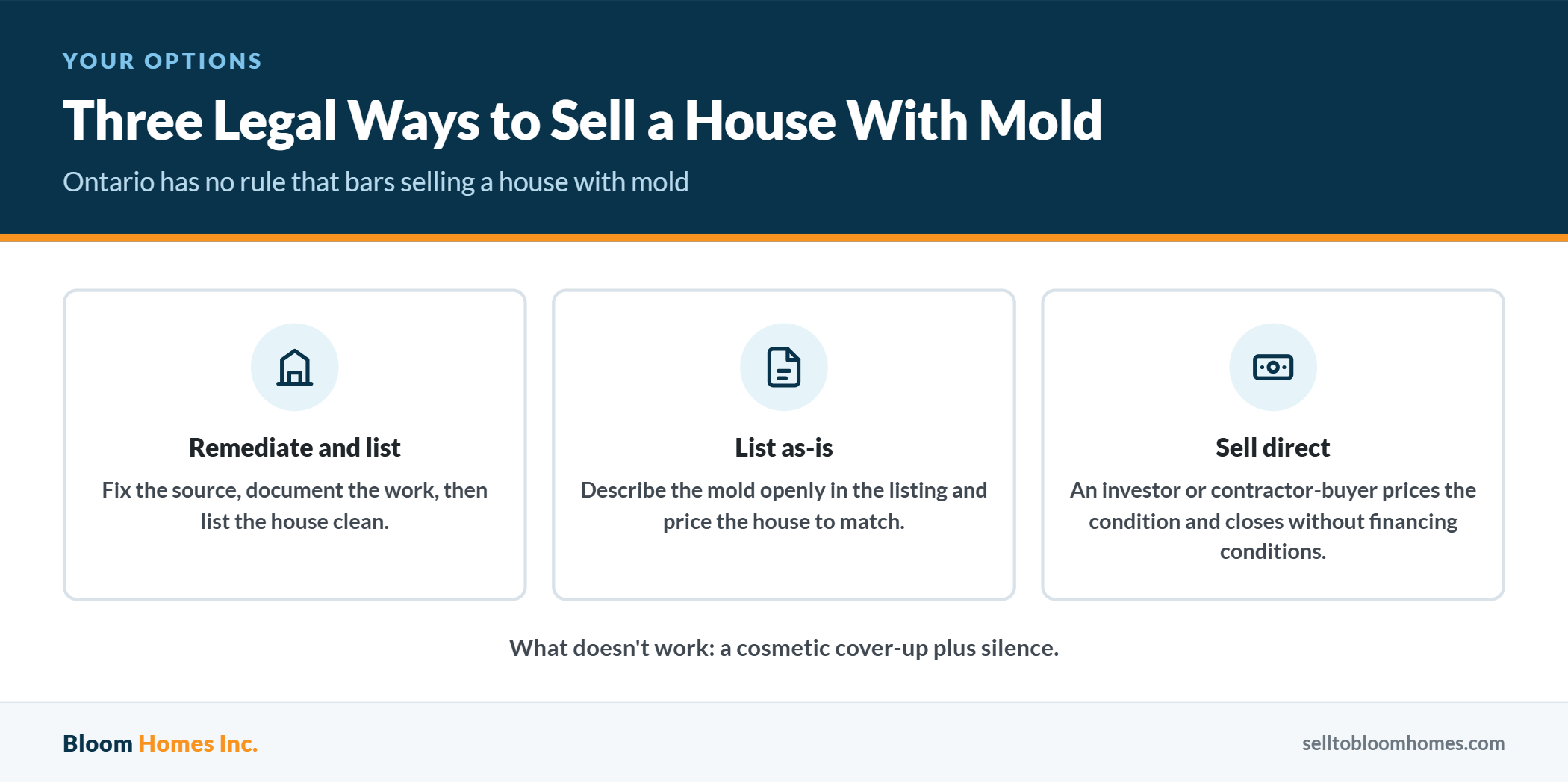
You’ve got three realistic paths. You can remediate first and list it clean. Another route is to list as-is, describe the mold openly, and price for it. Or you can sell directly to an investor or contractor-buyer who builds the condition into their offer and closes without financing conditions.
Each of those works in Ontario. The fourth option some sellers try, a cosmetic cover-up plus silence, doesn’t.
Cash buyers matter here because of the appraisal issue I mentioned earlier. A buyer paying cash doesn’t need a lender to approve the state of your basement. Bloom Homes Inc. is one of those buyers. We buy Ontario houses in exactly this condition, which takes financing out of the equation.
Right now the Ontario market cuts both ways. GTA inventory stood at 25,098 homes for sale in October 2026, down 10% from October 2025, so a sound Ontario property still moves. A moldy one with no explanation sits, collects showings, and gets relisted at a discount three months later.
Would you rather disclose mold on day one and negotiate once, or have the buyer’s inspector discover it and negotiate from a weaker spot? I’ve watched both, and the first goes better.
What Should You Do Before Selling a House with Mold?
Plenty of Ontario sellers plan to get three estimates, pick the middle one, fix everything, and list in six weeks. Then the first estimate comes in at $1,800 and the second at $11,000. The third includes tearing out a finished basement they built nine years ago.
Start with moisture, not mold. Find the water source before you spend a dollar on removal, because remediation without a fix is money burned. Health Canada recommends keeping indoor relative humidity between 30% and 50%. A hygrometer from any Ontario hardware store costs less than a tank of gas.
Next, get a written assessment from an independent inspector. Someone who doesn’t also sell remediation has no reason to inflate the scope. That report protects you two ways: it shows a buyer you acted honestly, and it gives you a solid record of what you knew.
I ask every Ontario seller for this report, and the ones who have it negotiate better.
Call your insurer, but keep your hopes modest. Most Ontario home policies cover sudden water events rather than long-term seepage, so mold traced to a 2019 foundation crack usually isn’t a claim.
Bring in a real estate lawyer early, not at closing. Selling in Ontario with a known defect calls for specific contract language. Your lawyer can draft wording that acknowledges the mold without blowing up the agreement. Health Canada’s guide to addressing moisture and mould has a prevention checklist worth reading before you meet with anyone.
What Are the Best Ways to Remove Mold From Your Home?
The method depends almost solely on square footage. Health Canada’s guidance says small amounts of mold can be cleaned with soap and water, while larger amounts may call for a professional. That line between small and large is where Ontario sellers overspend or underspend.
For small patches, soap, water, a scrub brush, good gloves, and a mask will do. A clean patch plus a fixed leak is usually all a buyer needs to see. Skip the online advice to bleach porous surfaces. Bleach doesn’t soak into drywall, and the water you add feeds the next round of growth.
Professional containment work is a different service entirely. Contractors here usually finish with clearance testing, so you get documentation at the end. That clearance report is the paper you hand a buyer.
Attic mold removal in Ontario usually means treating the sheathing and correcting the ventilation that caused it. In this province, soffit baffles blocked by blown-in insulation cause more attic mold than roof leaks do. Fix the airflow without fixing the insulation and you’ll see it again. Inspectors check soffit vents too, so fix the airflow before you list.
Basement mold work often means cutting out the bottom of the drywall and any affected framing, then handling drainage outside. Ontario basements in clay-soil areas like Brampton or parts of Ottawa’s older west end gain more from exterior grading than from anything you do indoors. Done before you list, that grading work becomes a selling point instead of a question.
One warning. Any contractor who prices mold removal over the phone without seeing the space is guessing. That guess will change the moment they open a wall. A quote that grows mid-job can push back your listing date.
What Does Mold Remediation Cost in Ontario?
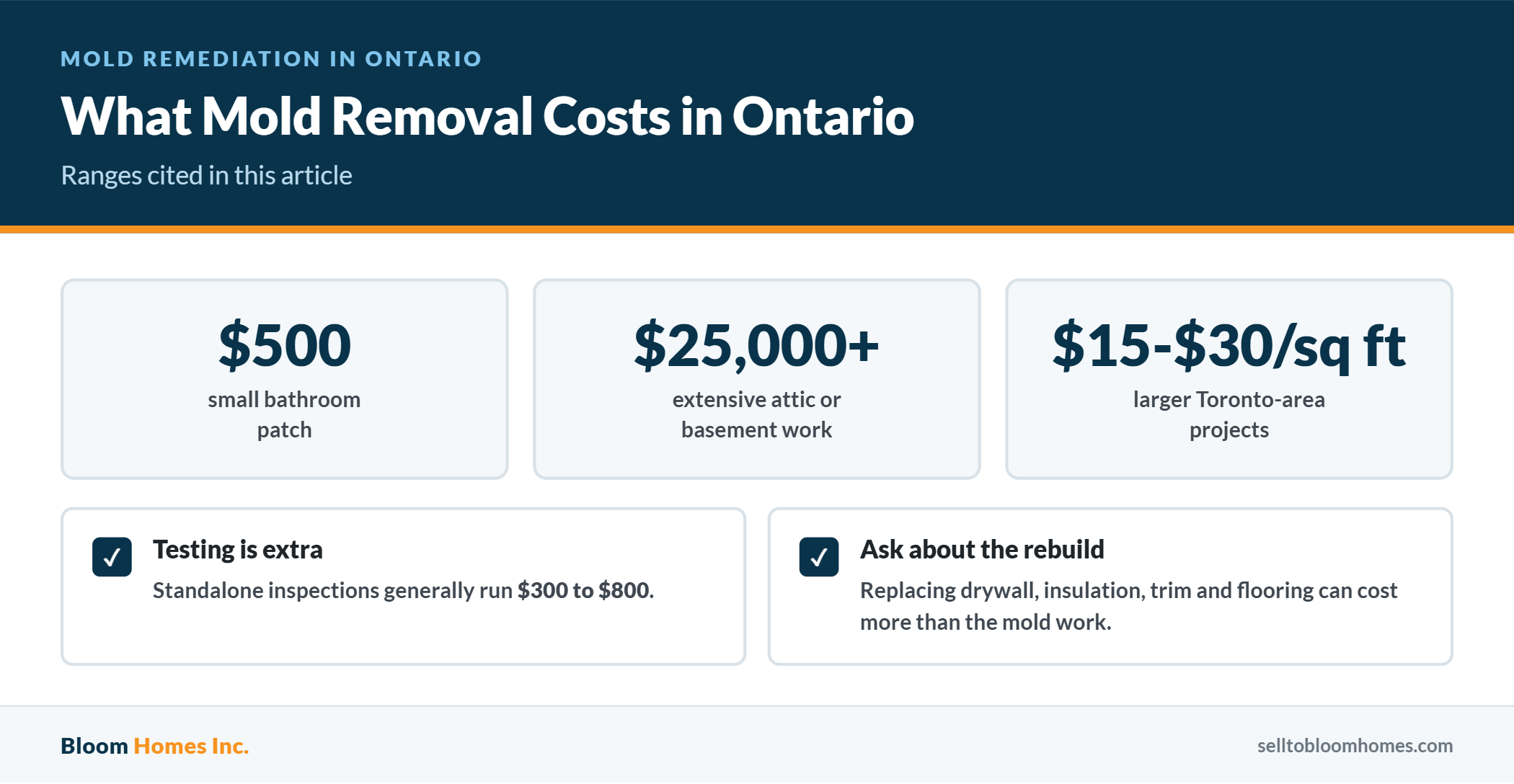
Most Ontario sellers overpay because they call the first company whose truck they recognize. Mold removal in Ontario runs from roughly $500 for a small bathroom patch to $25,000 or more for heavy attic or basement contamination.
Larger Toronto-area projects run about $15 to $30 per square foot. Below that size the rate climbs steeply, because a 20 square foot bathroom job still needs the same containment, filtration, and setup as a 200 square foot one.
Testing is its own line item. A standalone mold inspection in Canada generally costs between $300 and $800 for a residential property. Pay for it when you’re deciding whether to sell as-is. Skip it when the mold is obvious and you’ve already decided to remediate.
Sellers with a power of sale deadline looming face math nobody enjoys. Remediation takes days or weeks, and a mortgage in arrears won’t wait for a drying fan.
A seller in St. Catharines once showed me a contractor estimate for a kitchen gut, mold work included. It came to more than the kitchen would ever add back to the house. Her washer had leaked behind the cabinets for months, and she found it on a Sunday when the floor tile finally lifted.
Pulling out moldy drywall leaves you with bare studs. Replacing the drywall, insulation, trim, and flooring in an Ontario basement often costs more than the mold work itself. Ask every contractor whether their number includes putting the room back together.
How Do Buyers React to a House with Past Mold Problems?
The honest answer isn’t what most sellers expect: buyers care less about mold you fixed than about mold you hid.
Hand an Ontario buyer an invoice, a scope of work, and a clearance test, and they’ll treat the old mold as a solved problem.
Investors and contractor-buyers react differently from owner-occupant buyers. They price mold as a line item, close without appraisal conditions, and move on. That’s why so many Ontario properties with a remediation history end up selling to them.
First-time buyers in Ontario are the most mold-sensitive group I see, and I don’t blame them. They’re stretched on the down payment and have nothing left for surprises. With the Niagara Region benchmark at $566,100 in October 2026, a young buyer there can’t absorb a five-figure repair.
Here’s a stance that annoys some agents. Marketing a house with past mold as if nothing happened goes worse than naming it in the listing. Being upfront filters out buyers who’d back out at inspection anyway, and the ones who stay are already comfortable with it.
Ontario buyers also respond to the fix behind the fix. Telling someone you replaced the sump pump, added a bathroom fan, and regraded the side yard sounds competent. A bare line saying the mold was remediated sounds like a disclosure duty met through gritted teeth.
If all that back-and-forth sounds exhausting, a direct sale removes the inspection negotiation altogether. Bloom Homes Inc. looks at Ontario properties as they are and makes an offer based on what’s actually there.
Frequently Asked Questions
Can You Sell a House That Previously Had Mold?
Yes, and in Ontario it happens constantly. Keep your remediation invoice, the contractor’s scope of work, and any clearance test results, then give that package to buyers up front. A documented mold repair reassures people far more than silence does. It also protects you if questions come up after closing.
Do I Have to Tell a Buyer About Mold I Already Removed?
If the mold was hidden and dangerous, and you knew about it, Ontario’s common law duty discussed earlier points toward disclosure even after remediation. Keeping quiet is also bad tactics. Buyers discover past water damage through inspection reports and insurance history more often than sellers expect, and finding out late turns a small conversation into a dead sale.
Will a Home Inspector Always Find Mold in an Ontario House?
Not always. Inspectors work visually and don’t open walls, so mold inside a cavity or under flooring can slip past a standard inspection. That’s exactly why Ontario treats concealed growth differently from a patch sitting in plain view on a basement wall.
Is Mold in an Ontario Attic Worse Than Mold in a Basement?
Neither one is automatically worse. It depends on how much material is affected and what caused it. Attic mold usually comes from ventilation problems and tends to cost less to fix, because the space is unfinished. Basement mold often involves finished walls and flooring, so the tear-out and rebuild push the cost well past the removal itself.
Can I Just Clean the Mold Myself Before Listing?
For a small surface patch on tile or a window frame, sure, go ahead. For anything spreading across drywall, framing, or insulation, a DIY cleanup usually leaves the source alone, and the mold returns before your Ontario listing goes firm. Fix the water first, every time.
Does Mold Affect My Ability to Get a Mortgage Payout at Closing?
Your own payout isn’t the issue, though your buyer’s financing might be. Lenders in Ontario can hold back funds when an appraiser flags active mold growth as a condition problem, and that can delay or kill a closing. Selling to a buyer who isn’t using financing avoids that risk completely.
How Fast Can I Sell an Ontario House with Mold?
It depends on the route you take. A regular listing with the mold disclosed moves at normal market speed. In a well-supplied Ontario market, that means weeks of showings plus a financing period on top. A direct sale to a local buyer who pays cash can close in a couple of weeks, which matters if you’re up against a deadline.
If you’re sitting with a mold problem and a decision you’d rather not make alone, I’m happy to talk it through with you. We can go over what remediation would realistically cost on your Ontario property and what a cleaned-up listing might bring. Then we’ll compare that with a straight as-is sale. If the numbers point you toward a contractor and an agent instead of us, that’s a fine outcome. There’s no pressure and no obligation, just a conversation with someone who’s seen this a few hundred times.
What the Ontario Market Means for a House With Mold
The Toronto Regional Real Estate Board reported 5,603 GTA home sales in October 2026, down 7.9% from October 2025. With fewer buyers signing, a house with a damp basement is an easy one to skip.
Bloom Homes Inc. buys houses across Toronto and throughout Ontario with the mold still in place.
Talk With Bloom Homes About Your House
You don’t need a remediation contract signed before you call us. Tell us where the mold is, what caused it if you know, and when you’d like to move. We’ll show you what an as-is sale could look like next to fixing it first.
Get in touch with Bloom Homes Inc. or fill out the form below. There’s no obligation, and you’re free to list with an agent instead.
Helpful Ontario Blog Articles
- How to Find a Legitimate Cash Home Buyer in Ontario
- How to Sell Your House Fast in Any Condition in Ontario
- Can the Seller Back Out of a Contract in Ontario
- How Long a Real Estate Contract Lasts in Ontario Before It Expires
- How to Sell a House with Water in the Crawl Space in Ontario
- How to Sell an Ontario House That Needs Repairs Without Losing Money
- How Long Can a Seller Stay in the House After Closing
- How to Sell a House with Termites in Ontario
- Can You Sell a House with Mold in Ontario
- How to Sell a House with Title Issues in Ontario
- What Is the Best Time to Sell a House in Ontario
- What Appraisal Required Repairs Mean for Ontario Home Sellers
- Can You Sell a House in Ontario with a Pending Insurance Claim